字符串库cstring的常见操作
// 字符串拷贝
// strcpy (char dest [],char src []); // 拷贝 src 到dest
// 字符串比较大小
// int strcmp (char s1[],s2[]);  // 返回 0则相等
// 求字符串长度
// int strlen (char s[]); // 不算结尾的 '\0'
// 字符串 拼接
// strcat (char s1[],s2[]); //s2 拼接到 s1 后面
// 字符串转成大写
// strupr(char s[]);
// 字符串转成小写
// strlwr(char s[]);
#include<iostream>
#include<cstring>

using namespace std;

// 输出字典序小的字符串
void PrintSmall(char s1[],char s2[]){
    if(strcmp(s1,s2)<=0){
        cout<<s1<<endl;
    }
    else{
        cout<<s2<<endl;
    }
}
int main(){
    char s1[40];
    char s2[40];
    char s3[100];

    strcpy(s1,"Hello");
    // copy Hello to s1
    strcpy(s2,s1);
    // copy s2 to s1
    cout<<"1)"<<s1<<endl;
    strcat(s1,",world");
    // catch the ",world" to s1
    cout<<"2)"<<s1<<endl;

    cout<<"3)";
    PrintSmall("abc",s2);
    // print the smallest string of dict.
    cout<<endl;

    cout<<"4)";
    PrintSmall("abc","aaa");
    cout<<endl;

    int n=strlen(s2);
    // return a length of string .
    cout<<"5)"<<n<<","<<strlen("abc")<<endl;

    strupr(s1);
    cout<<"6)"<<s1<<endl;
    strlwr(s1);
    cout<<"7)"<<s1<<endl;

    system("pause");
    return 0;


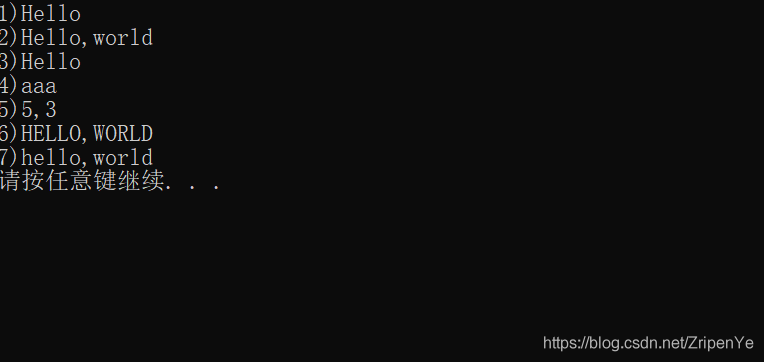
}
版权声明:本文为ZripenYe原创文章,遵循CC 4.0 BY-SA版权协议,转载请附上原文出处链接和本声明。