Apache Mina Server 是一个网络通信应用框架,也就是说,它主要是对基于 TCP/IP、UDP/IP协议栈的通信框架(当然,也可以提供 JAVA 对象的序列化服务、虚拟机管道通信服务等),Mina 可以帮助我们快速开发高性能、高扩展性的网络通信应用,Mina 提供了事件驱动、异步(Mina 的异步 IO 默认使用的是 JAVA NIO 作为底层支持)操作的编程模型。 从官网文档“MINA based Application Architecture”中可以看到Mina作为一个通信层框架,在实际应用所处的位置,如图所示: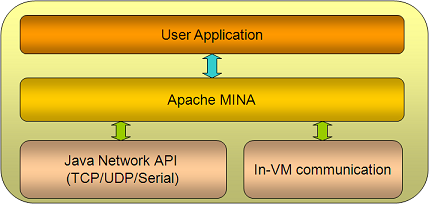
Mina位于用户应用程序和底层Java网络API(和in-VM通信)之间,我们开发基于Mina的网络应用程序,就无需关心复杂的通信细节。
应用整体架构
再看一下,Mina提供的基本组件,如图所示:
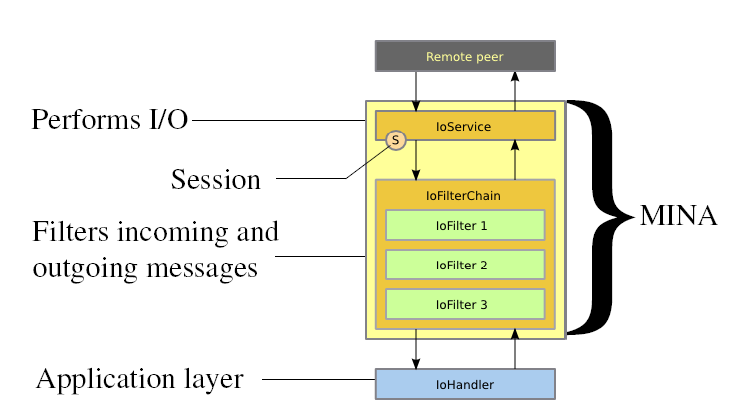
也就是说,无论是客户端还是服务端,使用Mina框架实现通信的逻辑分层在概念上统一的,即包含如下三层:
- I/O Service – Performs actual I/O
- I/O Filter Chain – Filters/Transforms bytes into desired Data Structures and vice-versa
- I/O Handler – Here resides the actual business logic
想要开发基于MIna的应用程序,你只需要做如下事情:
- Create an I/O service – Choose from already available Services (*Acceptor) or create your own
- Create a Filter Chain – Choose from already existing Filters or create a custom Filter for transforming request/response
- Create an I/O Handler – Write business logic, on handling different messages
下面看一下使用Mina的应用程序,在服务器端和客户端的架构细节:
服务器端架构
服务器端监听指定端口上到来的请求,对这些请求经过处理后,回复响应。它也会创建并处理一个链接过来的客户会话对象(Session)。服务器端架构如图所示:
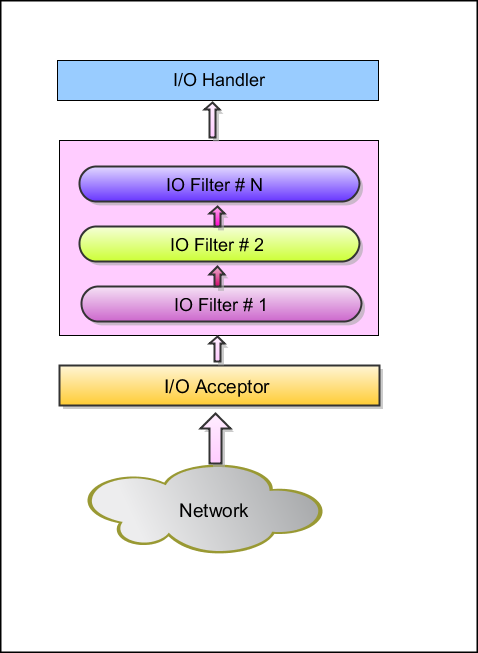
对服务器端的说明,引用官网文档,如下所示:
- IOAcceptor listens on the network for incoming connections/packets
- For a new connection, a new session is created and all subsequent request from IP Address/Port combination are handled in that Session
- All packets received for a Session, traverses the Filter Chain as specified in the diagram. Filters can be used to modify the content of packets (like converting to Objects, adding/removing information etc). For converting to/from raw bytes to High Level Objects, PacketEncoder/Decoder are particularly useful
- Finally the packet or converted object lands in IOHandler. IOHandlers can be used to fulfill business needs.
客户端架构
客户端主要做了如下工作:
- 连接到服务器端
- 向服务器发送消息
- 等待服务器端响应,并处理响应
客户端架构,如图所示:
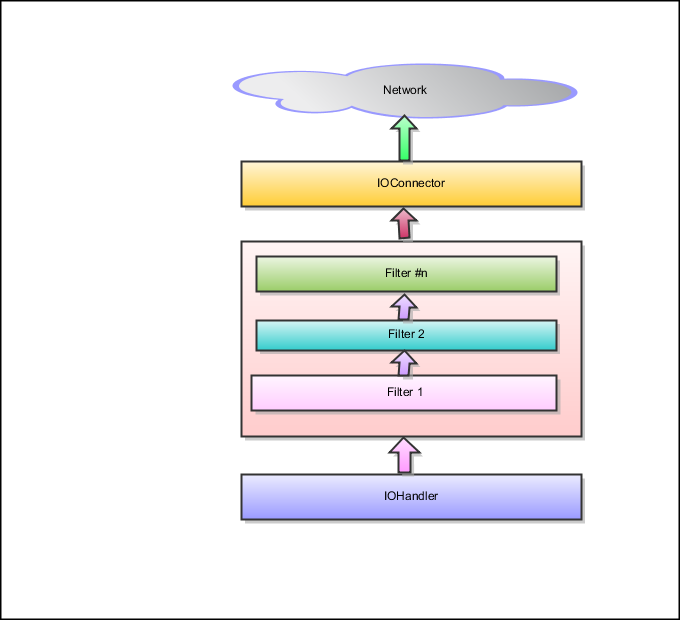
对客户端架构的说明,引用官网文档内容,如下所示:
- Client first creates an IOConnector (MINA Construct for connecting to Socket), initiates a bind with Server
- Upon Connection creation, a Session is created and is associated with Connection
- Application/Client writes to the Session, resulting in data being sent to Server, after traversing the Filter Chain
- All the responses/messages received from Server are traverses the Filter Chain and lands at IOHandler, for processing
应用实例开发
下面根据上面给出的架构设计描述,看一下Mina(版本2.0.7)自带的例子,如何实现一个简单的C/S通信的程序,非常容易。
服务端
首先,服务器端需要使用的组件有IoAdaptor、IoHandler、IoFilter,其中IoFilter可选.
我们基于Mina自带的例子进行了简单地修改,实现服务端IoHandler的代码如下所示:
01 | package org.shirdrn.mina.server; |
03 | import org.apache.mina.core.service.IoHandlerAdapter; |
04 | import org.apache.mina.core.session.IdleStatus; |
05 | import org.apache.mina.core.session.IoSession; |
06 | import org.slf4j.Logger; |
07 | import org.slf4j.LoggerFactory; |
09 | public class TinyServerProtocolHandlerextends IoHandlerAdapter { |
10 | private final static Logger LOGGER = LoggerFactory.getLogger(TinyServerProtocolHandler.class); |
13 | public void sessionCreated(IoSession session) { |
14 | session.getConfig().setIdleTime(IdleStatus.BOTH_IDLE,10); |
18 | public void sessionClosed(IoSession session)throws Exception { |
23 | public void sessionOpened(IoSession session)throws Exception { |
28 | public void sessionIdle(IoSession session, IdleStatus status) { |
29 | LOGGER.info("*** IDLE #" + session.getIdleCount(IdleStatus.BOTH_IDLE) +" ***"); |
33 | public void exceptionCaught(IoSession session, Throwable cause) { |
38 | public void messageReceived(IoSession session, Object message) |
40 | LOGGER.info("Received : " + message ); |
41 | if(!session.isConnected()) { |
这个版本中,IoHandlerAdapter实现了IoHandler接口,里面封装了一组用于事件处理的空方法,其中包含服务端和客户端的事件。在实际应用中,客户端可以选择客户端具有的事件,服务器端选择服务器端具有的事件,然后分别对这两类事件进行处理(有重叠的事件,如连接事件、关闭事件、异常事件等)。
客户端的IoHandler的具体实现也是类似的,不过多累述。
下面看启动服务器的主方法类,代码如下所示:
01 | package org.shirdrn.mina.server; |
03 | import java.net.InetSocketAddress; |
05 | import org.apache.mina.filter.codec.ProtocolCodecFilter; |
06 | import org.apache.mina.filter.codec.textline.TextLineCodecFactory; |
07 | import org.apache.mina.transport.socket.SocketAcceptor; |
08 | import org.apache.mina.transport.socket.nio.NioSocketAcceptor; |
09 | import org.slf4j.Logger; |
10 | import org.slf4j.LoggerFactory; |
12 | public class TinyMinaServer { |
14 | private final static Logger LOG = LoggerFactory.getLogger(TinyMinaServer.class); |
15 | /** Choose your favorite port number. */ |
16 | private static final int PORT =8080; |
18 | public static void main(String[] args)throws Exception { |
19 | SocketAcceptor acceptor =new NioSocketAcceptor(); |
20 | acceptor.setReuseAddress(true); |
21 | acceptor.getFilterChain().addLast("codec",new ProtocolCodecFilter(newTextLineCodecFactory())); |
24 | acceptor.setHandler(new TinyServerProtocolHandler()); |
25 | acceptor.bind(new InetSocketAddress(PORT)); |
26 | LOG.info("Listening on port " + PORT); |
28 | LOG.info("Server started!"); |
31 | LOG.info("R: " + acceptor.getStatistics().getReadBytesThroughput() +", W: " + acceptor.getStatistics().getWrittenBytesThroughput()); |
客户端
实现客户端IoHandler的代码如下所示:
01 | package org.shirdrn.mina.client; |
03 | import org.apache.mina.core.service.IoHandlerAdapter; |
04 | import org.apache.mina.core.session.IdleStatus; |
05 | import org.apache.mina.core.session.IoSession; |
06 | import org.slf4j.Logger; |
07 | import org.slf4j.LoggerFactory; |
09 | public class TinyClientProtocolHandlerextends IoHandlerAdapter { |
11 | private final static Logger LOGGER = LoggerFactory |
12 | .getLogger(TinyClientProtocolHandler.class); |
15 | public void sessionCreated(IoSession session) { |
16 | LOGGER.info("CLIENT::CREATED"); |
20 | public void sessionClosed(IoSession session)throws Exception { |
21 | LOGGER.info("CLIENT::CLOSED"); |
25 | public void sessionOpened(IoSession session)throws Exception { |
26 | LOGGER.info("CLIENT::OPENED"); |
30 | public void sessionIdle(IoSession session, IdleStatus status) { |
31 | LOGGER.info("CLIENT::*** IDLE #" |
32 | + session.getIdleCount(IdleStatus.BOTH_IDLE) +" ***"); |
36 | public void exceptionCaught(IoSession session, Throwable cause) { |
37 | LOGGER.info("CLIENT::EXCEPTIONCAUGHT"); |
38 | cause.printStackTrace(); |
41 | public void messageSent(IoSession session, Object message)throws Exception { |
42 | LOGGER.info("CLIENT::MESSAGESENT: " + message); |
下面看启动客户端的主方法类,代码如下所示:
01 | package org.shirdrn.mina.client; |
03 | import java.net.InetSocketAddress; |
05 | import org.apache.mina.core.future.ConnectFuture; |
06 | import org.apache.mina.filter.codec.ProtocolCodecFilter; |
07 | import org.apache.mina.filter.codec.textline.TextLineCodecFactory; |
08 | import org.apache.mina.transport.socket.SocketConnector; |
09 | import org.apache.mina.transport.socket.nio.NioSocketConnector; |
10 | import org.slf4j.Logger; |
11 | import org.slf4j.LoggerFactory; |
13 | public class TinyMinaClient { |
15 | private final static Logger LOG = LoggerFactory.getLogger(TinyMinaClient.class); |
16 | /** Choose your favorite port number. */ |
17 | private static final int PORT =8080; |
19 | public static void main(String[] args)throws Exception { |
20 | SocketConnector connector =new NioSocketConnector(); |
23 | connector.getFilterChain().addLast("codec",new ProtocolCodecFilter(newTextLineCodecFactory())); |
24 | connector.setHandler(new TinyClientProtocolHandler()); |
26 | for (int i =0; i <10; i++) { |
27 | ConnectFuture future = connector.connect(new InetSocketAddress(PORT)); |
28 | LOG.info("Connect to port " + PORT); |
29 | future.awaitUninterruptibly(); |
30 | future.getSession().write(String.valueOf(i)); |
我们只是发送了十个数字,每发一次间隔1500ms。
测试上述服务器端与客户端交互,首先启动服务器端,监听8080端口。
接着启动客户端,连接到服务器端8080端口,然后发送消息,服务器端接收到消息后,直接将到客户端的连接关闭掉。