概述:
当我们站在2012年的时间节点上,AlexNet网络模型的出现,可以说是CNN的里程碑。由于它将ImageNet LSVRC-2010图片识别测试的错误率从之前最好记录top-1 and top-5 测试集 错误率 47.1% and 28.2% 一下子降低到了 37.5% and 17.0%,虽然它不是CNN的开创者,但它首次使用了很多现代深度卷积神经网络(Deep Convolutional Neural Networks)一些技术,比如使用GPU进行并行训练(当时的旗舰级别GPU只有GTX 580 3GB,对于如此深度的CNN并不足够,因此网络被分成上下两层,一块GPU处理一部分的数据,并在中间部分层进行数据通讯),采用了ReLU作为非线性激活函数,使用Dropout(对于一部分的节点设置一个丢弃的概率 p = 0.5 ,通过将随机训练中的一些节点“暂时丢掉”,如果本次抽中“dropout”,那这个节点就不参与正向和反向的传播计算)来防止过拟合,使用数据增强(Data Augmentation)来提高模型的准确率等,因此它是深度卷积网络热潮的开端,从此以后人们开始更加关注CNN在图像方面的应用,以致后来产生了越来越强大的模型,比如GooLeNet、VGGNet、ResNet、Mask RCNN等等。
原论文链接:https://papers.nips.cc/paper/4824-imagenet-classification-with-deep-convolutional-neural-networks.pdf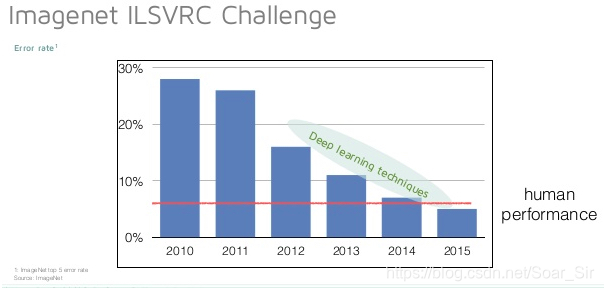
图1. AlexNet赢得了2012年ImageNet图像分类竞赛的冠军
AlexNet结构
AlexNet网络总共有8层构成,其中5层的卷积层(convolutional layers)、3个全连接层(fully connected layers)和1个softmax层。原论文中就是这张图,后来这张图被无数次的引用到各种CNN的课程和会议上。在 ILSVRC-2010中,它能够训练出1.2亿图片模型,其中验证集有:5,000 张图片,测试集有:150,000张图片。虽然这个网络看起来很简单,但是站在2012年那个时间节点上,对于当时的神经网络模型来说已经是一个非常重大的突破了。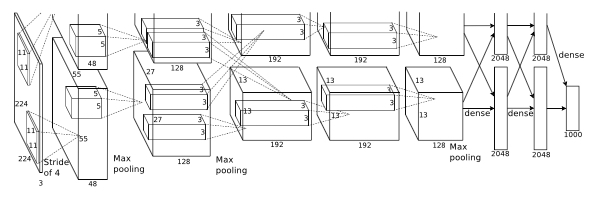
其中每个层的功能组成:
- 输入层,大小为224 × 224 × 3的图像;
- 第一个卷积层,使用两个大小为11 × 11 × 3 × 48的卷积核,步长s = 4,零填充p = 3,得到两个大小为55 × 55 × 48的特征映射组。
- 第一个池化层(汇聚层),使用大小为 3 × 3 的最大汇聚操作,步长 s = 2,得到两个27 × 27 × 48的特征映射组。
- 第二个卷积层,使用两个大小为5 × 5 × 48 × 128的卷积核,步长s = 1,零填充p = 2,得到两个大小为27 × 27 × 128的特征映射组。
Layer1: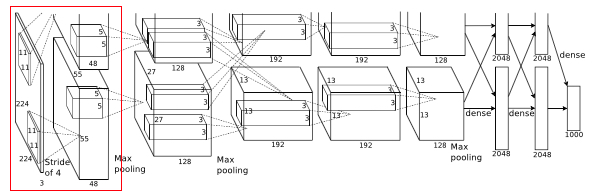
将图像输入到该层之前,训练集中的图片通过重新缩放图像以使得较短边长度为256,然后裁剪出中心256 * 256的固定大小图片。为了防止在该网络上出现过拟合现象,在一些层中dropout的值设定为0.5,并且使用两种保留标签的数据增强方法。 一个是从每个图像中提取随机224 * 224 patch。 因此,该方法通过合理的量增加训练集的大小。 另一种是执行变换以改变图像的照明强度和颜色,因为对象标识对这些图像是不变的。并且使用ReLU(y = max(0, x))作为其激活函数。 通过使用这些神经元,训练时间将根据观察结果减少。
- Then this 224 * 224 * 3 image is given to 1st convolutional layer.
- Where this layer filters the image with 96 kernels of size 11 * 11 * 3
- Stride - 4, assuming padding is 2 Here stride(s) < kernel size(z) (4 < 11), so this overlapping pooling. According to the paper, the models with overlapping pooling find it slightly more difficult to overfit.
- Therefore output = (224 - 11 + 2 *2)/4 + 1 = 55
- Output is of size 55 * 55 * 96
- To this output, local response normalization(LRN) is applied which is a brightness normalization.
- After LRN, max pooling layer is applied where stride is 2 and kernel size is 3 * 3
- Therefore now output is 27((55 - 3)/2 + 1 ) * 27 * 96
Layer2:
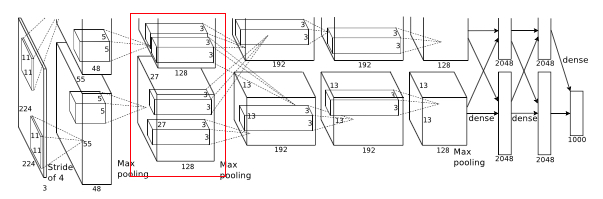
- Input to this layer is 27 * 27 * 96
- Filters = 256
- Kernel size = 5 * 5 * 48, padding = 2
- Stride = 1
- Output width or height = (27 - 5 + 2 * 2)/1 + 1 = 27
- Output is 27 * 27 * 256
- This is followed by LRN and max pooling layer
- Final output layer is
- Max pooling kernel of size 3 * 3 and stride 1
- Output width or height = (27 - 3 + 2)/1 + 1 = 27
- Final output = 27 * 27 * 256
Layer3:
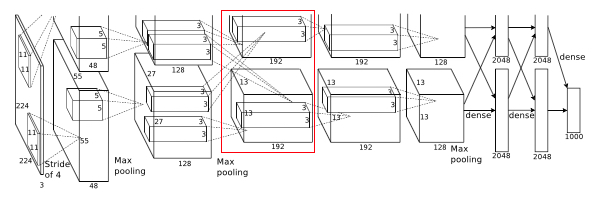
- Input to this layer is 27 * 27 * 256
- Filters = 384
- Kernel size 3 * 3 *256, padding - 1
- Output width or height = (27 - 3 + 2)/1 + 1 = 27
- Final output is 27 * 27 * 384
Layer4:
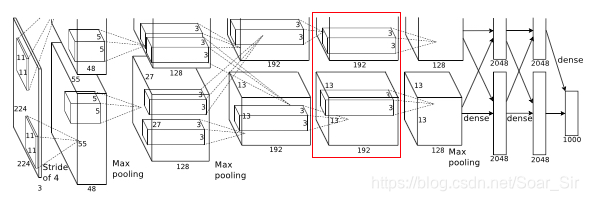
- Input to this layer is 27 * 27 * 384
- Filters = 384
- Kernel size is 3 * 3 * 192, padding = 1
- Output width or height = (27 - 3 + 2)/1 + 1 = 27
- Final output is 27 * 27 * 384
Layer5:
Similarly after the fifth convolutional layer
- As filters = 256
- Output is 27 * 27 * 256
- After the max pooling layer
- Kernel size is 3 * 3 and stride 2
- Final output width or height = (27 - 3 )/2 + 1 = 13
- Final output is 13 * 13 * 256 And other two layers are fully connected layers of 4096 each
Softmax:
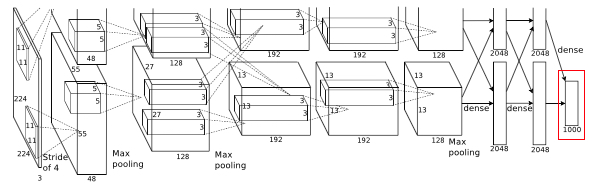
To the final layer 1000 way softmax is used to get predicted probabilities for each class.
代码实现(pytorch):
import torch.nn as nn
from .utils import load_state_dict_from_url


__all__ = ['AlexNet', 'alexnet']


model_urls = {
    'alexnet': 'https://download.pytorch.org/models/alexnet-owt-4df8aa71.pth',
}


class AlexNet(nn.Module):

    def __init__(self, num_classes=1000):
        super(AlexNet, self).__init__()
        self.features = nn.Sequential(
            nn.Conv2d(3, 64, kernel_size=11, stride=4, padding=2),
            nn.ReLU(inplace=True),
            nn.MaxPool2d(kernel_size=3, stride=2),
            nn.Conv2d(64, 192, kernel_size=5, padding=2),
            nn.ReLU(inplace=True),
            nn.MaxPool2d(kernel_size=3, stride=2),
            nn.Conv2d(192, 384, kernel_size=3, padding=1),
            nn.ReLU(inplace=True),
            nn.Conv2d(384, 256, kernel_size=3, padding=1),
            nn.ReLU(inplace=True),
            nn.Conv2d(256, 256, kernel_size=3, padding=1),
            nn.ReLU(inplace=True),
            nn.MaxPool2d(kernel_size=3, stride=2),
        )
        self.avgpool = nn.AdaptiveAvgPool2d((6, 6))
        self.classifier = nn.Sequential(
            nn.Dropout(),
            nn.Linear(256 * 6 * 6, 4096),
            nn.ReLU(inplace=True),
            nn.Dropout(),
            nn.Linear(4096, 4096),
            nn.ReLU(inplace=True),
            nn.Linear(4096, num_classes),
        )

    def forward(self, x):
        x = self.features(x)
        x = self.avgpool(x)
        x = x.view(x.size(0), 256 * 6 * 6)
        x = self.classifier(x)
        return x