一、linux 下的usb驱动框架
在linux系统中,usb驱动可以从两个角度去观察,一个是主机侧,一个是设备侧。linux usb 驱动的总体框架如下图所示:
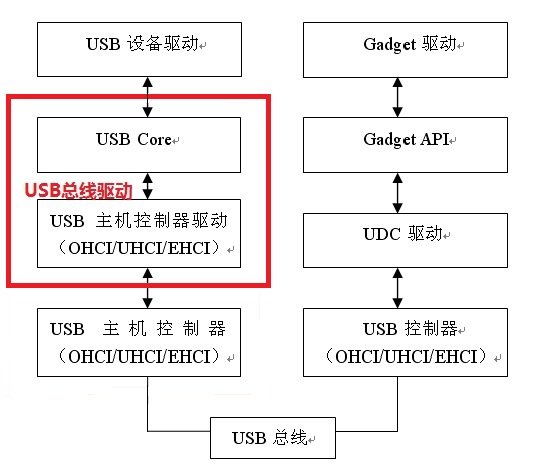
从主机侧看usb驱动可分为四层:usb主机控制器硬件底层、usb主机控制器驱动、usb核心和usb设备驱动。
在主机侧要实现的驱动主要分为两类:usb主机控制器驱动和usb设备驱动。主机控制器驱动负责控制插入其中的usb设备,usb设备驱动主要负责usb设备和主机的通信。
usb核心向上为设备驱动提供编程接口,向下为usb控制器驱动提供编程口,维护整个usb设备信息,完成设备热插拔控制,总线数据传输控制。
可以看到这种设备驱动、核心层、主机控制器驱动这种三层结构的驱动框架,与之前分析过linux系统下i2c子系统的驱动架构有异曲同工之处。linux内核中将主机控制器的驱动和外设端的驱动分离,通过一个核心层将某种总线的协议进行抽象,外设端的驱动调用核心层API间接过渡到主机驱动传输函数的调用。
这里借助一张图来对比linux下,i2c、spi、usb三个子系统的相似之处。
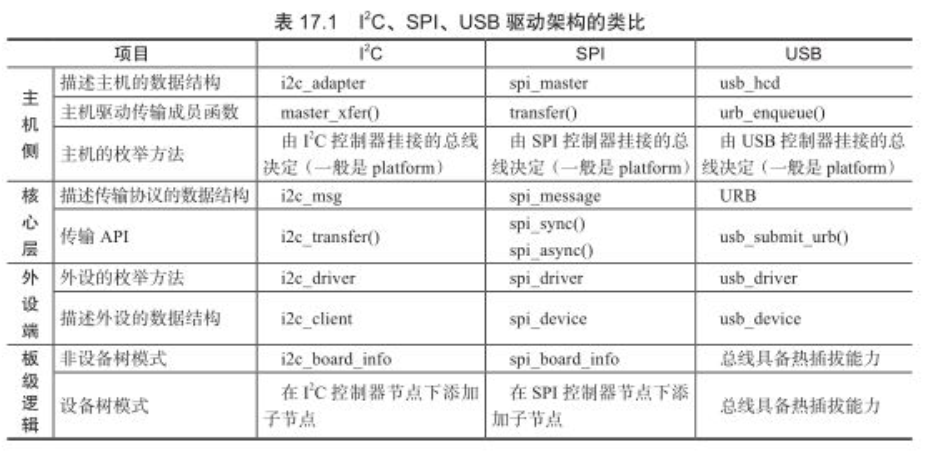
这样一对比,就能比较清晰的分析usb主机控制器驱动与usb设备驱动。
二、usb总线驱动程序分析
主机控制器中重要的数据结构:
usb_hcd:描述了USB主机控制器驱动,包含主机控制器的信息
hc_driver:用于操作主机控制器的驱动,该结构体在usb_hcd 中
ohci_hcd: 是usb_hcd 结构体中的私有数据
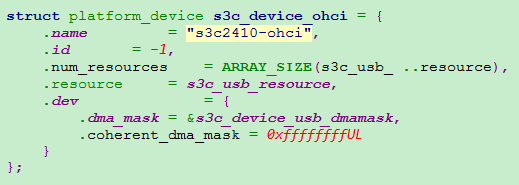
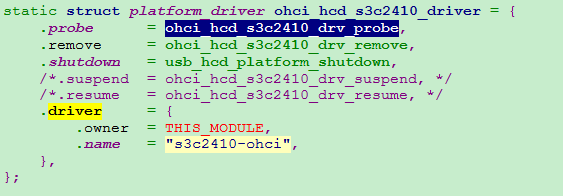
在主机控制驱动中还是通过平台设备驱动来注册platform_device和platform_driver,然后用平台总线进行匹配,匹配成功之后调用probe函数,在probe函数中做j进一步的操作。
probe函数:


static int usb_hcd_s3c2410_probe (const struct hc_driver *driver,
                  struct platform_device *dev)
{
    struct usb_hcd *hcd = NULL;
    int retval;
    // dev->dev.platform_data == NULL,因此这里不会不用set_power
    s3c2410_usb_set_power(dev->dev.platform_data, 1, 1);
    s3c2410_usb_set_power(dev->dev.platform_data, 2, 1);
    // 创建一个hcd结构体,并做一些设置
    hcd = usb_create_hcd(driver, &dev->dev, "s3c24xx");
    if (hcd == NULL)
        return -ENOMEM;
    // 设置内存和IO资源的开始位置
    hcd->rsrc_start = dev->resource[0].start;
    //  设置内存和IO资源的长度
    hcd->rsrc_len   = dev->resource[0].end - dev->resource[0].start + 1;
    // 申请一块内存资源
    if (!request_mem_region(hcd->rsrc_start, hcd->rsrc_len, hcd_name)) {
        dev_err(&dev->dev, "request_mem_region failed\n");
        retval = -EBUSY;
        goto err_put;
    }
    //  在clock.c中找到"usb-host"对应的clk结构体
    clk = clk_get(&dev->dev, "usb-host");
    if (IS_ERR(clk)) {
        dev_err(&dev->dev, "cannot get usb-host clock\n");
        retval = -ENOENT;
        goto err_mem;
    }
     //  在clock.c中找到"usb-bus-host"对应的clk结构体
    usb_clk = clk_get(&dev->dev, "usb-bus-host");
    if (IS_ERR(usb_clk)) {
        dev_err(&dev->dev, "cannot get usb-bus-host clock\n");
        retval = -ENOENT;
        goto err_clk;
    }
    //  使能时钟  使能过流检查
    s3c2410_start_hc(dev, hcd);
    //  io端口重映射
    hcd->regs = ioremap(hcd->rsrc_start, hcd->rsrc_len);
    if (!hcd->regs) {
        dev_err(&dev->dev, "ioremap failed\n");
        retval = -ENOMEM;
        goto err_ioremap;
    }
    // 初始化ohci_hcd 结构体ohci->next_statechange = jiffies
    ohci_hcd_init(hcd_to_ohci(hcd));
    // 这个函数下边分析 一个usb主机控制器对应一个usb_hcd,对应一条usb总线,集成一个root_hub
    retval = usb_add_hcd(hcd, dev->resource[1].start, IRQF_DISABLED);
    if (retval != 0)
        goto err_ioremap;
</span><span style="color: rgba(0, 0, 255, 1)">return</span> <span style="color: rgba(128, 0, 128, 1)">0</span><span style="color: rgba(0, 0, 0, 1)">;
err_ioremap:
s3c2410_stop_hc(dev);
iounmap(hcd->regs);
clk_put(usb_clk);
err_clk:
clk_put(clk);
err_mem:
release_mem_region(hcd->rsrc_start, hcd->rsrc_len);
err_put:
usb_put_hcd(hcd);
return retval;
}
在probe函数中主要的任务如下:
(1)创建一个usb_hcd结构体===>和i2c控制器驱动中的中分配一个i2c_adapter一样
(2)设置这个这个usb_hcd结构体(设置操作主机控制器的hc_driver)===>设置i2c_adapter结构体(设置操作i2c_adapter的transfer函数)
(3)从platform_device中获取到硬件资源,进行内存映射
(4)使能时钟
(5)usb_add_hcd
usb_create_hcd函数:
struct usb_hcd *usb_create_hcd (const struct hc_driver *driver,
        struct device *dev, const char *bus_name)
{
    struct usb_hcd *hcd;
    hcd = kzalloc(sizeof(*hcd) + driver->hcd_priv_size, GFP_KERNEL);
    dev_set_drvdata(dev, hcd);
        ...
        // 初始化hcd下边的usb_bus,为后边将其加入到usb_bus 中做准备:
            //bus->devnum_next = 1;  bus->root_hub = NULL;  bus->busnum = -1;
            //bus->bandwidth_allocated = 0;  bus->bandwidth_int_reqs  = 0;
            //bus->bandwidth_isoc_reqs = 0;
    usb_bus_init(&hcd->self);
    hcd->self.controller = dev;
    hcd->self.bus_name = bus_name;
    hcd->self.uses_dma = (dev->dma_mask != NULL);
        // 初始定时器用来轮询控制器的root_hub的状态改变
    init_timer(&hcd->rh_timer);
        // 注册定时器中断服务函数
    hcd->rh_timer.function = rh_timer_func;
    hcd->rh_timer.data = (unsigned long) hcd;
#ifdef CONFIG_USB_SUSPEND
    INIT_WORK(&hcd->wakeup_work, hcd_resume_work);
#endif
    mutex_init(&hcd->bandwidth_mutex);
        // 给hcd添加主机控制器驱动函数    driver==ohci_s3c2410_hc_driver
    hcd->driver = driver;
    hcd->product_desc = (driver->product_desc) ? driver->product_desc :
            "USB Host Controller";
    return hcd;
}
usb_add_hcd函数:一个usb主机控制器对应一条usb总线,集成一个root_hub,对应一个usb_hcd。
int usb_add_hcd(struct usb_hcd *hcd,
unsigned int irqnum, unsigned long irqflags)
{
// 初始化缓存池
if ((retval = hcd_buffer_create(hcd)) != 0) {
dev_dbg(hcd->self.controller, "pool alloc failed\n");
return retval;
}
//设置hcd下usb_bus的busnum并将其挂到usb_bus_list这个链表中 hcd->self 在usb_create_hcd 中已经初始化了 (注册完之后hcd->self.busnum = 1)
if ((retval = usb_register_bus(&hcd->self)) < 0)
goto err_register_bus;
// 创建一个root_hub
if ((rhdev = usb_alloc_dev(NULL, &hcd->self, 0)) == NULL) {
dev_err(hcd->self.controller, "unable to allocate root hub\n");
retval = -ENOMEM;
goto err_allocate_root_hub;
}
// 将上边分配好的usb_device挂在主机控制的usb_bus下
hcd->self.root_hub = rhdev;
// 根据ohci_s3c2410_hc_driver(HCD_USB11 | HCD_MEMORY,)下的flag 选择 root_hub 的speed
switch (hcd->driver->flags & HCD_MASK) {
case HCD_USB11:
rhdev->speed = USB_SPEED_FULL;
break;
case HCD_USB2:
rhdev->speed = USB_SPEED_HIGH;
break;
case HCD_USB3:
rhdev->speed = USB_SPEED_SUPER;
break;
default:
goto err_set_rh_speed;
}
device_init_wakeup(&rhdev->dev, 1);
if (hcd->driver->reset && (retval = hcd->driver->reset(hcd)) < 0) {
dev_err(hcd->self.controller, "can't setup\n");
goto err_hcd_driver_setup;
}
hcd->rh_pollable = 1;
</span><span style="color: rgba(0, 128, 0, 1)">/*</span><span style="color: rgba(0, 128, 0, 1)"> NOTE: root hub and controller capabilities may not be the same </span><span style="color: rgba(0, 128, 0, 1)">*/</span>
<span style="color: rgba(0, 0, 255, 1)">if</span> (device_can_wakeup(hcd-><span style="color: rgba(0, 0, 0, 1)">self.controller)
</span>&& device_can_wakeup(&hcd->self.root_hub-><span style="color: rgba(0, 0, 0, 1)">dev))
dev_dbg(hcd</span>->self.controller, <span style="color: rgba(128, 0, 0, 1)">"</span><span style="color: rgba(128, 0, 0, 1)">supports USB remote wakeup\n</span><span style="color: rgba(128, 0, 0, 1)">"</span><span style="color: rgba(0, 0, 0, 1)">);
</span><span style="color: rgba(0, 128, 0, 1)">/*</span><span style="color: rgba(0, 128, 0, 1)"> enable irqs just before we start the controller </span><span style="color: rgba(0, 128, 0, 1)">*/</span>
<span style="color: rgba(0, 128, 0, 1)">//</span><span style="color: rgba(0, 128, 0, 1)"> 接下来使能中断
</span><span style="color: rgba(0, 128, 0, 1)">//</span><span style="color: rgba(0, 128, 0, 1)"> 接下来执行主机控制器的启动函数</span>
<span style="color: rgba(0, 128, 0, 1)">/*</span><span style="color: rgba(0, 128, 0, 1)"> starting here, usbcore will pay attention to this root hub </span><span style="color: rgba(0, 128, 0, 1)">*/</span><span style="color: rgba(0, 0, 0, 1)">
rhdev</span>->bus_mA = min(<span style="color: rgba(128, 0, 128, 1)">500u</span>, hcd-><span style="color: rgba(0, 0, 0, 1)">power_budget);
</span><span style="color: rgba(0, 0, 255, 1)">if</span> ((retval = <span style="background-color: rgba(255, 102, 0, 1)">register_root_hub(hcd)</span>) != <span style="color: rgba(128, 0, 128, 1)">0</span><span style="color: rgba(0, 0, 0, 1)">)
</span><span style="color: rgba(0, 0, 255, 1)">goto</span><span style="color: rgba(0, 0, 0, 1)"> err_register_root_hub;
retval </span>= sysfs_create_group(&rhdev->dev.kobj, &<span style="color: rgba(0, 0, 0, 1)">usb_bus_attr_group);
</span><span style="color: rgba(0, 0, 255, 1)">if</span> (retval < <span style="color: rgba(128, 0, 128, 1)">0</span><span style="color: rgba(0, 0, 0, 1)">) {
printk(KERN_ERR </span><span style="color: rgba(128, 0, 0, 1)">"</span><span style="color: rgba(128, 0, 0, 1)">Cannot register USB bus sysfs attributes: %d\n</span><span style="color: rgba(128, 0, 0, 1)">"</span><span style="color: rgba(0, 0, 0, 1)">,
retval);
</span><span style="color: rgba(0, 0, 255, 1)">goto</span><span style="color: rgba(0, 0, 0, 1)"> error_create_attr_group;
}
</span><span style="color: rgba(0, 0, 255, 1)">if</span> (hcd->uses_new_polling &&<span style="color: rgba(0, 0, 0, 1)"> HCD_POLL_RH(hcd))
usb_hcd_poll_rh_status(hcd);
</span><span style="color: rgba(0, 0, 255, 1)">return</span><span style="color: rgba(0, 0, 0, 1)"> retval;
...
}
在usb_add_hcd中,最主要干的一件事是创建一个root_hub,这个root_hub的数据类型是一个usb_device,并将这个root_hub注册到usb总线中。
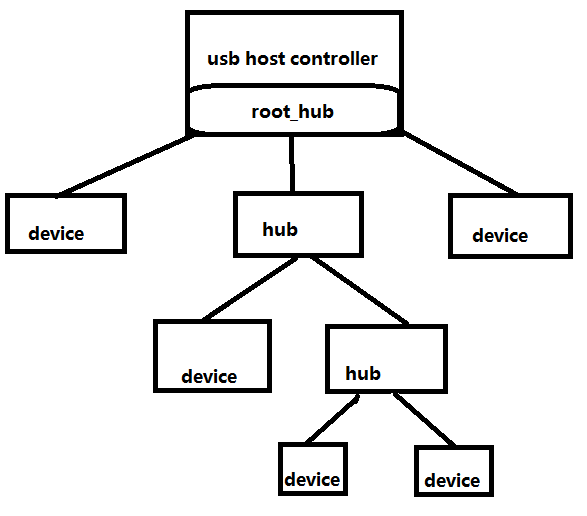
这里大概解释一下什么是root_hub。在我们的电脑上通常有几个usb端口,这些端口可以用来连接一个普通的usb设备,或者一个hub,hub是一个usb设备,可以用来扩展连接usb设备的端口数量。通常情况下主机控制器的物理端口由一个虚拟的root_hub来管理。这个hub是主机控制器的设备驱动虚拟的,用来统一管理总线拓扑。用一张图说明usb系统的拓扑结构。
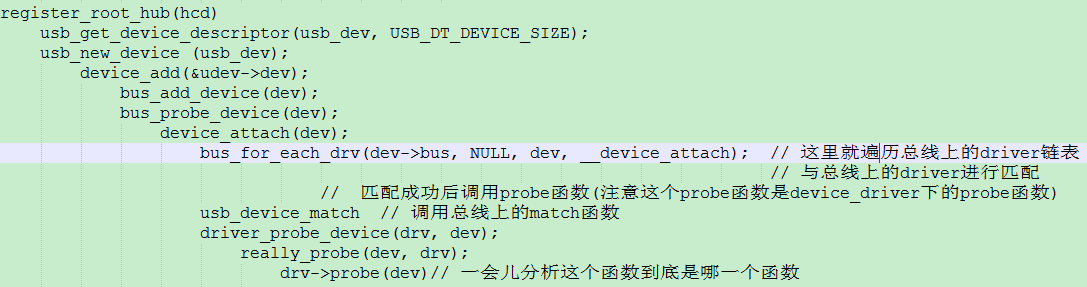
register_root_hub函数的调用太复杂了,这里先抽象出其函数调用过程如下:
为了分析清楚root_hub下的dev到底与总线上的哪一个device_driver匹配需要分析usb总线上的match函数
static int usb_device_match(struct device *dev, struct device_driver *drv)
{
    // 需要匹配的是usb_device时的情况
    if (is_usb_device(dev)) {
    </span><span style="color: rgba(0, 128, 0, 1)">/*</span><span style="color: rgba(0, 128, 0, 1)"> interface drivers never match devices </span><span style="color: rgba(0, 128, 0, 1)">*/</span>
    <span style="color: rgba(0, 0, 255, 1)">if</span> (!<span style="color: rgba(0, 0, 0, 1)">is_usb_device_driver(drv))
        </span><span style="color: rgba(0, 0, 255, 1)">return</span> <span style="color: rgba(128, 0, 128, 1)">0</span><span style="color: rgba(0, 0, 0, 1)">;

    </span><span style="color: rgba(0, 128, 0, 1)">/*</span><span style="color: rgba(0, 128, 0, 1)"> TODO: Add real matching code </span><span style="color: rgba(0, 128, 0, 1)">*/</span>
    <span style="color: rgba(0, 0, 255, 1)">return</span> <span style="color: rgba(128, 0, 128, 1)">1</span><span style="color: rgba(0, 0, 0, 1)">;
}
</span><span style="color: rgba(0, 128, 0, 1)">//</span><span style="color: rgba(0, 128, 0, 1)"> 需要匹配的是接口的情况</span>
else if (is_usb_interface(dev)) {
struct usb_interface *intf;
struct usb_driver usb_drv;
const struct usb_device_id id;
/ device drivers never match interfaces/
if (is_usb_device_driver(drv))
return 0;
intf = to_usb_interface(dev);
usb_drv = to_usb_driver(drv);
id </span>= usb_match_id(intf, usb_drv-><span style="color: rgba(0, 0, 0, 1)">id_table);
</span><span style="color: rgba(0, 0, 255, 1)">if</span><span style="color: rgba(0, 0, 0, 1)"> (id)
</span><span style="color: rgba(0, 0, 255, 1)">return</span> <span style="color: rgba(128, 0, 128, 1)">1</span><span style="color: rgba(0, 0, 0, 1)">;
id </span>=<span style="color: rgba(0, 0, 0, 1)"> usb_match_dynamic_id(intf, usb_drv);
</span><span style="color: rgba(0, 0, 255, 1)">if</span><span style="color: rgba(0, 0, 0, 1)"> (id)
</span><span style="color: rgba(0, 0, 255, 1)">return</span> <span style="color: rgba(128, 0, 128, 1)">1</span><span style="color: rgba(0, 0, 0, 1)">;
}
</span><span style="color: rgba(0, 0, 255, 1)">return</span> <span style="color: rgba(128, 0, 128, 1)">0</span><span style="color: rgba(0, 0, 0, 1)">;
}
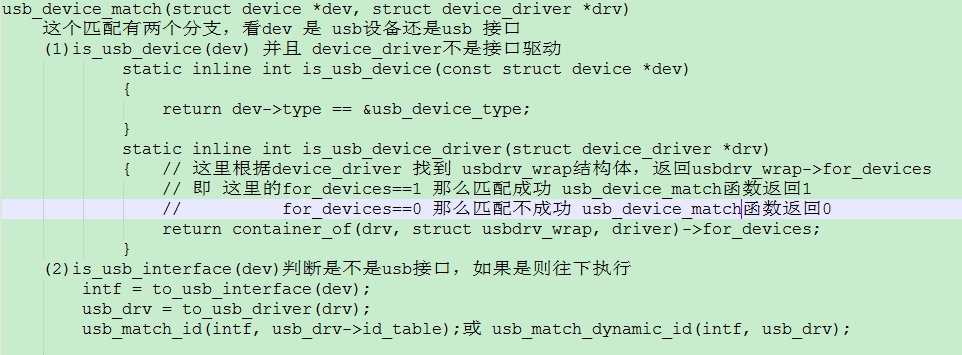
对于传入的match函数的dev其dev->type是usb_device_type(在分配usb_alloc_dev中已经设置了)。
现在看usb总线上有哪些device_driver:在/core/usb.c中我们可以看到已经注册了两个usb_driver结构体 usbfs_driver和hub_driver
一个usb_device_driver结构体 usb_generic_driver
(这里跳转的比较突然,这三个结构体的注册是在usb_init函数中进行的)
所以match函数中传入的dev会和这三个已经注册到usb_bus上的device_driver进行匹配,这里看哪一个usb_driver下的device_driver会匹配成功,也就是看usbdrv_wrap->for_devices的值,这个值需要在usb_register函数中查看,这里给出结果。其实从driver的名字就可以看出只有usb_device_driver (usb设备驱动)是能够和device(设备)进行匹配的。

因此root_hub->dev会和usb_generic_driver->drvwrap.driver进行匹配,匹配完成之后会执行probe函数。那么这个probe函数有是哪一个呢?probe函数肯定是usb_generic_driver->drvwrap.driver.probe
这个函数在usb_register_device_driver(&usb_generic_driver, THIS_MODULE)中进行了设置usb_generic_driver->drvwrap.driver.probe = usb_probe_device
usb_probe_device函数的分析:
static int usb_probe_device(struct device *dev)
{
// 这里通过container_of 找到usb_device_driver 和 usb_device
// 注意在really_probe 函数中已经将dev->driver 挂上了 device_driver ,所以这个地方才能找到usb_device_driver
struct usb_device_driver *udriver = to_usb_device_driver(dev->driver);
struct usb_device *udev = to_usb_device(dev);
int error = 0;
dev_dbg(dev, </span><span style="color: rgba(128, 0, 0, 1)">"</span><span style="color: rgba(128, 0, 0, 1)">%s\n</span><span style="color: rgba(128, 0, 0, 1)">"</span><span style="color: rgba(0, 0, 0, 1)">, __func__);
</span><span style="color: rgba(0, 128, 0, 1)">/*</span><span style="color: rgba(0, 128, 0, 1)"> TODO: Add real matching code </span><span style="color: rgba(0, 128, 0, 1)">*/</span>
<span style="color: rgba(0, 128, 0, 1)">/*</span><span style="color: rgba(0, 128, 0, 1)"> The device should always appear to be in use
* unless the driver suports autosuspend.
</span><span style="color: rgba(0, 128, 0, 1)">*/</span>
<span style="color: rgba(0, 0, 255, 1)">if</span> (!udriver-><span style="color: rgba(0, 0, 0, 1)">supports_autosuspend)
error </span>=<span style="color: rgba(0, 0, 0, 1)"> usb_autoresume_device(udev);
</span><span style="color: rgba(0, 128, 0, 1)">//</span><span style="color: rgba(0, 128, 0, 1)"> 程序执行到这里可以看到饶了一大圈的probe函数就是usb_generic_driver->probe函数 也就是generic_probe 函数<br></span> <span style="color: rgba(0, 0, 255, 1)">if</span> (!<span style="color: rgba(0, 0, 0, 1)">error)
error </span>= udriver-><span style="color: rgba(0, 0, 0, 1)">probe(udev);
</span><span style="color: rgba(0, 0, 255, 1)">return</span><span style="color: rgba(0, 0, 0, 1)"> error;
}
因此接下分析generic_probe 函数:
static int generic_probe(struct usb_device *udev)
{
    int err, c;
    if (usb_device_is_owned(udev))
        ;        /* Don't configure if the device is owned */
        // 在创建root_hub 时分配usb_device时已经设置了dev->authorized = 1
    else if (udev->authorized == 0)
        dev_err(&udev->dev, "Device is not authorized for usage\n");
    else {
        // 因此会执行到这里来配置操作
        c = usb_choose_configuration(udev);
        if (c >= 0) {
            err = usb_set_configuration(udev, c);
            if (err) {
                dev_err(&udev->dev, "can't set config #%d, error %d\n",
                    c, err);
            }
        }
    }
    /* USB device state == configured ... usable */
    usb_notify_add_device(udev);
    return 0;
}
在这里我们可以看一下到底对着root->hub选择了什么配置,设置了什么配置
int usb_choose_configuration(struct usb_device *udev)
{
int i;
int num_configs;
int insufficient_power = 0;
struct usb_host_config *c, *best;
best </span>=<span style="color: rgba(0, 0, 0, 1)"> NULL;
</span><span style="color: rgba(0, 128, 0, 1)">//</span><span style="color: rgba(0, 128, 0, 1)"> root_hub下的一些与配置有关的东西在usb_new_device中都读取出来然后放到了root_hub下的config中</span>
c = udev-><span style="color: rgba(0, 0, 0, 1)">config;
</span><span style="color: rgba(0, 128, 0, 1)">//</span><span style="color: rgba(0, 128, 0, 1)"> 有多少项配置</span>
num_configs = udev-><span style="color: rgba(0, 0, 0, 1)">descriptor.bNumConfigurations;
</span><span style="color: rgba(0, 128, 0, 1)">//</span><span style="color: rgba(0, 128, 0, 1)"> 遍历所有的配置项</span>
<span style="color: rgba(0, 0, 255, 1)">for</span> (i = <span style="color: rgba(128, 0, 128, 1)">0</span>; i < num_configs; (i++, c++<span style="color: rgba(0, 0, 0, 1)">)) {
</span><span style="color: rgba(0, 0, 255, 1)">struct</span> usb_interface_descriptor *desc =<span style="color: rgba(0, 0, 0, 1)"> NULL;
</span><span style="color: rgba(0, 128, 0, 1)">/*</span><span style="color: rgba(0, 128, 0, 1)"> It's possible that a config has no interfaces! </span><span style="color: rgba(0, 128, 0, 1)">*/</span>
<span style="color: rgba(0, 128, 0, 1)">//</span><span style="color: rgba(0, 128, 0, 1)"> 有可能一个配置没有接口,所以要做判断</span>
<span style="color: rgba(0, 0, 255, 1)">if</span> (c->desc.bNumInterfaces > <span style="color: rgba(128, 0, 128, 1)">0</span><span style="color: rgba(0, 0, 0, 1)">)
</span><span style="color: rgba(0, 128, 0, 1)">//</span><span style="color: rgba(0, 128, 0, 1)"> 取出配置下的第一个接口</span>
desc = &c->intf_cache[<span style="color: rgba(128, 0, 128, 1)">0</span>]->altsetting-><span style="color: rgba(0, 0, 0, 1)">desc;
</span><span style="color: rgba(0, 128, 0, 1)">/*</span><span style="color: rgba(0, 128, 0, 1)">
* HP's USB bus-powered keyboard has only one configuration
* and it claims to be self-powered; other devices may have
* similar errors in their descriptors. If the next test
* were allowed to execute, such configurations would always
* be rejected and the devices would not work as expected.
* In the meantime, we run the risk of selecting a config
* that requires external power at a time when that power
* isn't available. It seems to be the lesser of two evils.
*
* Bugzilla #6448 reports a device that appears to crash
* when it receives a GET_DEVICE_STATUS request! We don't
* have any other way to tell whether a device is self-powered,
* but since we don't use that information anywhere but here,
* the call has been removed.
*
* Maybe the GET_DEVICE_STATUS call and the test below can
* be reinstated when device firmwares become more reliable.
* Don't hold your breath.
</span><span style="color: rgba(0, 128, 0, 1)">*/</span>
#if 0
/ Rule out self-powered configs for a bus-powered device /
if (bus_powered && (c->desc.bmAttributes &
USB_CONFIG_ATT_SELFPOWER))
continue;
#endif
<span style="color: rgba(0, 128, 0, 1)">/*</span><span style="color: rgba(0, 128, 0, 1)">
* The next test may not be as effective as it should be.
* Some hubs have errors in their descriptor, claiming
* to be self-powered when they are really bus-powered.
* We will overestimate the amount of current such hubs
* make available for each port.
*
* This is a fairly benign sort of failure. It won't
* cause us to reject configurations that we should have
* accepted.
</span><span style="color: rgba(0, 128, 0, 1)">*/</span>
<span style="color: rgba(0, 128, 0, 1)">/*</span><span style="color: rgba(0, 128, 0, 1)"> Rule out configs that draw too much bus current </span><span style="color: rgba(0, 128, 0, 1)">*/</span>
<span style="color: rgba(0, 0, 255, 1)">if</span> (c->desc.bMaxPower * <span style="color: rgba(128, 0, 128, 1)">2</span> > udev-><span style="color: rgba(0, 0, 0, 1)">bus_mA) {
insufficient_power</span>++<span style="color: rgba(0, 0, 0, 1)">;
</span><span style="color: rgba(0, 0, 255, 1)">continue</span><span style="color: rgba(0, 0, 0, 1)">;
}
</span><span style="color: rgba(0, 128, 0, 1)">/*</span><span style="color: rgba(0, 128, 0, 1)"> When the first config's first interface is one of Microsoft's
* pet nonstandard Ethernet-over-USB protocols, ignore it unless
* this kernel has enabled the necessary host side driver.
* But: Don't ignore it if it's the only config.
</span><span style="color: rgba(0, 128, 0, 1)">*/</span>
<span style="color: rgba(0, 0, 255, 1)">if</span> (i == <span style="color: rgba(128, 0, 128, 1)">0</span> && num_configs > <span style="color: rgba(128, 0, 128, 1)">1</span> && desc &&<span style="color: rgba(0, 0, 0, 1)">
(is_rndis(desc) </span>||<span style="color: rgba(0, 0, 0, 1)"> is_activesync(desc))) {
#if !defined(CONFIG_USB_NET_RNDIS_HOST) && !defined(CONFIG_USB_NET_RNDIS_HOST_MODULE)
continue;
#else
best = c;
#endif
}
</span><span style="color: rgba(0, 128, 0, 1)">/*</span><span style="color: rgba(0, 128, 0, 1)"> From the remaining configs, choose the first one whose
* first interface is for a non-vendor-specific class.
* Reason: Linux is more likely to have a class driver
* than a vendor-specific driver. </span><span style="color: rgba(0, 128, 0, 1)">*/</span>
<span style="color: rgba(0, 0, 255, 1)">else</span> <span style="color: rgba(0, 0, 255, 1)">if</span> (udev->descriptor.bDeviceClass !=<span style="color: rgba(0, 0, 0, 1)">
USB_CLASS_VENDOR_SPEC </span>&&<span style="color: rgba(0, 0, 0, 1)">
(desc </span>&& desc->bInterfaceClass !=<span style="color: rgba(0, 0, 0, 1)">
USB_CLASS_VENDOR_SPEC)) {
best </span>=<span style="color: rgba(0, 0, 0, 1)"> c;
</span><span style="color: rgba(0, 0, 255, 1)">break</span><span style="color: rgba(0, 0, 0, 1)">;
}
</span><span style="color: rgba(0, 128, 0, 1)">/*</span><span style="color: rgba(0, 128, 0, 1)"> If all the remaining configs are vendor-specific,
* choose the first one. </span><span style="color: rgba(0, 128, 0, 1)">*/</span>
<span style="color: rgba(0, 0, 255, 1)">else</span> <span style="color: rgba(0, 0, 255, 1)">if</span> (!<span style="color: rgba(0, 0, 0, 1)">best)
best </span>=<span style="color: rgba(0, 0, 0, 1)"> c;
}
</span><span style="color: rgba(0, 0, 255, 1)">if</span> (insufficient_power > <span style="color: rgba(128, 0, 128, 1)">0</span><span style="color: rgba(0, 0, 0, 1)">)
dev_info(</span>&udev->dev, <span style="color: rgba(128, 0, 0, 1)">"</span><span style="color: rgba(128, 0, 0, 1)">rejected %d configuration%s </span><span style="color: rgba(128, 0, 0, 1)">"</span>
<span style="color: rgba(128, 0, 0, 1)">"</span><span style="color: rgba(128, 0, 0, 1)">due to insufficient available bus power\n</span><span style="color: rgba(128, 0, 0, 1)">"</span><span style="color: rgba(0, 0, 0, 1)">,
insufficient_power, plural(insufficient_power));
</span><span style="color: rgba(0, 0, 255, 1)">if</span><span style="color: rgba(0, 0, 0, 1)"> (best) {
i </span>= best-><span style="color: rgba(0, 0, 0, 1)">desc.bConfigurationValue;
dev_dbg(</span>&udev-><span style="color: rgba(0, 0, 0, 1)">dev,
</span><span style="color: rgba(128, 0, 0, 1)">"</span><span style="color: rgba(128, 0, 0, 1)">configuration #%d chosen from %d choice%s\n</span><span style="color: rgba(128, 0, 0, 1)">"</span><span style="color: rgba(0, 0, 0, 1)">,
i, num_configs, plural(num_configs));
} </span><span style="color: rgba(0, 0, 255, 1)">else</span><span style="color: rgba(0, 0, 0, 1)"> {
i </span>= -<span style="color: rgba(128, 0, 128, 1)">1</span><span style="color: rgba(0, 0, 0, 1)">;
dev_warn(</span>&udev-><span style="color: rgba(0, 0, 0, 1)">dev,
</span><span style="color: rgba(128, 0, 0, 1)">"</span><span style="color: rgba(128, 0, 0, 1)">no configuration chosen from %d choice%s\n</span><span style="color: rgba(128, 0, 0, 1)">"</span><span style="color: rgba(0, 0, 0, 1)">,
num_configs, plural(num_configs));
}
</span><span style="color: rgba(0, 0, 255, 1)">return</span> i; <span style="color: rgba(0, 128, 0, 1)">//</span><span style="color: rgba(0, 128, 0, 1)"> 这里返回了一个系统觉得合适的配置项的编号</span>
}
返回的这个最好的配置项的编号传入到usb_set_configuration,猜测要对此项配置进行设置。
int usb_set_configuration(struct usb_device *dev, int configuration)
{
int i, ret;
struct usb_host_config *cp = NULL;
struct usb_interface **new_interfaces = NULL;
struct usb_hcd *hcd = bus_to_hcd(dev->bus);
int n, nintf;
// 首先根据选择的配置项的编号 找到相应的配置
if (dev->authorized == 0 || configuration == -1)
configuration = 0;
else {
for (i = 0; i < dev->descriptor.bNumConfigurations; i++) {
if (dev->config[i].desc.bConfigurationValue ==
configuration) {
cp = &dev->config[i];
break;
}
}
}
if ((!cp && configuration != 0))
return -EINVAL;
</span><span style="color: rgba(0, 128, 0, 1)">/*</span><span style="color: rgba(0, 128, 0, 1)"> The USB spec says configuration 0 means unconfigured.
* But if a device includes a configuration numbered 0,
* we will accept it as a correctly configured state.
* Use -1 if you really want to unconfigure the device.
</span><span style="color: rgba(0, 128, 0, 1)">*/</span>
<span style="color: rgba(0, 128, 0, 1)">//</span><span style="color: rgba(0, 128, 0, 1)">当configuration==0 时发出警告,0是无效的配置,但仍然认为他是正确的</span>
<span style="color: rgba(0, 0, 255, 1)">if</span> (cp && configuration == <span style="color: rgba(128, 0, 128, 1)">0</span><span style="color: rgba(0, 0, 0, 1)">)
dev_warn(</span>&dev->dev, <span style="color: rgba(128, 0, 0, 1)">"</span><span style="color: rgba(128, 0, 0, 1)">config 0 descriptor??\n</span><span style="color: rgba(128, 0, 0, 1)">"</span><span style="color: rgba(0, 0, 0, 1)">);
</span><span style="color: rgba(0, 128, 0, 1)">/*</span><span style="color: rgba(0, 128, 0, 1)"> Allocate memory for new interfaces before doing anything else,
* so that if we run out then nothing will have changed. </span><span style="color: rgba(0, 128, 0, 1)">*/</span><span style="color: rgba(0, 0, 0, 1)">
n </span>= nintf = <span style="color: rgba(128, 0, 128, 1)">0</span><span style="color: rgba(0, 0, 0, 1)">;
</span><span style="color: rgba(0, 128, 0, 1)">//</span><span style="color: rgba(0, 128, 0, 1)"> 得到接口总数,并分配内存</span>
<span style="color: rgba(0, 0, 255, 1)">if</span><span style="color: rgba(0, 0, 0, 1)"> (cp) {
nintf </span>= cp-><span style="color: rgba(0, 0, 0, 1)">desc.bNumInterfaces;
new_interfaces </span>= kmalloc(nintf * <span style="color: rgba(0, 0, 255, 1)">sizeof</span>(*<span style="color: rgba(0, 0, 0, 1)">new_interfaces),
GFP_NOIO);
</span><span style="color: rgba(0, 0, 255, 1)">if</span> (!<span style="color: rgba(0, 0, 0, 1)">new_interfaces) {
dev_err(</span>&dev->dev, <span style="color: rgba(128, 0, 0, 1)">"</span><span style="color: rgba(128, 0, 0, 1)">Out of memory\n</span><span style="color: rgba(128, 0, 0, 1)">"</span><span style="color: rgba(0, 0, 0, 1)">);
</span><span style="color: rgba(0, 0, 255, 1)">return</span> -<span style="color: rgba(0, 0, 0, 1)">ENOMEM;
}
</span><span style="color: rgba(0, 0, 255, 1)">for</span> (; n < nintf; ++<span style="color: rgba(0, 0, 0, 1)">n) {
new_interfaces[n] </span>=<span style="color: rgba(0, 0, 0, 1)"> kzalloc(
</span><span style="color: rgba(0, 0, 255, 1)">sizeof</span>(<span style="color: rgba(0, 0, 255, 1)">struct</span><span style="color: rgba(0, 0, 0, 1)"> usb_interface),
GFP_NOIO);
</span><span style="color: rgba(0, 0, 255, 1)">if</span> (!<span style="color: rgba(0, 0, 0, 1)">new_interfaces[n]) {
dev_err(</span>&dev->dev, <span style="color: rgba(128, 0, 0, 1)">"</span><span style="color: rgba(128, 0, 0, 1)">Out of memory\n</span><span style="color: rgba(128, 0, 0, 1)">"</span><span style="color: rgba(0, 0, 0, 1)">);
ret </span>= -<span style="color: rgba(0, 0, 0, 1)">ENOMEM;
free_interfaces:
while (–n >= 0)
kfree(new_interfaces[n]);
kfree(new_interfaces);
return ret;
}
}
i </span>= dev->bus_mA - cp->desc.bMaxPower * <span style="color: rgba(128, 0, 128, 1)">2</span><span style="color: rgba(0, 0, 0, 1)">;
</span><span style="color: rgba(0, 0, 255, 1)">if</span> (i < <span style="color: rgba(128, 0, 128, 1)">0</span><span style="color: rgba(0, 0, 0, 1)">)
dev_warn(</span>&dev->dev, <span style="color: rgba(128, 0, 0, 1)">"</span><span style="color: rgba(128, 0, 0, 1)">new config #%d exceeds power </span><span style="color: rgba(128, 0, 0, 1)">"</span>
<span style="color: rgba(128, 0, 0, 1)">"</span><span style="color: rgba(128, 0, 0, 1)">limit by %dmA\n</span><span style="color: rgba(128, 0, 0, 1)">"</span><span style="color: rgba(0, 0, 0, 1)">,
configuration, </span>-<span style="color: rgba(0, 0, 0, 1)">i);
}
</span><span style="color: rgba(0, 128, 0, 1)">/*</span><span style="color: rgba(0, 128, 0, 1)"> Wake up the device so we can send it the Set-Config request </span><span style="color: rgba(0, 128, 0, 1)">*/</span>
<span style="color: rgba(0, 128, 0, 1)">//</span><span style="color: rgba(0, 128, 0, 1)"> 配置前唤醒设备</span>
ret =<span style="color: rgba(0, 0, 0, 1)"> usb_autoresume_device(dev);
</span><span style="color: rgba(0, 0, 255, 1)">if</span><span style="color: rgba(0, 0, 0, 1)"> (ret)
</span><span style="color: rgba(0, 0, 255, 1)">goto</span><span style="color: rgba(0, 0, 0, 1)"> free_interfaces;
</span><span style="color: rgba(0, 128, 0, 1)">/*</span><span style="color: rgba(0, 128, 0, 1)"> if it's already configured, clear out old state first.
* getting rid of old interfaces means unbinding their drivers.
</span><span style="color: rgba(0, 128, 0, 1)">*/</span>
<span style="color: rgba(0, 0, 255, 1)">if</span> (dev->state !=<span style="color: rgba(0, 0, 0, 1)"> USB_STATE_ADDRESS)
usb_disable_device(dev, </span><span style="color: rgba(128, 0, 128, 1)">1</span>); <span style="color: rgba(0, 128, 0, 1)">/*</span><span style="color: rgba(0, 128, 0, 1)"> Skip ep0 </span><span style="color: rgba(0, 128, 0, 1)">*/</span>
<span style="color: rgba(0, 128, 0, 1)">/*</span><span style="color: rgba(0, 128, 0, 1)"> Get rid of pending async Set-Config requests for this device </span><span style="color: rgba(0, 128, 0, 1)">*/</span><span style="color: rgba(0, 0, 0, 1)">
cancel_async_set_config(dev);
</span><span style="color: rgba(0, 128, 0, 1)">/*</span><span style="color: rgba(0, 128, 0, 1)"> Make sure we have bandwidth (and available HCD resources) for this
* configuration. Remove endpoints from the schedule if we're dropping
* this configuration to set configuration 0. After this point, the
* host controller will not allow submissions to dropped endpoints. If
* this call fails, the device state is unchanged.
</span><span style="color: rgba(0, 128, 0, 1)">*/</span><span style="color: rgba(0, 0, 0, 1)">
mutex_lock(</span>&hcd-><span style="color: rgba(0, 0, 0, 1)">bandwidth_mutex);
ret </span>=<span style="color: rgba(0, 0, 0, 1)"> usb_hcd_alloc_bandwidth(dev, cp, NULL, NULL);
</span><span style="color: rgba(0, 0, 255, 1)">if</span> (ret < <span style="color: rgba(128, 0, 128, 1)">0</span><span style="color: rgba(0, 0, 0, 1)">) {
mutex_unlock(</span>&hcd-><span style="color: rgba(0, 0, 0, 1)">bandwidth_mutex);
usb_autosuspend_device(dev);
</span><span style="color: rgba(0, 0, 255, 1)">goto</span><span style="color: rgba(0, 0, 0, 1)"> free_interfaces;
}
</span><span style="color: rgba(0, 128, 0, 1)">//</span><span style="color: rgba(0, 128, 0, 1)"> 设置配置</span>
ret = usb_control_msg(dev, usb_sndctrlpipe(dev, <span style="color: rgba(128, 0, 128, 1)">0</span><span style="color: rgba(0, 0, 0, 1)">),
USB_REQ_SET_CONFIGURATION, </span><span style="color: rgba(128, 0, 128, 1)">0</span>, configuration, <span style="color: rgba(128, 0, 128, 1)">0</span><span style="color: rgba(0, 0, 0, 1)">,
NULL, </span><span style="color: rgba(128, 0, 128, 1)">0</span><span style="color: rgba(0, 0, 0, 1)">, USB_CTRL_SET_TIMEOUT);
</span><span style="color: rgba(0, 0, 255, 1)">if</span> (ret < <span style="color: rgba(128, 0, 128, 1)">0</span><span style="color: rgba(0, 0, 0, 1)">) {
</span><span style="color: rgba(0, 128, 0, 1)">/*</span><span style="color: rgba(0, 128, 0, 1)"> All the old state is gone, so what else can we do?
* The device is probably useless now anyway.
</span><span style="color: rgba(0, 128, 0, 1)">*/</span><span style="color: rgba(0, 0, 0, 1)">
cp </span>=<span style="color: rgba(0, 0, 0, 1)"> NULL;
}
dev</span>->actconfig =<span style="color: rgba(0, 0, 0, 1)"> cp;
</span><span style="color: rgba(0, 0, 255, 1)">if</span> (!<span style="color: rgba(0, 0, 0, 1)">cp) {
usb_set_device_state(dev, USB_STATE_ADDRESS);
usb_hcd_alloc_bandwidth(dev, NULL, NULL, NULL);
mutex_unlock(</span>&hcd-><span style="color: rgba(0, 0, 0, 1)">bandwidth_mutex);
usb_autosuspend_device(dev);
</span><span style="color: rgba(0, 0, 255, 1)">goto</span><span style="color: rgba(0, 0, 0, 1)"> free_interfaces;
}
mutex_unlock(</span>&hcd-><span style="color: rgba(0, 0, 0, 1)">bandwidth_mutex);
usb_set_device_state(dev, USB_STATE_CONFIGURED);
</span><span style="color: rgba(0, 128, 0, 1)">/*</span><span style="color: rgba(0, 128, 0, 1)"> Initialize the new interface structures and the
* hc/hcd/usbcore interface/endpoint state.
</span><span style="color: rgba(0, 128, 0, 1)">*/</span>
<span style="color: rgba(0, 128, 0, 1)">//</span><span style="color: rgba(0, 128, 0, 1)"> 接下来设置这个配置的接口并将接口注册到usb总线下</span>
<span style="color: rgba(0, 0, 255, 1)">for</span> (i = <span style="color: rgba(128, 0, 128, 1)">0</span>; i < nintf; ++<span style="color: rgba(0, 0, 0, 1)">i) {
</span><span style="color: rgba(0, 0, 255, 1)">struct</span> usb_interface_cache *<span style="color: rgba(0, 0, 0, 1)">intfc;
</span><span style="color: rgba(0, 0, 255, 1)">struct</span> usb_interface *<span style="color: rgba(0, 0, 0, 1)">intf;
</span><span style="color: rgba(0, 0, 255, 1)">struct</span> usb_host_interface *<span style="color: rgba(0, 0, 0, 1)">alt;
cp</span>-><span style="color: rgba(0, 0, 255, 1)">interface</span>[i] = intf =<span style="color: rgba(0, 0, 0, 1)"> new_interfaces[i];
intfc </span>= cp-><span style="color: rgba(0, 0, 0, 1)">intf_cache[i];
intf</span>->altsetting = intfc-><span style="color: rgba(0, 0, 0, 1)">altsetting;
intf</span>->num_altsetting = intfc-><span style="color: rgba(0, 0, 0, 1)">num_altsetting;
intf</span>->intf_assoc =<span style="color: rgba(0, 0, 0, 1)"> find_iad(dev, cp, i);
kref_get(</span>&intfc-><span style="color: rgba(0, 0, 255, 1)">ref</span><span style="color: rgba(0, 0, 0, 1)">);
alt </span>= usb_altnum_to_altsetting(intf, <span style="color: rgba(128, 0, 128, 1)">0</span><span style="color: rgba(0, 0, 0, 1)">);
</span><span style="color: rgba(0, 128, 0, 1)">/*</span><span style="color: rgba(0, 128, 0, 1)"> No altsetting 0? We'll assume the first altsetting.
* We could use a GetInterface call, but if a device is
* so non-compliant that it doesn't have altsetting 0
* then I wouldn't trust its reply anyway.
</span><span style="color: rgba(0, 128, 0, 1)">*/</span>
<span style="color: rgba(0, 0, 255, 1)">if</span> (!<span style="color: rgba(0, 0, 0, 1)">alt)
alt </span>= &intf->altsetting[<span style="color: rgba(128, 0, 128, 1)">0</span><span style="color: rgba(0, 0, 0, 1)">];
intf</span>->cur_altsetting =<span style="color: rgba(0, 0, 0, 1)"> alt;
usb_enable_interface(dev, intf, </span><span style="color: rgba(0, 0, 255, 1)">true</span><span style="color: rgba(0, 0, 0, 1)">);
intf</span>->dev.parent = &dev-><span style="color: rgba(0, 0, 0, 1)">dev;
intf</span>->dev.driver =<span style="color: rgba(0, 0, 0, 1)"> NULL;
intf</span>->dev.bus = &<span style="color: rgba(0, 0, 0, 1)">usb_bus_type;
intf</span>->dev.type = &<span style="color: rgba(0, 0, 0, 1)">usb_if_device_type;
intf</span>->dev.groups =<span style="color: rgba(0, 0, 0, 1)"> usb_interface_groups;
intf</span>->dev.dma_mask = dev-><span style="color: rgba(0, 0, 0, 1)">dev.dma_mask;
INIT_WORK(</span>&intf-><span style="color: rgba(0, 0, 0, 1)">reset_ws, __usb_queue_reset_device);
intf</span>->minor = -<span style="color: rgba(128, 0, 128, 1)">1</span><span style="color: rgba(0, 0, 0, 1)">;
device_initialize(</span>&intf-><span style="color: rgba(0, 0, 0, 1)">dev);
pm_runtime_no_callbacks(</span>&intf-><span style="color: rgba(0, 0, 0, 1)">dev);
dev_set_name(</span>&intf->dev, <span style="color: rgba(128, 0, 0, 1)">"</span><span style="color: rgba(128, 0, 0, 1)">%d-%s:%d.%d</span><span style="color: rgba(128, 0, 0, 1)">"</span><span style="color: rgba(0, 0, 0, 1)">,
dev</span>->bus->busnum, dev-><span style="color: rgba(0, 0, 0, 1)">devpath,
configuration, alt</span>-><span style="color: rgba(0, 0, 0, 1)">desc.bInterfaceNumber);
}
kfree(new_interfaces);
</span><span style="color: rgba(0, 0, 255, 1)">if</span> (cp-><span style="color: rgba(0, 0, 255, 1)">string</span> == NULL &&
!(dev->quirks &<span style="color: rgba(0, 0, 0, 1)"> USB_QUIRK_CONFIG_INTF_STRINGS))
cp</span>-><span style="color: rgba(0, 0, 255, 1)">string</span> = usb_cache_string(dev, cp-><span style="color: rgba(0, 0, 0, 1)">desc.iConfiguration);
</span><span style="color: rgba(0, 128, 0, 1)">/*</span><span style="color: rgba(0, 128, 0, 1)"> Now that all the interfaces are set up, register them
* to trigger binding of drivers to interfaces. probe()
* routines may install different altsettings and may
* claim() any interfaces not yet bound. Many class drivers
* need that: CDC, audio, video, etc.
</span><span style="color: rgba(0, 128, 0, 1)">*/</span>
<span style="color: rgba(0, 0, 255, 1)">for</span> (i = <span style="color: rgba(128, 0, 128, 1)">0</span>; i < nintf; ++<span style="color: rgba(0, 0, 0, 1)">i) {
</span><span style="color: rgba(0, 0, 255, 1)">struct</span> usb_interface *intf = cp-><span style="color: rgba(0, 0, 255, 1)">interface</span><span style="color: rgba(0, 0, 0, 1)">[i];
dev_dbg(</span>&dev-><span style="color: rgba(0, 0, 0, 1)">dev,
</span><span style="color: rgba(128, 0, 0, 1)">"</span><span style="color: rgba(128, 0, 0, 1)">adding %s (config #%d, interface %d)\n</span><span style="color: rgba(128, 0, 0, 1)">"</span><span style="color: rgba(0, 0, 0, 1)">,
dev_name(</span>&intf-><span style="color: rgba(0, 0, 0, 1)">dev), configuration,
intf</span>->cur_altsetting-><span style="color: rgba(0, 0, 0, 1)">desc.bInterfaceNumber);
device_enable_async_suspend(</span>&intf-><span style="color: rgba(0, 0, 0, 1)">dev);
ret </span>= device_add(&intf-><span style="color: rgba(0, 0, 0, 1)">dev);
</span><span style="color: rgba(0, 0, 255, 1)">if</span> (ret != <span style="color: rgba(128, 0, 128, 1)">0</span><span style="color: rgba(0, 0, 0, 1)">) {
dev_err(</span>&dev->dev, <span style="color: rgba(128, 0, 0, 1)">"</span><span style="color: rgba(128, 0, 0, 1)">device_add(%s) --> %d\n</span><span style="color: rgba(128, 0, 0, 1)">"</span><span style="color: rgba(0, 0, 0, 1)">,
dev_name(</span>&intf-><span style="color: rgba(0, 0, 0, 1)">dev), ret);
</span><span style="color: rgba(0, 0, 255, 1)">continue</span><span style="color: rgba(0, 0, 0, 1)">;
}
create_intf_ep_devs(intf);
}
usb_autosuspend_device(dev);
</span><span style="color: rgba(0, 0, 255, 1)">return</span> <span style="color: rgba(128, 0, 128, 1)">0</span><span style="color: rgba(0, 0, 0, 1)">;
}
简单看完usb_set_configuration之后,看一下此刻在/sys/bus/usb/device 路径存在的设备如下:

usb1这个设备是在之前一次register_root_hub中的device_add中添加的,而1-0:1.0是在sub_set_configuration中device_add添加的,对应表示 总线号-设备路径:配置号-接口号
1-0:1.0表示usb控制器1下的usb_hub下的1号配置的0号接口
注意到这里有出现了device_add,这又是一长串的函数调用,但是还是向总线注册设备、与总线上的device_driver进行匹配,匹配成功之后执行probe函数的一系列套路。所以在这里又得分析usb_device_match函数和probe,重点是这个probe函数执行的是哪一个函数?
之前分析过usb_device_match函数,这次传入到usb_device_match中的dev是一个接口类型的,所以应该执行usb_device_match中的第二条分支,通过id来进行匹配。这次与root_hub下的接口匹配的应该是hub_driver->drvwrap.driver,通过静态id_table的匹配成功之后应该执行usb_probe_interface这个函数。
static int usb_probe_interface(struct device *dev)
{
    struct usb_driver *driver = to_usb_driver(dev->driver);
    struct usb_interface *intf = to_usb_interface(dev);
    struct usb_device *udev = interface_to_usbdev(intf);
    const struct usb_device_id *id;
        ....
        // 执行到这里又回到了hub_driver下的hub_probe函数
        // 可以看到这里的probe函数的调用是一层套一层的,但最终都会执行到driver下的probe函数
    error = driver->probe(intf, id);
    if (error)
        goto err;
      ....
}
hub_probe函数:
static int hub_probe(struct usb_interface *intf, const struct usb_device_id *id)
{
struct usb_host_interface *desc;
struct usb_endpoint_descriptor *endpoint;
struct usb_device *hdev;
struct usb_hub *hub;
desc </span>= intf-><span style="color: rgba(0, 0, 0, 1)">cur_altsetting;
hdev </span>=<span style="color: rgba(0, 0, 0, 1)"> interface_to_usbdev(intf);
</span><span style="color: rgba(0, 128, 0, 1)">/*</span><span style="color: rgba(0, 128, 0, 1)"> Hubs have proper suspend/resume support </span><span style="color: rgba(0, 128, 0, 1)">*/</span><span style="color: rgba(0, 0, 0, 1)">
usb_enable_autosuspend(hdev);
</span><span style="color: rgba(0, 128, 0, 1)">//</span><span style="color: rgba(0, 128, 0, 1)"> hub 只支持6层嵌套,在前边那张usb系统拓扑图中hub接hub最多接6层 </span>
<span style="color: rgba(0, 0, 255, 1)">if</span> (hdev->level ==<span style="color: rgba(0, 0, 0, 1)"> MAX_TOPO_LEVEL) {
dev_err(</span>&intf-><span style="color: rgba(0, 0, 0, 1)">dev,
</span><span style="color: rgba(128, 0, 0, 1)">"</span><span style="color: rgba(128, 0, 0, 1)">Unsupported bus topology: hub nested too deep\n</span><span style="color: rgba(128, 0, 0, 1)">"</span><span style="color: rgba(0, 0, 0, 1)">);
</span><span style="color: rgba(0, 0, 255, 1)">return</span> -<span style="color: rgba(0, 0, 0, 1)">E2BIG;
}
#ifdef CONFIG_USB_OTG_BLACKLIST_HUB
if (hdev->parent) {
dev_warn(&intf->dev, “ignoring external hub\n”);
return -ENODEV;
}
#endif
<span style="color: rgba(0, 128, 0, 1)">/*</span><span style="color: rgba(0, 128, 0, 1)"> Some hubs have a subclass of 1, which AFAICT according to the </span><span style="color: rgba(0, 128, 0, 1)">*/</span>
<span style="color: rgba(0, 128, 0, 1)">/*</span><span style="color: rgba(0, 128, 0, 1)"> specs is not defined, but it works </span><span style="color: rgba(0, 128, 0, 1)">*/</span>
<span style="color: rgba(0, 0, 255, 1)">if</span> ((desc->desc.bInterfaceSubClass != <span style="color: rgba(128, 0, 128, 1)">0</span>) &&<span style="color: rgba(0, 0, 0, 1)">
(desc</span>->desc.bInterfaceSubClass != <span style="color: rgba(128, 0, 128, 1)">1</span><span style="color: rgba(0, 0, 0, 1)">)) {
descriptor_error:
dev_err (&intf->dev, “bad descriptor, ignoring hub\n”);
return -EIO;
}
</span><span style="color: rgba(0, 128, 0, 1)">//</span><span style="color: rgba(0, 128, 0, 1)">hub interface的endpoint数目为1,这里的数目没有包括ep0</span>
<span style="color: rgba(0, 0, 255, 1)">if</span> (desc->desc.bNumEndpoints != <span style="color: rgba(128, 0, 128, 1)">1</span><span style="color: rgba(0, 0, 0, 1)">)
</span><span style="color: rgba(0, 0, 255, 1)">goto</span><span style="color: rgba(0, 0, 0, 1)"> descriptor_error;
</span><span style="color: rgba(0, 128, 0, 1)">//</span><span style="color: rgba(0, 128, 0, 1)">获取端点描述符</span>
endpoint = &desc->endpoint[<span style="color: rgba(128, 0, 128, 1)">0</span><span style="color: rgba(0, 0, 0, 1)">].desc;
</span><span style="color: rgba(0, 128, 0, 1)">//</span><span style="color: rgba(0, 128, 0, 1)">判断端点是不是中断in类型的端点,</span>
<span style="color: rgba(0, 0, 255, 1)">if</span> (!<span style="color: rgba(0, 0, 0, 1)">usb_endpoint_is_int_in(endpoint))
</span><span style="color: rgba(0, 0, 255, 1)">goto</span><span style="color: rgba(0, 0, 0, 1)"> descriptor_error;
</span><span style="color: rgba(0, 128, 0, 1)">//</span><span style="color: rgba(0, 128, 0, 1)"> 在上述情况都满足的情况下才说明有一个hub存在</span>
<span style="color: rgba(0, 128, 0, 1)">/*</span><span style="color: rgba(0, 128, 0, 1)"> We found a hub </span><span style="color: rgba(0, 128, 0, 1)">*/</span><span style="color: rgba(0, 0, 0, 1)">
dev_info (</span>&intf->dev, <span style="color: rgba(128, 0, 0, 1)">"</span><span style="color: rgba(128, 0, 0, 1)">USB hub found\n</span><span style="color: rgba(128, 0, 0, 1)">"</span><span style="color: rgba(0, 0, 0, 1)">);
</span><span style="color: rgba(0, 128, 0, 1)">//</span><span style="color: rgba(0, 128, 0, 1)"> 分配一个usb_hub</span>
hub = kzalloc(<span style="color: rgba(0, 0, 255, 1)">sizeof</span>(*<span style="color: rgba(0, 0, 0, 1)">hub), GFP_KERNEL);
</span><span style="color: rgba(0, 0, 255, 1)">if</span> (!<span style="color: rgba(0, 0, 0, 1)">hub) {
dev_dbg (</span>&intf->dev, <span style="color: rgba(128, 0, 0, 1)">"</span><span style="color: rgba(128, 0, 0, 1)">couldn't kmalloc hub struct\n</span><span style="color: rgba(128, 0, 0, 1)">"</span><span style="color: rgba(0, 0, 0, 1)">);
</span><span style="color: rgba(0, 0, 255, 1)">return</span> -<span style="color: rgba(0, 0, 0, 1)">ENOMEM;
}
</span><span style="color: rgba(0, 128, 0, 1)">//</span><span style="color: rgba(0, 128, 0, 1)">初始化引用计数</span>
kref_init(&hub-><span style="color: rgba(0, 0, 0, 1)">kref);
INIT_LIST_HEAD(</span>&hub-><span style="color: rgba(0, 0, 0, 1)">event_list);
hub</span>->intfdev = &intf->dev;<span style="color: rgba(0, 128, 0, 1)">//</span><span style="color: rgba(0, 128, 0, 1)"> 接口设备</span>
hub->hdev = hdev; <span style="color: rgba(0, 128, 0, 1)">//</span><span style="color: rgba(0, 128, 0, 1)"> hub实体</span>
INIT_DELAYED_WORK(&hub-><span style="color: rgba(0, 0, 0, 1)">leds, led_work);
INIT_DELAYED_WORK(</span>&hub-><span style="color: rgba(0, 0, 0, 1)">init_work, NULL);
usb_get_intf(intf);
usb_set_intfdata (intf, hub);
intf</span>->needs_remote_wakeup = <span style="color: rgba(128, 0, 128, 1)">1</span><span style="color: rgba(0, 0, 0, 1)">;
</span><span style="color: rgba(0, 0, 255, 1)">if</span> (hdev->speed ==<span style="color: rgba(0, 0, 0, 1)"> USB_SPEED_HIGH)
highspeed_hubs</span>++<span style="color: rgba(0, 0, 0, 1)">;
</span><span style="color: rgba(0, 128, 0, 1)">//</span><span style="color: rgba(0, 128, 0, 1)"> 配置hub</span>
<span style="color: rgba(0, 0, 255, 1)">if</span> (hub_configure(hub, endpoint) >= <span style="color: rgba(128, 0, 128, 1)">0</span><span style="color: rgba(0, 0, 0, 1)">)
</span><span style="color: rgba(0, 0, 255, 1)">return</span> <span style="color: rgba(128, 0, 128, 1)">0</span><span style="color: rgba(0, 0, 0, 1)">;
hub_disconnect (intf);
</span><span style="color: rgba(0, 0, 255, 1)">return</span> -<span style="color: rgba(0, 0, 0, 1)">ENODEV;
}
在hub_probe函数中创建了一个hub实例后,在hub_configure中配置这个hub。
static int hub_configure(struct usb_hub *hub,
struct usb_endpoint_descriptor *endpoint)
{
...
// 为hub开辟缓冲区
hub->buffer = kmalloc(sizeof(*hub->buffer), GFP_KERNEL);
hub->status = kmalloc(sizeof(*hub->status), GFP_KERNEL);
hub->descriptor = kmalloc(sizeof(*hub->descriptor), GFP_KERNEL);
// 获取hub的描述符, 之前说过hub从本质上讲也是一种usb设备,只是其设备描述符与普通的usb设备不同
ret = get_hub_descriptor(hdev, hub->descriptor,
sizeof(*hub->descriptor));
hdev</span>->maxchild = hub->descriptor-><span style="color: rgba(0, 0, 0, 1)">bNbrPorts;
hub</span>->port_owners = kzalloc(hdev->maxchild * <span style="color: rgba(0, 0, 255, 1)">sizeof</span>(<span style="color: rgba(0, 0, 255, 1)">void</span> *<span style="color: rgba(0, 0, 0, 1)">), GFP_KERNEL);
</span><span style="color: rgba(0, 128, 0, 1)">//</span><span style="color: rgba(0, 128, 0, 1)"> 获取描述hub特性的信息</span>
wHubCharacteristics = le16_to_cpu(hub->descriptor-><span style="color: rgba(0, 0, 0, 1)">wHubCharacteristics);
</span><span style="color: rgba(0, 128, 0, 1)">//</span><span style="color: rgba(0, 128, 0, 1)"> 判断hub是不是混合设备</span>
<span style="color: rgba(0, 0, 255, 1)">if</span> (wHubCharacteristics &<span style="color: rgba(0, 0, 0, 1)"> HUB_CHAR_COMPOUND) {
</span><span style="color: rgba(0, 128, 0, 1)">//</span><span style="color: rgba(0, 128, 0, 1)"> 如果是混合设备就需要存储其每一个下行端口是否可以被移除
</span><span style="color: rgba(0, 128, 0, 1)">//</span><span style="color: rgba(0, 128, 0, 1)"> 判断hub的电源管理类型</span>
<span style="color: rgba(0, 0, 255, 1)">switch</span> (wHubCharacteristics &<span style="color: rgba(0, 0, 0, 1)"> HUB_CHAR_LPSM) {
}
</span><span style="color: rgba(0, 128, 0, 1)">//</span><span style="color: rgba(0, 128, 0, 1)"> 判断hub的过流保护类型</span>
<span style="color: rgba(0, 0, 255, 1)">switch</span> (wHubCharacteristics &<span style="color: rgba(0, 0, 0, 1)"> HUB_CHAR_OCPM) {
}
spin_lock_init (</span>&hub->tt.<span style="color: rgba(0, 0, 255, 1)">lock</span><span style="color: rgba(0, 0, 0, 1)">);
INIT_LIST_HEAD (</span>&hub-><span style="color: rgba(0, 0, 0, 1)">tt.clear_list);
INIT_WORK(</span>&hub-><span style="color: rgba(0, 0, 0, 1)">tt.clear_work, hub_tt_work);
</span><span style="color: rgba(0, 128, 0, 1)">//</span><span style="color: rgba(0, 128, 0, 1)"> 根据设备描述符中bDeviceProtocol字段信息设置hub->tt</span>
<span style="color: rgba(0, 0, 255, 1)">switch</span> (hdev-><span style="color: rgba(0, 0, 0, 1)">descriptor.bDeviceProtocol) {
}
</span><span style="color: rgba(0, 128, 0, 1)">//</span><span style="color: rgba(0, 128, 0, 1)"> 设置usb->tt.think_time</span>
<span style="color: rgba(0, 0, 255, 1)">switch</span> (wHubCharacteristics &<span style="color: rgba(0, 0, 0, 1)"> HUB_CHAR_TTTT) {
}
</span><span style="color: rgba(0, 128, 0, 1)">//</span><span style="color: rgba(0, 128, 0, 1)"> 判断是否支持指示</span>
<span style="color: rgba(0, 0, 255, 1)">if</span> (wHubCharacteristics &<span style="color: rgba(0, 0, 0, 1)"> HUB_CHAR_PORTIND) {
}
</span><span style="color: rgba(0, 128, 0, 1)">//</span><span style="color: rgba(0, 128, 0, 1)"> 获得hub的状态</span>
ret = usb_get_status(hdev, USB_RECIP_DEVICE, <span style="color: rgba(128, 0, 128, 1)">0</span>, &<span style="color: rgba(0, 0, 0, 1)">hubstatus);
</span><span style="color: rgba(0, 128, 0, 1)">//</span><span style="color: rgba(0, 128, 0, 1)"> 对hub的电源管理</span>
…
ret = hub_hub_status(hub, &hubstatus, &hubchange);
…
// 分配一个urb
hub->urb = usb_alloc_urb(0, GFP_KERNEL);
// 填充这个urb
usb_fill_int_urb(hub->urb, hdev, pipe, *hub->buffer, maxp, hub_irq,
hub, endpoint->bInterval);
// 激活hub
hub_activate(hub, HUB_INIT);
}
在hub_configure中填充了urb后,检测hub端口,如果状态发生变化,那么会调用hub_irq函数(这其中的过程需要后续的发现)