蒟蒻来讲题,还望大家喜。若哪有问题,大家尽可提!
Hello, 大家好哇!本初中生蒟蒻讲解一下AtCoder Beginner Contest 291(Sponsored by TOYOTA SYSTEMS)这场比赛的A-F题!
===========================================================================================
A题
原题
Problem Statement
You are given a string S SS consisting of uppercase and lowercase English letters.
Here, exactly one character of S SS is uppercase, and the others are all lowercase.
Find the integer x xx such that the x xx-th character of S SS is uppercase.
Here, the initial character of S SS is considered the 1 11-st one.
Constraints
S SS is a string of length between 2 22 and 100 100100, inclusive, consisting of uppercase and lowercase English letters.
S SS has exactly one uppercase letter.
Input
The input is given from Standard Input in the following format:
S SS
Output
Print the integer x xx such that the x xx-th character of S SS is uppercase.
Sample Input 1
aBc
Sample Output 1
2
The 1 11-st character of aBc is a, the 2 22-nd is B, and the 3 33-rd is c;
the 2 22-nd character is uppercase.
Thus, 2 22 should be printed.
Sample Input 2
xxxxxxXxxx
Sample Output 2
7
An uppercase letter X occurs as the 7 77-th character of S = S=S=xxxxxxXxxx, so 7 77 should be printed.
Sample Input 3
Zz
Sample Output 3
1
思路
这道题仅需循环找到大写字母输出位置即可
代码
/*
------------------Welcome to Your Code--------------
Name:
Contest:AtCoder Beginner Contest 291
Wishes:AK!
------------------Start Writing!!!------------------
*/
#include <iostream>
#define endl '\n'
#define pb(i) push_back(i)

using namespace std;

inline int read()
{
    int w = 1, s = 0;
    char c = getchar();
    while (c < '0' || c > '9')
    {
        if (c == '-') w = -1;
        c = getchar();
    }
    while (c >= '0' && c <= '9') s = s * 10 + c - '0', c = getchar();

    return w * s;
}

int main()
{
    cin.tie(0);
    cout.tie(0);
    ios::sync_with_stdio(0);

    string s;

    cin >> s;

    s = ' ' + s;

    for (int i = 1; i <= s.size(); i ++)
    	if (s[i] >= 'A' && s[i] <= 'Z')
    	{
    		cout << i << endl;
    		return 0;
    	}

    return 0;
}
B题
原题
Problem Statement
Takahashi is participating in a gymnastic competition.
In the competition, each of 5 N 5N5N judges grades Takahashi’s performance, and his score is determined as follows:
Invalidate the grades given by the N NN judges who gave the highest grades.
Invalidate the grades given by the N NN judges who gave the lowest grades.
Takahashi’s score is defined as the average of the remaining 3 N 3N3N judges’ grades.
More formally, Takahashi’s score is obtained by performing the following procedure on the multiset of the judges’ grades S SS (∣ S ∣ = 5 N |S|=5N∣S∣=5N):
Repeat the following operation N NN times: choose the maximum element (if there are multiple such elements, choose one of them) and remove it from S SS.
Repeat the following operation N NN times: choose the minimum element (if there are multiple such elements, choose one of them) and remove it from S SS.
Takahashi’s score is defined as the average of the 3 N 3N3N elements remaining in S SS.
The i ii-th ( 1 ≤ i ≤ 5 N ) (1\leq i\leq 5N)(1≤i≤5N) judge’s grade for Takahashi’s performance was X i X_iXi points.
Find Takahashi’s score.
Constraints
1 ≤ N ≤ 100 1\leq N\leq 1001≤N≤100
0 ≤ X i ≤ 100 0\leq X_i\leq 1000≤Xi≤100
All values in the input are integers.
Input
The input is given from Standard Input in the following format:
N NN
X 1 X_1X1 X 2 X_2X2 … \ldots… X 5 N X_{5N}X5N
Output
Print Takahashi’s score.
Your answer will be considered correct if the absolute or relative error from the true value is at most 1 0 − 5 10^{-5}10−5.
Sample Input 1
1
10 100 20 50 30
Sample Output 1
33.333333333333336
Since N = 1 N=1N=1, the grade given by one judge who gave the highest grade, and one with the lowest, are invalidated.
The 2 22-nd judge gave the highest grade (100 100100 points), which is invalidated.
Additionally, the 1 11-st judge gave the lowest grade (10 1010 points), which is also invalidated.
Thus, the average is 20 + 50 + 30 3 = 33.333 ⋯ \displaystyle\frac{20+50+30}{3}=33.333\cdots320+50+30=33.333⋯.
Note that the output will be considered correct if the absolute or relative error from the true value is at most 1 0 − 5 10^{-5}10−5.
Sample Input 2
2
3 3 3 4 5 6 7 8 99 100
Sample Output 2
5.500000000000000
Since N = 2 N=2N=2, the grades given by the two judges who gave the highest grades, and two with the lowest, are invalidated.
The 10 1010-th and 9 99-th judges gave the highest grades (100 100100 and 99 9999 points, respectively), which are invalidated.
Three judges, the 1 11-st, 2 22-nd, and 3 33-rd, gave the lowest grade (3 33 points), so two of them are invalidated.
Thus, the average is 3 + 4 + 5 + 6 + 7 + 8 6 = 5.5 \displaystyle\frac{3+4+5+6+7+8}{6}=5.563+4+5+6+7+8=5.5.
Note that the choice of the two invalidated judges from the three with the lowest grades does not affect the answer.
思路
这道题读入之后,排序一下,取出从[ N − 4 N ] [N - 4N][N−4N]的和,除以3 N 3N3N即可。
代码
/*
------------------Welcome to Your Code--------------
Name:
Contest:AtCoder Beginner Contest 291
Wishes:AK!
------------------Start Writing!!!------------------
*/
#include <iostream>
#include <algorithm>
#define endl '\n'
#define pb(i) push_back(i)

using namespace std;

const int N = 5e2 + 10;

int sc[N];

inline int read()
{
    int w = 1, s = 0;
    char c = getchar();
    while (c < '0' || c > '9')
    {
        if (c == '-') w = -1;
        c = getchar();
    }
    while (c >= '0' && c <= '9') s = s * 10 + c - '0', c = getchar();

    return w * s;
}

int main()
{
    cin.tie(0);
    cout.tie(0);
    ios::sync_with_stdio(0);

    int n;

    cin >> n;

    for (int i = 1; i <= n * 5; i ++)
    	cin >> sc[i];

    sort(sc + 1, sc + 1 + n * 5);

    int sum = 0;
	for (int i = n + 1; i <= 4 * n; i ++)
		sum += sc[i];

	printf("%.7f", sum * 1.0 / (3 * n));

    return 0;
}
C题
原题
Problem Statement
Takahashi is on a two-dimensional plane. Starting from the origin, he made N NN moves.
The N NN moves are represented by a string of length N NN as described below:
Takahashi’s coordinates after the i ii-th move are:
( x + 1 , y ) (x+1,y)(x+1,y) if the i ii-th character of S SS is R;
( x − 1 , y ) (x-1,y)(x−1,y) if the i ii-th character of S SS is L;
( x , y + 1 ) (x,y+1)(x,y+1) if the i ii-th character of S SS is U; and
( x , y − 1 ) (x,y-1)(x,y−1) if the i ii-th character of S SS is D,
where ( x , y ) (x,y)(x,y) is his coordinates before the move.
Determine if Takahashi visited the same coordinates multiple times in the course of the N NN moves (including the starting and ending points).
Constraints
1 ≤ N ≤ 2 × 1 0 5 1 \leq N \leq 2\times 10^51≤N≤2×10⁵
N NN is an integer.
S SS is a string of length N NN consisting of R, L, U, and D.
Input
The input is given from Standard Input in the following format:
N NN
S SS
Output
Print Yes if Takahashi visited the same coordinates multiple times in the course of the N NN moves; print No otherwise.
Sample Input 1
5
RLURU
Sample Output 1
Yes
Takahashi’s coordinates change as follows: ( 0 , 0 ) → ( 1 , 0 ) → ( 0 , 0 ) → ( 0 , 1 ) → ( 1 , 1 ) → ( 1 , 2 ) (0,0)\to (1,0)\to (0,0)\to (0,1)\to (1,1)\to (1,2)(0,0)→(1,0)→(0,0)→(0,1)→(1,1)→(1,2).
Sample Input 2
20
URDDLLUUURRRDDDDLLLL
Sample Output 2
No
思路
这道题直接暴力一遍即可,看看有没有重复的点,由于简单不再多说~~~
代码
/*
------------------Welcome to Your Code--------------
Name:
Contest:AtCoder Beginner Contest 291
Wishes:AK!
------------------Start Writing!!!------------------
*/
#include <iostream>
#include <set>
#define endl '\n'
#define pb(i) push_back(i)

using namespace std;

typedef pair<int, int> PII;

set<PII> pos;

inline int read()
{
    int w = 1, s = 0;
    char c = getchar();
    while (c < '0' || c > '9')
    {
        if (c == '-') w = -1;
        c = getchar();
    }
    while (c >= '0' && c <= '9') s = s * 10 + c - '0', c = getchar();

    return w * s;
}

int main()
{
    cin.tie(0);
    cout.tie(0);
    ios::sync_with_stdio(0);

    int n;
    string s;

    cin >> n >> s;

    s = ' ' + s;
    int x = 0, y = 0;
    pos.insert({x, y});
    for (int i = 1; i <= n; i ++)
    {
    	if (s[i] == 'R') y ++;
    	else if (s[i] == 'L') y --;
    	else if (s[i] == 'U') x --;
    	else x ++;
    	pos.insert({x, y});
    }

    if (pos.size() != n + 1) cout << "Yes" << endl;
    else cout << "No" << endl;

    return 0;
}
D题
原题
Problem Statement
N NN cards, numbered 1 11 through N NN, are arranged in a line. For each KaTeX parse error: Expected 'EOF', got '&' at position 13: i\ (1\leq i &̲lt; N), card i ii and card ( i + 1 ) (i+1)(i+1) are adjacent to each other.
Card i ii has A i A_iAi written on its front, and B i B_iBi written on its back. Initially, all cards are face up.
Consider flipping zero or more cards chosen from the N NN cards.
Among the 2 N 2^N2N ways to choose the cards to flip, find the number, modulo 998244353 998244353998244353, of such ways that:
when the chosen cards are flipped, for every pair of adjacent cards, the integers written on their face-up sides are different.
Constraints
1 ≤ N ≤ 2 × 1 0 5 1\leq N \leq 2\times 10^51≤N≤2×10⁵
1 ≤ A i , B i ≤ 1 0 9 1\leq A_i,B_i \leq 10^91≤Ai,Bi≤109
All values in the input are integers.
Input
The input is given from Standard Input in the following format:
N NN
A 1 A_1A1 B 1 B_1B1
A 2 A_2A2 B 2 B_2B2
⋮ \vdots⋮
A N A_NAN B N B_NBN
Output
Print the answer as an integer.
Sample Input 1
3
1 2
4 2
3 4
Sample Output 1
4
Let S SS be the set of card numbers to flip.
For example, when S = { 2 , 3 } S=\{2,3\}S={2,3} is chosen, the integers written on their visible sides are 1 , 2 1,21,2, and 4 44, from card 1 11 to card 3 33, so it satisfies the condition.
On the other hand, when S = { 3 } S=\{3\}S={3} is chosen, the integers written on their visible sides are 1 , 4 1,41,4, and 4 44, from card 1 11 to card 3 33, where the integers on card 2 22 and card 3 33 are the same, violating the condition.
Four S SS satisfy the conditions: { } , { 1 } , { 2 } \{\},\{1\},\{2\}{},{1},{2}, and { 2 , 3 } \{2,3\}{2,3}.
Sample Input 2
4
1 5
2 6
3 7
4 8
Sample Output 2
16
Sample Input 3
8
877914575 602436426
861648772 623690081
476190629 262703497
971407775 628894325
822804784 450968417
161735902 822804784
161735902 822804784
822804784 161735902
Sample Output 3
48
思路
我们这道题可以用 DP(动态规划) 来做,故我们可以继续用我们的闫氏DP分析法!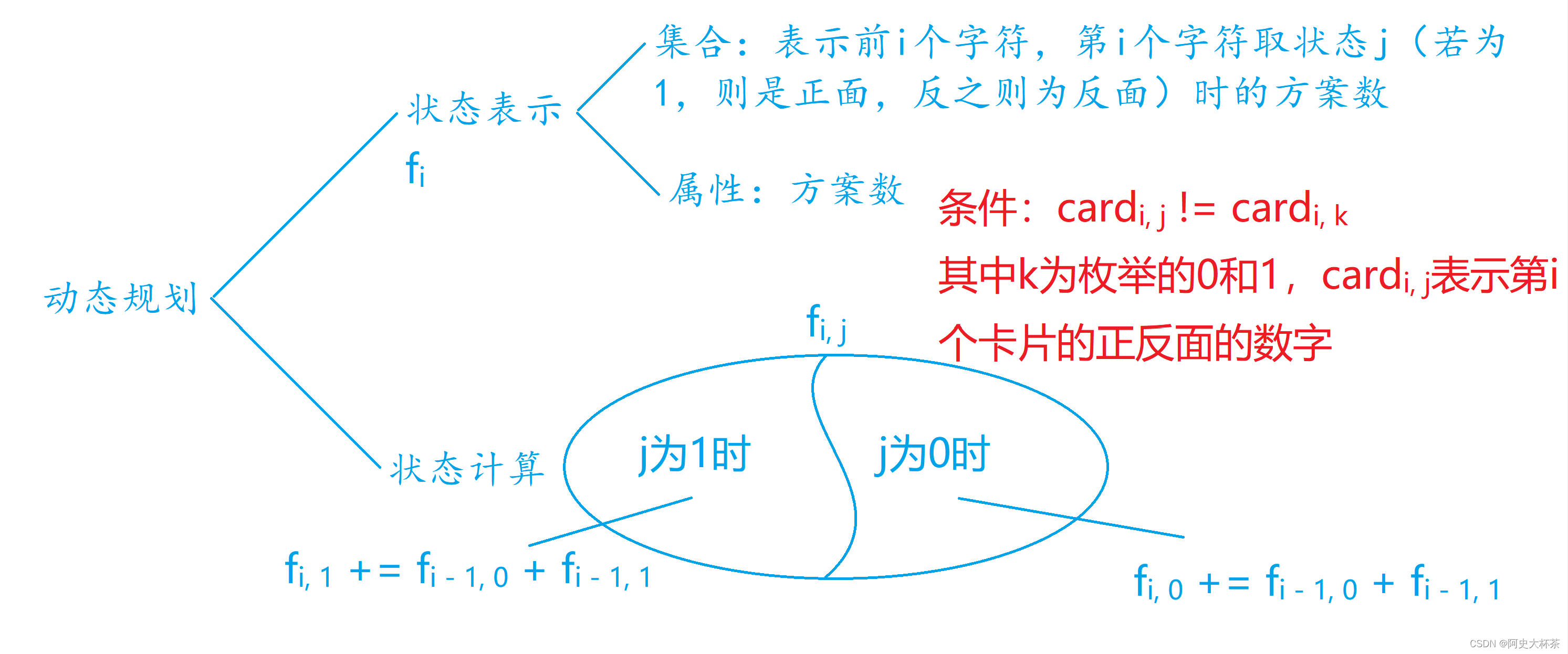
不过,不要忘了模余数!
代码
/*
------------------Welcome to Your Code--------------
Name:
Contest:
Wishes:AK!
------------------Start Writing!!!------------------
*/
#include <iostream>
#define int long long
#define endl '\n'
#define pb(i) push_back(i)

using namespace std;

const int N = 2e5 + 10, MOD = 998244353;

int n;
int card[N][2];
int f[N][2];

inline int read()
{
    int w = 1, s = 0;
    char c = getchar();
    while (c < '0' || c > '9')
    {
        if (c == '-') w = -1;
        c = getchar();
    }
    while (c >= '0' && c <= '9') s = s * 10 + c - '0', c = getchar();

    return w * s;
}

signed main()
{
    cin.tie(0);
    cout.tie(0);
    ios::sync_with_stdio(0);

	n = read();

    for (int i = 1; i <= n; i ++)
    	card[i][0] = read(), card[i][1] = read();

    f[1][0] = f[1][1] = 1;
    for (int i = 2; i <= n; i ++)
    	for (int t = 0; t < 2; t ++)
    		for (int k = 0; k < 2; k ++)
    			if (card[i - 1][t] != card[i][k])
    				f[i][k] = (f[i][k] + f[i - 1][t]) % MOD;

    cout << (f[n][0] + f[n][1]) % MOD << endl;

    return 0;
}
E题
原题
Problem Statement
There is a length-N NN sequence A = ( A 1 , … , A N ) A=(A_1,\ldots,A_N)A=(A1,…,AN) that is a permutation of 1 , … , N 1,\ldots,N1,…,N.
While you do not know A AA, you know that KaTeX parse error: Expected 'EOF', got '&' at position 8: A_{X_i}&̲lt;A_{Y_i} for M MM pairs of integers ( X i , Y i ) (X_i,Y_i)(Xi,Yi).
Can A AA be uniquely determined? If it is possible, find A AA.
Constraints
2 ≤ N ≤ 2 × 1 0 5 2 \leq N \leq 2\times 10^52≤N≤2×10⁵
1 ≤ M ≤ 2 × 1 0 5 1 \leq M \leq 2\times 10^51≤M≤2×10⁵
1 ≤ X i , Y i ≤ N 1\leq X_i,Y_i \leq N1≤Xi,Yi≤N
All values in the input are integers.
There is an A AA consistent with the input.
Input
The input is given from Standard Input in the following format:
N NN M MM
X 1 X_1X1 Y 1 Y_1Y1
⋮ \vdots⋮
X M X_MXM Y M Y_MYM
Output
If A AA can be uniquely determined, print Yes in the first line. Then, print A 1 , … , A N A_1,\ldots,A_NA1,…,AN in the second line, separated by spaces.
If A AA cannot be uniquely determined, just print No.
Sample Input 1
3 2
3 1
2 3
Sample Output 1
Yes
3 1 2
We can uniquely determine that A = ( 3 , 1 , 2 ) A=(3,1,2)A=(3,1,2).
Sample Input 2
3 2
3 1
3 2
Sample Output 2
No
Two sequences ( 2 , 3 , 1 ) (2,3,1)(2,3,1) and ( 3 , 2 , 1 ) (3,2,1)(3,2,1) can be A AA.
Sample Input 3
4 6
1 2
1 2
2 3
2 3
3 4
3 4
Sample Output 3
Yes
1 2 3 4
思路
这道题我们可以想成一个图,A x i < A y i A_{x_{i}}<A_{y_{i}}Axi<Ayi,我们可以将A x i A_{x_{i}}Axi向A y i A_{y_{i}}Ayi建一条边,之后其实就是看看能否成为唯一的拓扑序列,所以就是一个BFS宽搜的过程,在过程中用拓扑排序的方法,同时记录每个点的数值,可能说起来有点抽象,那么看看代码吧~~~
代码
/*
------------------Welcome to Your Code--------------
Name:
Contest:
Wishes:AK!
------------------Start Writing!!!------------------
*/
#include <iostream>
#include <vector>
#include <queue>
#define endl '\n'
#define pb(i) push_back(i)

using namespace std;

const int N = 2e5 + 10;

int n, m;
int x, y;
vector<int> g[N];
queue<int> q;
int ru[N], res[N];

inline int read()
{
    int w = 1, s = 0;
    char c = getchar();
    while (c < '0' || c > '9')
    {
        if (c == '-') w = -1;
        c = getchar();
    }
    while (c >= '0' && c <= '9') s = s * 10 + c - '0', c = getchar();

    return w * s;
}

void topsort()
{
	for (int i = 1; i <= n; i ++)
		if (!ru[i])
			q.push(i);

	int cnt = 0;
	while (q.size())
	{
		if (q.size() != 1) //说明有多种可能
		{
			cout << "No" << endl;
			return;
		}

		auto t = q.front();
		q.pop();

		res[t] = ++ cnt; //记录

		for (auto c : g[t])
			if (!(-- ru[c]))
				q.push(c);
	}

	cout << "Yes" << endl;
	for (int i = 1; i <= n; i ++)
		cout << res[i] << " \n"[i == n];

}

int main()
{
    cin.tie(0);
    cout.tie(0);
    ios::sync_with_stdio(0);

    n = read(), m = read();

    for (int i = 1; i <= m; i ++)
    	x = read(), y = read(), g[x].pb(y), ru[y] ++;

    topsort();

    return 0;
}
今天就到这里了!
大家有什么问题尽管提,我都会尽力回答的!
吾欲您伸手,点的小赞赞。吾欲您喜欢,点得小关注!