目录
文章前半部分暂时大多数从此链接粘贴过来,仅学习使用,但在后续学习过程中再对每一部分再做详细补充,原链接:https://www.jb51.net/article/140726.htm
1.概述
- Unsafe类是在sun.misc包下,不属于Java标准。但是很多Java的基础类库,包括一些被广泛使用的高性能开发库都是基于Unsafe类开发的,比如Netty、Hadoop、Kafka等。
- 使用Unsafe可用来直接访问系统内存资源并进行自主管理,Unsafe类在提升Java运行效率,增强Java语言底层操作能力方面起了很大的作用。
- Unsafe可认为是Java中留下的后门,提供了一些低层次操作,如直接内存访问、线程调度等。
- Unsafe里面的方法都是native方法,通过使用JNI的方式来访问本地C++实现库。
- 官方并不建议使用Unsafe。
2.源码分析
Unsafe的大部分API都是native的方法,主要包括以下几类:
- 1)Class相关。主要提供Class和它的静态字段的操作方法。
- 2)Object相关。主要提供Object和它的字段的操作方法。
- 3)Arrray相关。主要提供数组及其中元素的操作方法。
- 4)并发相关。主要提供低级别同步原语,如CAS、线程调度、volatile、内存屏障等。
- 5)Memory相关。提供了直接内存访问方法(绕过Java堆直接操作本地内存),可做到像C一样自由利用系统内存资源。
- 6)系统相关。主要返回某些低级别的内存信息,如地址大小、内存页大小。
2.1 Class相关
//判断是否需要初始化一个类
public native boolean shouldBeInitialized(Class<?> c);
//确保类被初始化
public native void ensureClassInitialized(Class<?> c);
//定义一个类,可用于动态创建类
public native Class<?> defineClass(String name, byte[] b, int off, int len,
     ClassLoader loader,
     ProtectionDomain protectionDomain);
//定义一个匿名类,可用于动态创建类
public native Class<?> defineAnonymousClass(Class<?> hostClass, byte[] data, Object[] cpPatches);
2.2 Object相关
Java中的基本类型(boolean、byte、char、short、int、long、float、double)及对象引用类型都有以下方法。
//获得实例对象的字段的偏移地址
public native long objectFieldOffset(Field f);
//获得给定对象地址偏移量的int值,而offset参数即为上述的objectFiledOffset的返回值
public native int getInt(Object o, long offset);
//设置给定对象地址偏移量的int值
public native void putInt(Object o, long offset, int x);
objectFieldOffset获取到的偏移地址仅仅在该Unsafe函数中访问指定字段时使用
- 如下代码使用unsafe获取AtomicLong中变量value在AtomicLong对象中的内存偏移,代码如下:
    static {
        try {
            valueOffset = unsafe.objectFieldOffset(AtomicLong.class.getDeclaredField("value"));
        } catch (Exception ex) {
            throw new Error(ex);
        }

    }
//获取静态字段的偏移量,用于在对应的Class对象中读写静态属性
public native long staticFieldOffset(Field f);
//获取静态字段的定义它的类的class对象,这个方法得到的值跟staticFieldOffset方法得到的值可以共同确定字段的在堆中的位置
public native Object staticFieldBase(Field f);
说明:
- 以上方法访问的皆是在堆中
- 我们知道在Java8使用元空间实现了方法区,在直接内存中,但是类的静态变量和常量池在堆中,所以staticFieldBase仍然返回的是堆中的地址,它和statciFieldOffset,一起同样可以通过上述的getInt(Object o, long offset)方法去获得静态字段的值,通过putInt(Object o, long offset, int x)修改静态字段的值
//创建对象,但并不会调用其构造方法。如果类未被初始化,将初始化类。
public native Object allocateInstance(Class<?> cls)
 throws InstantiationException;
2.3 数组相关
    //返回数组中第一个元素的偏移地址,它可以和下面的元素大小一起来让我们使用去访问数组中的元素
    public native int arrayBaseOffset(Class<?> arrayClass);

    //boolean、byte、short、char、int、long、float、double,及对象类型均有以下字段
    public static final int ARRAY_BOOLEAN_BASE_OFFSET
            = theUnsafe.arrayBaseOffset(boolean[].class);


    //返回数组中每一个元素占用的大小
    public native int arrayIndexScale(Class<?> arrayClass);

    //boolean、byte、short、char、int、long、float、double,及对象类型均有以下字段
    public static final int ARRAY_BOOLEAN_INDEX_SCALE
            = theUnsafe.arrayIndexScale(boolean[].class);
- 通过arrayBaseOffset和arrayIndexScale可定位数组中每个元素在内存中的位置
2.4 并发相关
(1)CAS相关
CAS:CompareAndSwap,内存偏移地址offset,预期值expected,新值x。如果变量在当前时刻的值和预期值expected相等,尝试将变量的值更新为x。如果更新成功,返回true;否则,返回false。
//更新变量值为x,如果当前值为expected
//o:对象    offset:偏移量     expected:期望值     x:新值
public final native boolean compareAndSwapObject(Object o, long offset,Object expected,Object x);

public final native boolean compareAndSwapInt(Object o, long offset,int expected,int x);

public final native boolean compareAndSwapLong(Object o, long offset,long expected,long x);
从Java 8开始,Unsafe中提供了以下方法:(注意:以下方法不是native的哦)
    //取到并增加值
    public final int getAndAddInt(Object o, long offset, int delta) {
        int v;
        do {
            v = getIntVolatile(o, offset);
        } while (!compareAndSwapInt(o, offset, v, v + delta));
        return v;
    }

    public final long getAndAddLong(Object o, long offset, long delta) {
        long v;
        do {
            v = getLongVolatile(o, offset);
        } while (!compareAndSwapLong(o, offset, v, v + delta));
        return v;
    }

    //取到并设置为新值
    public final int getAndSetInt(Object o, long offset, int newValue) {
        int v;
        do {
            v = getIntVolatile(o, offset);
        } while (!compareAndSwapInt(o, offset, v, newValue));
        return v;
    }

    public final long getAndSetLong(Object o, long offset, long newValue) {
        long v;
        do {
            v = getLongVolatile(o, offset);
        } while (!compareAndSwapLong(o, offset, v, newValue));
        return v;
    }

    public final Object getAndSetObject(Object o, long offset, Object newValue) {
        Object v;
        do {
            v = getObjectVolatile(o, offset);
        } while (!compareAndSwapObject(o, offset, v, newValue));
        return v;
    }
(2)线程调度相关
    /**
     * 阻塞当前线程,
     * 其中参数 isAbsolute 等于 false 时候,time 等于 0 表示一直阻塞,
     *      time 大于 0 表示等待指定的 time 后阻塞线程会被唤醒,
     *      这个 time 是个相对值,是个增量值,
     *      也就是相对当前时间累加 time 后当前线程就会被唤醒。
     * 如果 isAbsolute 等于 true,并且 time 大于 0 表示阻塞后到指定的时间点后会被唤醒,
     *      这里 time 是个绝对的时间,是某一个时间点换算为 ms 后的值。
     * 另外当其它线程调用了当前阻塞线程的 interrupt 方法中断了当前线程时候,
     *      当前线程也会返回,
     *      当其它线程调用了 unpark 方法并且把当前线程作为参数时候当前线程也会返回。
     */
    public native void park(boolean isAbsolute, long time);


    /**
     * 唤醒调用 park 后阻塞的线程,参数为需要唤醒的线程。
     */

public native void unpark(Object thread);关于park和unpark方法更详细的源码分析见另一篇博客:待补充链接
    //获得对象锁
    public native void monitorEnter(Object o);
    //释放对象锁
    public native void monitorExit(Object o);
    //尝试获取对象锁,返回true或false表示是否获取成功
    public native boolean tryMonitorEnter(Object o);
(3)volatile相关读写
Java中的基本类型(boolean、byte、char、short、int、long、float、double)及对象引用类型都有以下方法。
    //从对象的指定偏移量处获取变量的引用,使用volatile的加载语义(保证可见性和禁止指令重排序)
    //相当于getObject(Object, long)的volatile版本,
    public native Object getObjectVolatile(Object o, long offset);

    //存储变量的引用到对象的指定的偏移量处,使用volatile的存储语义(保证可见性和禁止指令重排序)
    //相当于putObject(Object, long, Object)的volatile版本
    public native void putObjectVolatile(Object o, long offset, Object x);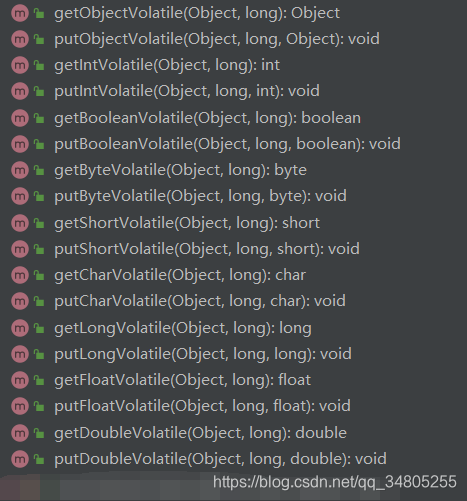
    /**
     * 设置 obj 对象中 offset 偏移地址对应的 long 型 field 的值为 value。
     *
     * 这是有延迟的 putLongVolatile 方法,并不保证值修改对其它线程立刻可见。
     * 变量只有使用 volatile 修饰并且期望被意外修改的时候使用才有用。
     *
     */
    public native void putOrderedObject(Object o, long offset, Object x);


    public native void putOrderedInt(Object o, long offset, int x);


    public native void putOrderedLong(Object o, long offset, long x);
(4)内存屏障相关
//内存屏障,禁止load操作重排序,即屏障前的load操作不能被重排序到屏障后,屏障后的load操作不能被重排序到屏障前
public native void loadFence();
//内存屏障,禁止store操作重排序,即屏障前的store操作不能被重排序到屏障后,屏障后的store操作不能被重排序到屏障前
public native void storeFence();
//内存屏障,禁止load、store操作重排序
public native void fullFence();
2.5 直接内存访问(非堆内存)
//(boolean、byte、char、short、int、long、float、double)都有以下get、put两个方法。
//获得给定地址上的int值
public native int getInt(long address);
//设置给定地址上的int值
public native void putInt(long address, int x);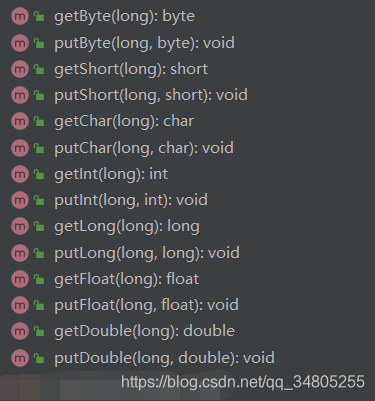
//获得本地指针
public native long getAddress(long address);
//存储本地指针到给定的内存地址
public native void putAddress(long address, long x);
//分配内存
public native long allocateMemory(long bytes);
//重新分配内存
public native long reallocateMemory(long address, long bytes);
//初始化内存内容
public native void setMemory(Object o, long offset, long bytes, byte value);
//初始化内存内容
public void setMemory(long address, long bytes, byte value) {
setMemory(null, address, bytes, value);
}
//内存内容拷贝
public native void copyMemory(Object srcBase, long srcOffset,
Object destBase, long destOffset,
long bytes);
//内存内容拷贝
public void copyMemory(long srcAddress, long destAddress, long bytes) {
copyMemory(null, srcAddress, null, destAddress, bytes);
}
//释放内存
public native void freeMemory(long address);- 注意:allocateMemory所分配的内存需要手动free(不被GC回收)
2.6 系统相关
//返回指针的大小。返回值为4或8。
public native int addressSize();

/** The value of {@code addressSize()} */
public static final int ADDRESS_SIZE = theUnsafe.addressSize();

//内存页的大小。
public native int pageSize();
2.7 getUnsafe特别说明
3.带英文原注释的源码
/*
* Copyright (c) 2000, 2013, Oracle and/or its affiliates. All rights reserved.
* DO NOT ALTER OR REMOVE COPYRIGHT NOTICES OR THIS FILE HEADER.
*
* This code is free software; you can redistribute it and/or modify it
* under the terms of the GNU General Public License version 2 only, as
* published by the Free Software Foundation. Oracle designates this
* particular file as subject to the "Classpath" exception as provided
* by Oracle in the LICENSE file that accompanied this code.
*
* This code is distributed in the hope that it will be useful, but WITHOUT
* ANY WARRANTY; without even the implied warranty of MERCHANTABILITY or
* FITNESS FOR A PARTICULAR PURPOSE. See the GNU General Public License
* version 2 for more details (a copy is included in the LICENSE file that
* accompanied this code).
*
* You should have received a copy of the GNU General Public License version
* 2 along with this work; if not, write to the Free Software Foundation,
* Inc., 51 Franklin St, Fifth Floor, Boston, MA 02110-1301 USA.
*
* Please contact Oracle, 500 Oracle Parkway, Redwood Shores, CA 94065 USA
* or visit www.oracle.com if you need additional information or have any
* questions.
*/
package sun.misc;
import java.security.*;
import java.lang.reflect.*;
import sun.reflect.CallerSensitive;
import sun.reflect.Reflection;
/**
* A collection of methods for performing low-level, unsafe operations.
* Although the class and all methods are public, use of this class is
* limited because only trusted code can obtain instances of it.
*
* @author John R. Rose
* @see #getUnsafe
*/
public final class Unsafe {
private static native void registerNatives();
static {
registerNatives();
sun.reflect.Reflection.registerMethodsToFilter(Unsafe.class, "getUnsafe");
}
private Unsafe() {}
private static final Unsafe theUnsafe = new Unsafe();
/**
* Provides the caller with the capability of performing unsafe
* operations.
*
* <p> The returned <code>Unsafe</code> object should be carefully guarded
* by the caller, since it can be used to read and write data at arbitrary
* memory addresses. It must never be passed to untrusted code.
*
* <p> Most methods in this class are very low-level, and correspond to a
* small number of hardware instructions (on typical machines). Compilers
* are encouraged to optimize these methods accordingly.
*
* <p> Here is a suggested idiom for using unsafe operations:
*
* <blockquote><pre>
* class MyTrustedClass {
* private static final Unsafe unsafe = Unsafe.getUnsafe();
* ...
* private long myCountAddress = ...;
* public int getCount() { return unsafe.getByte(myCountAddress); }
* }
* </pre></blockquote>
*
* (It may assist compilers to make the local variable be
* <code>final</code>.)
*
* @exception SecurityException if a security manager exists and its
* <code>checkPropertiesAccess</code> method doesn't allow
* access to the system properties.
*/
@CallerSensitive
public static Unsafe getUnsafe() {
Class<?> caller = Reflection.getCallerClass();
if (!VM.isSystemDomainLoader(caller.getClassLoader()))
throw new SecurityException("Unsafe");
return theUnsafe;
}
/// peek and poke operations
/// (compilers should optimize these to memory ops)
// These work on object fields in the Java heap.
// They will not work on elements of packed arrays.
/**
* Fetches a value from a given Java variable.
* More specifically, fetches a field or array element within the given
* object <code>o</code> at the given offset, or (if <code>o</code> is
* null) from the memory address whose numerical value is the given
* offset.
* <p>
* The results are undefined unless one of the following cases is true:
* <ul>
* <li>The offset was obtained from {@link #objectFieldOffset} on
* the {@link java.lang.reflect.Field} of some Java field and the object
* referred to by <code>o</code> is of a class compatible with that
* field's class.
*
* <li>The offset and object reference <code>o</code> (either null or
* non-null) were both obtained via {@link #staticFieldOffset}
* and {@link #staticFieldBase} (respectively) from the
* reflective {@link Field} representation of some Java field.
*
* <li>The object referred to by <code>o</code> is an array, and the offset
* is an integer of the form <code>B+N*S</code>, where <code>N</code> is
* a valid index into the array, and <code>B</code> and <code>S</code> are
* the values obtained by {@link #arrayBaseOffset} and {@link
* #arrayIndexScale} (respectively) from the array's class. The value
* referred to is the <code>N</code><em>th</em> element of the array.
*
* </ul>
* <p>
* If one of the above cases is true, the call references a specific Java
* variable (field or array element). However, the results are undefined
* if that variable is not in fact of the type returned by this method.
* <p>
* This method refers to a variable by means of two parameters, and so
* it provides (in effect) a <em>double-register</em> addressing mode
* for Java variables. When the object reference is null, this method
* uses its offset as an absolute address. This is similar in operation
* to methods such as {@link #getInt(long)}, which provide (in effect) a
* <em>single-register</em> addressing mode for non-Java variables.
* However, because Java variables may have a different layout in memory
* from non-Java variables, programmers should not assume that these
* two addressing modes are ever equivalent. Also, programmers should
* remember that offsets from the double-register addressing mode cannot
* be portably confused with longs used in the single-register addressing
* mode.
*
* @param o Java heap object in which the variable resides, if any, else
* null
* @param offset indication of where the variable resides in a Java heap
* object, if any, else a memory address locating the variable
* statically
* @return the value fetched from the indicated Java variable
* @throws RuntimeException No defined exceptions are thrown, not even
* {@link NullPointerException}
*/
public native int getInt(Object o, long offset);
/**
* Stores a value into a given Java variable.
* <p>
* The first two parameters are interpreted exactly as with
* {@link #getInt(Object, long)} to refer to a specific
* Java variable (field or array element). The given value
* is stored into that variable.
* <p>
* The variable must be of the same type as the method
* parameter <code>x</code>.
*
* @param o Java heap object in which the variable resides, if any, else
* null
* @param offset indication of where the variable resides in a Java heap
* object, if any, else a memory address locating the variable
* statically
* @param x the value to store into the indicated Java variable
* @throws RuntimeException No defined exceptions are thrown, not even
* {@link NullPointerException}
*/
public native void putInt(Object o, long offset, int x);
/**
* Fetches a reference value from a given Java variable.
* @see #getInt(Object, long)
*/
public native Object getObject(Object o, long offset);
/**
* Stores a reference value into a given Java variable.
* <p>
* Unless the reference <code>x</code> being stored is either null
* or matches the field type, the results are undefined.
* If the reference <code>o</code> is non-null, car marks or
* other store barriers for that object (if the VM requires them)
* are updated.
* @see #putInt(Object, int, int)
*/
public native void putObject(Object o, long offset, Object x);
/** @see #getInt(Object, long) */
public native boolean getBoolean(Object o, long offset);
/** @see #putInt(Object, int, int) */
public native void putBoolean(Object o, long offset, boolean x);
/** @see #getInt(Object, long) */
public native byte getByte(Object o, long offset);
/** @see #putInt(Object, int, int) */
public native void putByte(Object o, long offset, byte x);
/** @see #getInt(Object, long) */
public native short getShort(Object o, long offset);
/** @see #putInt(Object, int, int) */
public native void putShort(Object o, long offset, short x);
/** @see #getInt(Object, long) */
public native char getChar(Object o, long offset);
/** @see #putInt(Object, int, int) */
public native void putChar(Object o, long offset, char x);
/** @see #getInt(Object, long) */
public native long getLong(Object o, long offset);
/** @see #putInt(Object, int, int) */
public native void putLong(Object o, long offset, long x);
/** @see #getInt(Object, long) */
public native float getFloat(Object o, long offset);
/** @see #putInt(Object, int, int) */
public native void putFloat(Object o, long offset, float x);
/** @see #getInt(Object, long) */
public native double getDouble(Object o, long offset);
/** @see #putInt(Object, int, int) */
public native void putDouble(Object o, long offset, double x);
/**
* This method, like all others with 32-bit offsets, was native
* in a previous release but is now a wrapper which simply casts
* the offset to a long value. It provides backward compatibility
* with bytecodes compiled against 1.4.
* @deprecated As of 1.4.1, cast the 32-bit offset argument to a long.
* See {@link #staticFieldOffset}.
*/
@Deprecated
public int getInt(Object o, int offset) {
return getInt(o, (long)offset);
}
/**
* @deprecated As of 1.4.1, cast the 32-bit offset argument to a long.
* See {@link #staticFieldOffset}.
*/
@Deprecated
public void putInt(Object o, int offset, int x) {
putInt(o, (long)offset, x);
}
/**
* @deprecated As of 1.4.1, cast the 32-bit offset argument to a long.
* See {@link #staticFieldOffset}.
*/
@Deprecated
public Object getObject(Object o, int offset) {
return getObject(o, (long)offset);
}
/**
* @deprecated As of 1.4.1, cast the 32-bit offset argument to a long.
* See {@link #staticFieldOffset}.
*/
@Deprecated
public void putObject(Object o, int offset, Object x) {
putObject(o, (long)offset, x);
}
/**
* @deprecated As of 1.4.1, cast the 32-bit offset argument to a long.
* See {@link #staticFieldOffset}.
*/
@Deprecated
public boolean getBoolean(Object o, int offset) {
return getBoolean(o, (long)offset);
}
/**
* @deprecated As of 1.4.1, cast the 32-bit offset argument to a long.
* See {@link #staticFieldOffset}.
*/
@Deprecated
public void putBoolean(Object o, int offset, boolean x) {
putBoolean(o, (long)offset, x);
}
/**
* @deprecated As of 1.4.1, cast the 32-bit offset argument to a long.
* See {@link #staticFieldOffset}.
*/
@Deprecated
public byte getByte(Object o, int offset) {
return getByte(o, (long)offset);
}
/**
* @deprecated As of 1.4.1, cast the 32-bit offset argument to a long.
* See {@link #staticFieldOffset}.
*/
@Deprecated
public void putByte(Object o, int offset, byte x) {
putByte(o, (long)offset, x);
}
/**
* @deprecated As of 1.4.1, cast the 32-bit offset argument to a long.
* See {@link #staticFieldOffset}.
*/
@Deprecated
public short getShort(Object o, int offset) {
return getShort(o, (long)offset);
}
/**
* @deprecated As of 1.4.1, cast the 32-bit offset argument to a long.
* See {@link #staticFieldOffset}.
*/
@Deprecated
public void putShort(Object o, int offset, short x) {
putShort(o, (long)offset, x);
}
/**
* @deprecated As of 1.4.1, cast the 32-bit offset argument to a long.
* See {@link #staticFieldOffset}.
*/
@Deprecated
public char getChar(Object o, int offset) {
return getChar(o, (long)offset);
}
/**
* @deprecated As of 1.4.1, cast the 32-bit offset argument to a long.
* See {@link #staticFieldOffset}.
*/
@Deprecated
public void putChar(Object o, int offset, char x) {
putChar(o, (long)offset, x);
}
/**
* @deprecated As of 1.4.1, cast the 32-bit offset argument to a long.
* See {@link #staticFieldOffset}.
*/
@Deprecated
public long getLong(Object o, int offset) {
return getLong(o, (long)offset);
}
/**
* @deprecated As of 1.4.1, cast the 32-bit offset argument to a long.
* See {@link #staticFieldOffset}.
*/
@Deprecated
public void putLong(Object o, int offset, long x) {
putLong(o, (long)offset, x);
}
/**
* @deprecated As of 1.4.1, cast the 32-bit offset argument to a long.
* See {@link #staticFieldOffset}.
*/
@Deprecated
public float getFloat(Object o, int offset) {
return getFloat(o, (long)offset);
}
/**
* @deprecated As of 1.4.1, cast the 32-bit offset argument to a long.
* See {@link #staticFieldOffset}.
*/
@Deprecated
public void putFloat(Object o, int offset, float x) {
putFloat(o, (long)offset, x);
}
/**
* @deprecated As of 1.4.1, cast the 32-bit offset argument to a long.
* See {@link #staticFieldOffset}.
*/
@Deprecated
public double getDouble(Object o, int offset) {
return getDouble(o, (long)offset);
}
/**
* @deprecated As of 1.4.1, cast the 32-bit offset argument to a long.
* See {@link #staticFieldOffset}.
*/
@Deprecated
public void putDouble(Object o, int offset, double x) {
putDouble(o, (long)offset, x);
}
// These work on values in the C heap.
/**
* Fetches a value from a given memory address. If the address is zero, or
* does not point into a block obtained from {@link #allocateMemory}, the
* results are undefined.
*
* @see #allocateMemory
*/
public native byte getByte(long address);
/**
* Stores a value into a given memory address. If the address is zero, or
* does not point into a block obtained from {@link #allocateMemory}, the
* results are undefined.
*
* @see #getByte(long)
*/
public native void putByte(long address, byte x);
/** @see #getByte(long) */
public native short getShort(long address);
/** @see #putByte(long, byte) */
public native void putShort(long address, short x);
/** @see #getByte(long) */
public native char getChar(long address);
/** @see #putByte(long, byte) */
public native void putChar(long address, char x);
/** @see #getByte(long) */
public native int getInt(long address);
/** @see #putByte(long, byte) */
public native void putInt(long address, int x);
/** @see #getByte(long) */
public native long getLong(long address);
/** @see #putByte(long, byte) */
public native void putLong(long address, long x);
/** @see #getByte(long) */
public native float getFloat(long address);
/** @see #putByte(long, byte) */
public native void putFloat(long address, float x);
/** @see #getByte(long) */
public native double getDouble(long address);
/** @see #putByte(long, byte) */
public native void putDouble(long address, double x);
/**
* Fetches a native pointer from a given memory address. If the address is
* zero, or does not point into a block obtained from {@link
* #allocateMemory}, the results are undefined.
*
* <p> If the native pointer is less than 64 bits wide, it is extended as
* an unsigned number to a Java long. The pointer may be indexed by any
* given byte offset, simply by adding that offset (as a simple integer) to
* the long representing the pointer. The number of bytes actually read
* from the target address maybe determined by consulting {@link
* #addressSize}.
*
* @see #allocateMemory
*/
public native long getAddress(long address);
/**
* Stores a native pointer into a given memory address. If the address is
* zero, or does not point into a block obtained from {@link
* #allocateMemory}, the results are undefined.
*
* <p> The number of bytes actually written at the target address maybe
* determined by consulting {@link #addressSize}.
*
* @see #getAddress(long)
*/
public native void putAddress(long address, long x);
/// wrappers for malloc, realloc, free:
/**
* Allocates a new block of native memory, of the given size in bytes. The
* contents of the memory are uninitialized; they will generally be
* garbage. The resulting native pointer will never be zero, and will be
* aligned for all value types. Dispose of this memory by calling {@link
* #freeMemory}, or resize it with {@link #reallocateMemory}.
*
* @throws IllegalArgumentException if the size is negative or too large
* for the native size_t type
*
* @throws OutOfMemoryError if the allocation is refused by the system
*
* @see #getByte(long)
* @see #putByte(long, byte)
*/
public native long allocateMemory(long bytes);
/**
* Resizes a new block of native memory, to the given size in bytes. The
* contents of the new block past the size of the old block are
* uninitialized; they will generally be garbage. The resulting native
* pointer will be zero if and only if the requested size is zero. The
* resulting native pointer will be aligned for all value types. Dispose
* of this memory by calling {@link #freeMemory}, or resize it with {@link
* #reallocateMemory}. The address passed to this method may be null, in
* which case an allocation will be performed.
*
* @throws IllegalArgumentException if the size is negative or too large
* for the native size_t type
*
* @throws OutOfMemoryError if the allocation is refused by the system
*
* @see #allocateMemory
*/
public native long reallocateMemory(long address, long bytes);
/**
* Sets all bytes in a given block of memory to a fixed value
* (usually zero).
*
* <p>This method determines a block's base address by means of two parameters,
* and so it provides (in effect) a <em>double-register</em> addressing mode,
* as discussed in {@link #getInt(Object,long)}. When the object reference is null,
* the offset supplies an absolute base address.
*
* <p>The stores are in coherent (atomic) units of a size determined
* by the address and length parameters. If the effective address and
* length are all even modulo 8, the stores take place in 'long' units.
* If the effective address and length are (resp.) even modulo 4 or 2,
* the stores take place in units of 'int' or 'short'.
*
* @since 1.7
*/
public native void setMemory(Object o, long offset, long bytes, byte value);
/**
* Sets all bytes in a given block of memory to a fixed value
* (usually zero). This provides a <em>single-register</em> addressing mode,
* as discussed in {@link #getInt(Object,long)}.
*
* <p>Equivalent to <code>setMemory(null, address, bytes, value)</code>.
*/
public void setMemory(long address, long bytes, byte value) {
setMemory(null, address, bytes, value);
}
/**
* Sets all bytes in a given block of memory to a copy of another
* block.
*
* <p>This method determines each block's base address by means of two parameters,
* and so it provides (in effect) a <em>double-register</em> addressing mode,
* as discussed in {@link #getInt(Object,long)}. When the object reference is null,
* the offset supplies an absolute base address.
*
* <p>The transfers are in coherent (atomic) units of a size determined
* by the address and length parameters. If the effective addresses and
* length are all even modulo 8, the transfer takes place in 'long' units.
* If the effective addresses and length are (resp.) even modulo 4 or 2,
* the transfer takes place in units of 'int' or 'short'.
*
* @since 1.7
*/
public native void copyMemory(Object srcBase, long srcOffset,
Object destBase, long destOffset,
long bytes);
/**
* Sets all bytes in a given block of memory to a copy of another
* block. This provides a <em>single-register</em> addressing mode,
* as discussed in {@link #getInt(Object,long)}.
*
* Equivalent to <code>copyMemory(null, srcAddress, null, destAddress, bytes)</code>.
*/
public void copyMemory(long srcAddress, long destAddress, long bytes) {
copyMemory(null, srcAddress, null, destAddress, bytes);
}
/**
* Disposes of a block of native memory, as obtained from {@link
* #allocateMemory} or {@link #reallocateMemory}. The address passed to
* this method may be null, in which case no action is taken.
*
* @see #allocateMemory
*/
public native void freeMemory(long address);
/// random queries
/**
* This constant differs from all results that will ever be returned from
* {@link #staticFieldOffset}, {@link #objectFieldOffset},
* or {@link #arrayBaseOffset}.
*/
public static final int INVALID_FIELD_OFFSET = -1;
/**
* Returns the offset of a field, truncated to 32 bits.
* This method is implemented as follows:
* <blockquote><pre>
* public int fieldOffset(Field f) {
* if (Modifier.isStatic(f.getModifiers()))
* return (int) staticFieldOffset(f);
* else
* return (int) objectFieldOffset(f);
* }
* </pre></blockquote>
* @deprecated As of 1.4.1, use {@link #staticFieldOffset} for static
* fields and {@link #objectFieldOffset} for non-static fields.
*/
@Deprecated
public int fieldOffset(Field f) {
if (Modifier.isStatic(f.getModifiers()))
return (int) staticFieldOffset(f);
else
return (int) objectFieldOffset(f);
}
/**
* Returns the base address for accessing some static field
* in the given class. This method is implemented as follows:
* <blockquote><pre>
* public Object staticFieldBase(Class c) {
* Field[] fields = c.getDeclaredFields();
* for (int i = 0; i < fields.length; i++) {
* if (Modifier.isStatic(fields[i].getModifiers())) {
* return staticFieldBase(fields[i]);
* }
* }
* return null;
* }
* </pre></blockquote>
* @deprecated As of 1.4.1, use {@link #staticFieldBase(Field)}
* to obtain the base pertaining to a specific {@link Field}.
* This method works only for JVMs which store all statics
* for a given class in one place.
*/
@Deprecated
public Object staticFieldBase(Class<?> c) {
Field[] fields = c.getDeclaredFields();
for (int i = 0; i < fields.length; i++) {
if (Modifier.isStatic(fields[i].getModifiers())) {
return staticFieldBase(fields[i]);
}
}
return null;
}
/**
* Report the location of a given field in the storage allocation of its
* class. Do not expect to perform any sort of arithmetic on this offset;
* it is just a cookie which is passed to the unsafe heap memory accessors.
*
* <p>Any given field will always have the same offset and base, and no
* two distinct fields of the same class will ever have the same offset
* and base.
*
* <p>As of 1.4.1, offsets for fields are represented as long values,
* although the Sun JVM does not use the most significant 32 bits.
* However, JVM implementations which store static fields at absolute
* addresses can use long offsets and null base pointers to express
* the field locations in a form usable by {@link #getInt(Object,long)}.
* Therefore, code which will be ported to such JVMs on 64-bit platforms
* must preserve all bits of static field offsets.
* @see #getInt(Object, long)
*/
public native long staticFieldOffset(Field f);
/**
* Report the location of a given static field, in conjunction with {@link
* #staticFieldBase}.
* <p>Do not expect to perform any sort of arithmetic on this offset;
* it is just a cookie which is passed to the unsafe heap memory accessors.
*
* <p>Any given field will always have the same offset, and no two distinct
* fields of the same class will ever have the same offset.
*
* <p>As of 1.4.1, offsets for fields are represented as long values,
* although the Sun JVM does not use the most significant 32 bits.
* It is hard to imagine a JVM technology which needs more than
* a few bits to encode an offset within a non-array object,
* However, for consistency with other methods in this class,
* this method reports its result as a long value.
* @see #getInt(Object, long)
*/
public native long objectFieldOffset(Field f);
/**
* Report the location of a given static field, in conjunction with {@link
* #staticFieldOffset}.
* <p>Fetch the base "Object", if any, with which static fields of the
* given class can be accessed via methods like {@link #getInt(Object,
* long)}. This value may be null. This value may refer to an object
* which is a "cookie", not guaranteed to be a real Object, and it should
* not be used in any way except as argument to the get and put routines in
* this class.
*/
public native Object staticFieldBase(Field f);
/**
* Detect if the given class may need to be initialized. This is often
* needed in conjunction with obtaining the static field base of a
* class.
* @return false only if a call to {@code ensureClassInitialized} would have no effect
*/
public native boolean shouldBeInitialized(Class<?> c);
/**
* Ensure the given class has been initialized. This is often
* needed in conjunction with obtaining the static field base of a
* class.
*/
public native void ensureClassInitialized(Class<?> c);
/**
* Report the offset of the first element in the storage allocation of a
* given array class. If {@link #arrayIndexScale} returns a non-zero value
* for the same class, you may use that scale factor, together with this
* base offset, to form new offsets to access elements of arrays of the
* given class.
*
* @see #getInt(Object, long)
* @see #putInt(Object, long, int)
*/
public native int arrayBaseOffset(Class<?> arrayClass);
/** The value of {@code arrayBaseOffset(boolean[].class)} */
public static final int ARRAY_BOOLEAN_BASE_OFFSET
= theUnsafe.arrayBaseOffset(boolean[].class);
/** The value of {@code arrayBaseOffset(byte[].class)} */
public static final int ARRAY_BYTE_BASE_OFFSET
= theUnsafe.arrayBaseOffset(byte[].class);
/** The value of {@code arrayBaseOffset(short[].class)} */
public static final int ARRAY_SHORT_BASE_OFFSET
= theUnsafe.arrayBaseOffset(short[].class);
/** The value of {@code arrayBaseOffset(char[].class)} */
public static final int ARRAY_CHAR_BASE_OFFSET
= theUnsafe.arrayBaseOffset(char[].class);
/** The value of {@code arrayBaseOffset(int[].class)} */
public static final int ARRAY_INT_BASE_OFFSET
= theUnsafe.arrayBaseOffset(int[].class);
/** The value of {@code arrayBaseOffset(long[].class)} */
public static final int ARRAY_LONG_BASE_OFFSET
= theUnsafe.arrayBaseOffset(long[].class);
/** The value of {@code arrayBaseOffset(float[].class)} */
public static final int ARRAY_FLOAT_BASE_OFFSET
= theUnsafe.arrayBaseOffset(float[].class);
/** The value of {@code arrayBaseOffset(double[].class)} */
public static final int ARRAY_DOUBLE_BASE_OFFSET
= theUnsafe.arrayBaseOffset(double[].class);
/** The value of {@code arrayBaseOffset(Object[].class)} */
public static final int ARRAY_OBJECT_BASE_OFFSET
= theUnsafe.arrayBaseOffset(Object[].class);
/**
* Report the scale factor for addressing elements in the storage
* allocation of a given array class. However, arrays of "narrow" types
* will generally not work properly with accessors like {@link
* #getByte(Object, int)}, so the scale factor for such classes is reported
* as zero.
*
* @see #arrayBaseOffset
* @see #getInt(Object, long)
* @see #putInt(Object, long, int)
*/
public native int arrayIndexScale(Class<?> arrayClass);
/** The value of {@code arrayIndexScale(boolean[].class)} */
public static final int ARRAY_BOOLEAN_INDEX_SCALE
= theUnsafe.arrayIndexScale(boolean[].class);
/** The value of {@code arrayIndexScale(byte[].class)} */
public static final int ARRAY_BYTE_INDEX_SCALE
= theUnsafe.arrayIndexScale(byte[].class);
/** The value of {@code arrayIndexScale(short[].class)} */
public static final int ARRAY_SHORT_INDEX_SCALE
= theUnsafe.arrayIndexScale(short[].class);
/** The value of {@code arrayIndexScale(char[].class)} */
public static final int ARRAY_CHAR_INDEX_SCALE
= theUnsafe.arrayIndexScale(char[].class);
/** The value of {@code arrayIndexScale(int[].class)} */
public static final int ARRAY_INT_INDEX_SCALE
= theUnsafe.arrayIndexScale(int[].class);
/** The value of {@code arrayIndexScale(long[].class)} */
public static final int ARRAY_LONG_INDEX_SCALE
= theUnsafe.arrayIndexScale(long[].class);
/** The value of {@code arrayIndexScale(float[].class)} */
public static final int ARRAY_FLOAT_INDEX_SCALE
= theUnsafe.arrayIndexScale(float[].class);
/** The value of {@code arrayIndexScale(double[].class)} */
public static final int ARRAY_DOUBLE_INDEX_SCALE
= theUnsafe.arrayIndexScale(double[].class);
/** The value of {@code arrayIndexScale(Object[].class)} */
public static final int ARRAY_OBJECT_INDEX_SCALE
= theUnsafe.arrayIndexScale(Object[].class);
/**
* Report the size in bytes of a native pointer, as stored via {@link
* #putAddress}. This value will be either 4 or 8. Note that the sizes of
* other primitive types (as stored in native memory blocks) is determined
* fully by their information content.
*/
public native int addressSize();
/** The value of {@code addressSize()} */
public static final int ADDRESS_SIZE = theUnsafe.addressSize();
/**
* Report the size in bytes of a native memory page (whatever that is).
* This value will always be a power of two.
*/
public native int pageSize();
/// random trusted operations from JNI:
/**
* Tell the VM to define a class, without security checks. By default, the
* class loader and protection domain come from the caller's class.
*/
public native Class<?> defineClass(String name, byte[] b, int off, int len,
ClassLoader loader,
ProtectionDomain protectionDomain);
/**
* Define a class but do not make it known to the class loader or system dictionary.
* <p>
* For each CP entry, the corresponding CP patch must either be null or have
* the a format that matches its tag:
* <ul>
* <li>Integer, Long, Float, Double: the corresponding wrapper object type from java.lang
* <li>Utf8: a string (must have suitable syntax if used as signature or name)
* <li>Class: any java.lang.Class object
* <li>String: any object (not just a java.lang.String)
* <li>InterfaceMethodRef: (NYI) a method handle to invoke on that call site's arguments
* </ul>
* @params hostClass context for linkage, access control, protection domain, and class loader
* @params data bytes of a class file
* @params cpPatches where non-null entries exist, they replace corresponding CP entries in data
*/
public native Class<?> defineAnonymousClass(Class<?> hostClass, byte[] data, Object[] cpPatches);
/** Allocate an instance but do not run any constructor.
Initializes the class if it has not yet been. */
public native Object allocateInstance(Class<?> cls)
throws InstantiationException;
/** Lock the object. It must get unlocked via {@link #monitorExit}. */
@Deprecated
public native void monitorEnter(Object o);
/**
* Unlock the object. It must have been locked via {@link
* #monitorEnter}.
*/
@Deprecated
public native void monitorExit(Object o);
/**
* Tries to lock the object. Returns true or false to indicate
* whether the lock succeeded. If it did, the object must be
* unlocked via {@link #monitorExit}.
*/
@Deprecated
public native boolean tryMonitorEnter(Object o);
/** Throw the exception without telling the verifier. */
public native void throwException(Throwable ee);
/**
* Atomically update Java variable to <tt>x</tt> if it is currently
* holding <tt>expected</tt>.
* @return <tt>true</tt> if successful
*/
public final native boolean compareAndSwapObject(Object o, long offset,
Object expected,
Object x);
/**
* Atomically update Java variable to <tt>x</tt> if it is currently
* holding <tt>expected</tt>.
* @return <tt>true</tt> if successful
*/
public final native boolean compareAndSwapInt(Object o, long offset,
int expected,
int x);
/**
* Atomically update Java variable to <tt>x</tt> if it is currently
* holding <tt>expected</tt>.
* @return <tt>true</tt> if successful
*/
public final native boolean compareAndSwapLong(Object o, long offset,
long expected,
long x);
/**
* Fetches a reference value from a given Java variable, with volatile
* load semantics. Otherwise identical to {@link #getObject(Object, long)}
*/
public native Object getObjectVolatile(Object o, long offset);
/**
* Stores a reference value into a given Java variable, with
* volatile store semantics. Otherwise identical to {@link #putObject(Object, long, Object)}
*/
public native void putObjectVolatile(Object o, long offset, Object x);
/** Volatile version of {@link #getInt(Object, long)} */
public native int getIntVolatile(Object o, long offset);
/** Volatile version of {@link #putInt(Object, long, int)} */
public native void putIntVolatile(Object o, long offset, int x);
/** Volatile version of {@link #getBoolean(Object, long)} */
public native boolean getBooleanVolatile(Object o, long offset);
/** Volatile version of {@link #putBoolean(Object, long, boolean)} */
public native void putBooleanVolatile(Object o, long offset, boolean x);
/** Volatile version of {@link #getByte(Object, long)} */
public native byte getByteVolatile(Object o, long offset);
/** Volatile version of {@link #putByte(Object, long, byte)} */
public native void putByteVolatile(Object o, long offset, byte x);
/** Volatile version of {@link #getShort(Object, long)} */
public native short getShortVolatile(Object o, long offset);
/** Volatile version of {@link #putShort(Object, long, short)} */
public native void putShortVolatile(Object o, long offset, short x);
/** Volatile version of {@link #getChar(Object, long)} */
public native char getCharVolatile(Object o, long offset);
/** Volatile version of {@link #putChar(Object, long, char)} */
public native void putCharVolatile(Object o, long offset, char x);
/** Volatile version of {@link #getLong(Object, long)} */
public native long getLongVolatile(Object o, long offset);
/** Volatile version of {@link #putLong(Object, long, long)} */
public native void putLongVolatile(Object o, long offset, long x);
/** Volatile version of {@link #getFloat(Object, long)} */
public native float getFloatVolatile(Object o, long offset);
/** Volatile version of {@link #putFloat(Object, long, float)} */
public native void putFloatVolatile(Object o, long offset, float x);
/** Volatile version of {@link #getDouble(Object, long)} */
public native double getDoubleVolatile(Object o, long offset);
/** Volatile version of {@link #putDouble(Object, long, double)} */
public native void putDoubleVolatile(Object o, long offset, double x);
/**
* Version of {@link #putObjectVolatile(Object, long, Object)}
* that does not guarantee immediate visibility of the store to
* other threads. This method is generally only useful if the
* underlying field is a Java volatile (or if an array cell, one
* that is otherwise only accessed using volatile accesses).
*/
public native void putOrderedObject(Object o, long offset, Object x);
/** Ordered/Lazy version of {@link #putIntVolatile(Object, long, int)} */
public native void putOrderedInt(Object o, long offset, int x);
/** Ordered/Lazy version of {@link #putLongVolatile(Object, long, long)} */
public native void putOrderedLong(Object o, long offset, long x);
/**
* Unblock the given thread blocked on <tt>park</tt>, or, if it is
* not blocked, cause the subsequent call to <tt>park</tt> not to
* block. Note: this operation is "unsafe" solely because the
* caller must somehow ensure that the thread has not been
* destroyed. Nothing special is usually required to ensure this
* when called from Java (in which there will ordinarily be a live
* reference to the thread) but this is not nearly-automatically
* so when calling from native code.
* @param thread the thread to unpark.
*
*/
public native void unpark(Object thread);
/**
* Block current thread, returning when a balancing
* <tt>unpark</tt> occurs, or a balancing <tt>unpark</tt> has
* already occurred, or the thread is interrupted, or, if not
* absolute and time is not zero, the given time nanoseconds have
* elapsed, or if absolute, the given deadline in milliseconds
* since Epoch has passed, or spuriously (i.e., returning for no
* "reason"). Note: This operation is in the Unsafe class only
* because <tt>unpark</tt> is, so it would be strange to place it
* elsewhere.
*/
public native void park(boolean isAbsolute, long time);
/**
* Gets the load average in the system run queue assigned
* to the available processors averaged over various periods of time.
* This method retrieves the given <tt>nelem</tt> samples and
* assigns to the elements of the given <tt>loadavg</tt> array.
* The system imposes a maximum of 3 samples, representing
* averages over the last 1, 5, and 15 minutes, respectively.
*
* @params loadavg an array of double of size nelems
* @params nelems the number of samples to be retrieved and
* must be 1 to 3.
*
* @return the number of samples actually retrieved; or -1
* if the load average is unobtainable.
*/
public native int getLoadAverage(double[] loadavg, int nelems);
// The following contain CAS-based Java implementations used on
// platforms not supporting native instructions
/**
* Atomically adds the given value to the current value of a field
* or array element within the given object <code>o</code>
* at the given <code>offset</code>.
*
* @param o object/array to update the field/element in
* @param offset field/element offset
* @param delta the value to add
* @return the previous value
* @since 1.8
*/
public final int getAndAddInt(Object o, long offset, int delta) {
int v;
do {
v = getIntVolatile(o, offset);
} while (!compareAndSwapInt(o, offset, v, v + delta));
return v;
}
/**
* Atomically adds the given value to the current value of a field
* or array element within the given object <code>o</code>
* at the given <code>offset</code>.
*
* @param o object/array to update the field/element in
* @param offset field/element offset
* @param delta the value to add
* @return the previous value
* @since 1.8
*/
public final long getAndAddLong(Object o, long offset, long delta) {
long v;
do {
v = getLongVolatile(o, offset);
} while (!compareAndSwapLong(o, offset, v, v + delta));
return v;
}
/**
* Atomically exchanges the given value with the current value of
* a field or array element within the given object <code>o</code>
* at the given <code>offset</code>.
*
* @param o object/array to update the field/element in
* @param offset field/element offset
* @param newValue new value
* @return the previous value
* @since 1.8
*/
public final int getAndSetInt(Object o, long offset, int newValue) {
int v;
do {
v = getIntVolatile(o, offset);
} while (!compareAndSwapInt(o, offset, v, newValue));
return v;
}
/**
* Atomically exchanges the given value with the current value of
* a field or array element within the given object <code>o</code>
* at the given <code>offset</code>.
*
* @param o object/array to update the field/element in
* @param offset field/element offset
* @param newValue new value
* @return the previous value
* @since 1.8
*/
public final long getAndSetLong(Object o, long offset, long newValue) {
long v;
do {
v = getLongVolatile(o, offset);
} while (!compareAndSwapLong(o, offset, v, newValue));
return v;
}
/**
* Atomically exchanges the given reference value with the current
* reference value of a field or array element within the given
* object <code>o</code> at the given <code>offset</code>.
*
* @param o object/array to update the field/element in
* @param offset field/element offset
* @param newValue new value
* @return the previous value
* @since 1.8
*/
public final Object getAndSetObject(Object o, long offset, Object newValue) {
Object v;
do {
v = getObjectVolatile(o, offset);
} while (!compareAndSwapObject(o, offset, v, newValue));
return v;
}
/**
* Ensures lack of reordering of loads before the fence
* with loads or stores after the fence.
* @since 1.8
*/
public native void loadFence();
/**
* Ensures lack of reordering of stores before the fence
* with loads or stores after the fence.
* @since 1.8
*/
public native void storeFence();
/**
* Ensures lack of reordering of loads or stores before the fence
* with loads or stores after the fence.
* @since 1.8
*/
public native void fullFence();
/**
* Throws IllegalAccessError; for use by the VM.
* @since 1.8
*/
private static void throwIllegalAccessError() {
throw new IllegalAccessError();
}
}
版权声明:本文为qq_34805255原创文章,遵循CC 4.0 BY-SA版权协议,转载请附上原文出处链接和本声明。