✅作者简介:热爱科研的Matlab仿真开发者,修心和技术同步精进,matlab项目合作可私信。
?个人主页:Matlab科研工作室
?个人信条:格物致知。
更多Matlab仿真内容点击?
⛄ 内容介绍
盲源信号分离技术在雷达抗干扰领域得到了广泛的关注和应用研究,所以对经过盲源分离的雷达信号的研究是至关重要的.分析了经过盲源分离的雷达信号存在幅度,相位的不确定性,并通过仿真分析得出了信噪比对盲源分离的影响.仿真结果表明,在信噪比满足一定的条件下,盲源分离能从强压制干扰中将信号分离.
⛄ 完整代码
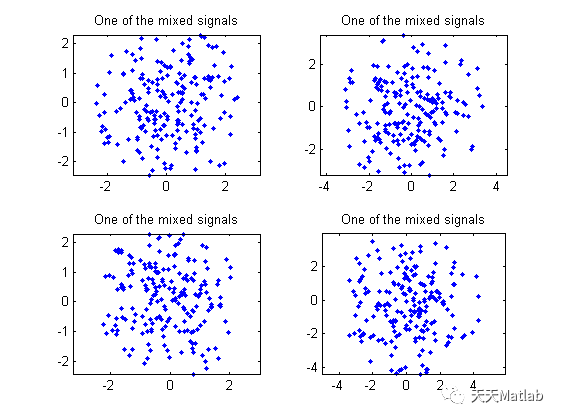
% This code is just a front-end to source separation algorithms.% Purpose:% 1) generate synthetic data% 2) call some source separation algorithm% 3) display the results% The data are CM (constant modulus signals and QAM4.% The mixing matrix is randomly generated.% Comments, bug reports, info requests are appreciated% and should be directed to cardoso@sig.enst.fr (Jean-Francois Cardoso)% Author : Jean-Francois Cardoso CNRS URA 820 / GdR TdSI / Telecom Paris%=======================================================================clear;close all;clc;N = 4 ; % N = number of sensors (add the relevant lines in S= ...)M = 3 ; % M = number of sourcesT = 200 ; % sample sizeNdB = -15 ; % kind of noise level in dB%----------------------------------------------------------------------------disp('Each of the following plots shows the COMPLEX PLANE.')disp('Each point is a sample of a source signal, of a sensor output')disp('or a separated signal as indicated.')while 1disp('____________________________________________________________');% the source signalsS= [ ...exp(2*i*pi*rand(1,T)) ; % constant modulus random phaseexp(2*i*pi*rand(1,T)) ; % constant modulus random phase(2*fix(2*rand(1,T))-1+i*(2*fix(2*rand(1,T))-1))/sqrt(2) ; % QAM4];% random mixing matrixA=randn(N,M)+j*randn(N,M);disp('Mixing matrix');disp(A);subplot(1,1,1);for is=1:M,subplot(2,2,is);plot(S(is,:),'.');title('One of the source signals');axis('square'); axis('equal'); axis([-2 2 -2 2]);end;fprintf('\nStrike any key to mix\n');pause;% mixing and noisingnoiseamp = 10^(NdB/20)/sqrt(2) ; % (the sqrt(2) accounts for real+imaginary powers)X= A*S + noiseamp*(randn(N,T)+i*randn(N,T));for is=1:min([ N 4]),subplot(2,2,is);plot(X(is,:),'.');title('One of the mixed signals');axis('square');axis('equal');%axis([-2 2 -2 2]);end;fprintf('\nStrike any key to unmix\n');pause;% Separationfprintf('\nIdentification running ......\n');[Ae,Se]=jade(X,M);for is=1:M,subplot(2,2,is);plot(Se(is,:),'.');title('One of the separated signals');axis('square');axis('equal');axis([-2 2 -2 2]);end;% Performancedisp('Performance:');disp('The global (sepration*mixing) matrix should be close to a permutation');disp('The following shows its squared entries (rejection levels)');disp(abs(pinv(Ae)*A).^2);fprintf('\nStrike any key for a different mixture\n');pause;end; %endless loop
function [A,S]=jade(X,m)% Source separation of complex signals with JADE.% Jade performs `Source Separation' in the following sense:% X is an n x T data matrix assumed modelled as X = A S + N where%% o A is an unknown n x m matrix with full rank.% o S is a m x T data matrix (source signals) with the properties% a) for each t, the components of S(:,t) are statistically% independent% b) for each p, the S(p,:) is the realization of a zero-mean% `source signal'.% c) At most one of these processes has a vanishing 4th-order% cumulant.% o N is a n x T matrix. It is a realization of a spatially white% Gaussian noise, i.e. Cov(X) = sigma*eye(n) with unknown variance% sigma. This is probably better than no modeling at all...%% Jade performs source separation via a% Joint Approximate Diagonalization of Eigen-matrices.%% THIS VERSION ASSUMES ZERO-MEAN SIGNALS%% Input :% * X: Each column of X is a sample from the n sensors% * m: m is an optional argument for the number of sources.% If ommited, JADE assumes as many sources as sensors.%% Output :% * A is an n x m estimate of the mixing matrix% * S is an m x T naive (ie pinv(A)*X) estimate of the source signals%%% Version 1.5. Copyright: JF Cardoso.%% See notes, references and revision history at the bottom of this file[n,T] = size(X);%% source detection not implemented yet !if nargin==1, m=n ; end;%%%%%%%%%%%%%%%%%%%%%%%%%%%%%%%%%%%%%%%%%%%%%%%%%%%%%%%%%%%%%%%%% A few parameters that could be adjustednem = m; % number of eigen-matrices to be diagonalizedseuil = 1/sqrt(T)/100;% a statistical threshold for stopping joint diag%%%%%%%%%%%%%%%%%%%%%%%%%%%%%%%%%%%%%%%%%%%%%%%%%%%%%%%%%%%%%%%%%%% whitening%if m<n, %assumes white noise[U,D] = eig((X*X')/T);[puiss,k]=sort(diag(D));ibl = sqrt(puiss(n-m+1:n)-mean(puiss(1:n-m)));bl = ones(m,1) ./ ibl ;W = diag(bl)*U(1:n,k(n-m+1:n))';IW = U(1:n,k(n-m+1:n))*diag(ibl);else %assumes no noiseIW = sqrtm((X*X')/T);W = inv(IW);end;Y = W*X;%%%%%%%%%%%%%%%%%%%%%%%%%%%%%%%%%%%%%%%%%%%%%%%%%%%%%%%%%%%%%%%%%%% Cumulant estimationR = (Y*Y' )/T ;C = (Y*Y.')/T ;Yl = zeros(1,T);Ykl = zeros(1,T);Yjkl = zeros(1,T);Q = zeros(m*m*m*m,1) ;index = 1;for lx = 1:m ; Yl = Y(lx,:);for kx = 1:m ; Ykl = Yl.*conj(Y(kx,:));for jx = 1:m ; Yjkl = Ykl.*conj(Y(jx,:));for ix = 1:m ;Q(index) = ...(Yjkl * Y(ix,:).')/T - R(ix,jx)*R(lx,kx) - R(ix,kx)*R(lx,jx) - C(ix,lx)*conj(C(jx,kx)) ;index = index + 1 ;end ;end ;end ;end%% If you prefer to use more memory and less CPU, you may prefer this%% code (due to J. Galy of ENSICA) for the estimation the cumulants%ones_m = ones(m,1) ;%T1 = kron(ones_m,Y);%T2 = kron(Y,ones_m);%TT = (T1.* conj(T2)) ;%TS = (T1 * T2.')/T ;%R = (Y*Y')/T ;%Q = (TT*TT')/T - kron(R,ones(m)).*kron(ones(m),conj(R)) - R(:)*R(:)' - TS.*TS' ;%%%%%%%%%%%%%%%%%%%%%%%%%%%%%%%%%%%%%%%%%%%%%%%%%%%%%%%%%%%%%%%%%%%%computation and reshaping of the significant eigen matrices[U,D] = eig(reshape(Q,m*m,m*m));[la,K] = sort(abs(diag(D)));%% reshaping the most (there are `nem' of them) significant eigenmatriceM = zeros(m,nem*m); % array to hold the significant eigen-matricesZ = zeros(m) ; % bufferh = m*m;for u=1:m:nem*m,Z(:) = U(:,K(h));M(:,u:u+m-1) = la(h)*Z;h = h-1;end;%%%%%%%%%%%%%%%%%%%%%%%%%%%%%%%%%%%%%%%%%%%%%%%%%%%%%%%%%%%%%%%%%%% joint approximate diagonalization of the eigen-matrices%% Better declare the variables used in the loop :B = [ 1 0 0 ; 0 1 1 ; 0 -i i ] ;Bt = B' ;Ip = zeros(1,nem) ;Iq = zeros(1,nem) ;g = zeros(3,nem) ;G = zeros(2,2) ;vcp = zeros(3,3);D = zeros(3,3);la = zeros(3,1);K = zeros(3,3);angles = zeros(3,1);pair = zeros(1,2);c = 0 ;s = 0 ;%init;encore = 1;V = eye(m);% Main loopwhile encore, encore=0;for p=1:m-1,for q=p+1:m,Ip = p:m:nem*m ;Iq = q:m:nem*m ;% Computing the Givens anglesg = [ M(p,Ip)-M(q,Iq) ; M(p,Iq) ; M(q,Ip) ] ;[vcp,D] = eig(real(B*(g*g')*Bt));[la, K] = sort(diag(D));angles = vcp(:,K(3));if angles(1)<0 , angles= -angles ; end ;c = sqrt(0.5+angles(1)/2);s = 0.5*(angles(2)-j*angles(3))/c;if abs(s)>seuil, %%% updates matrices M and V by a Givens rotationencore = 1 ;pair = [p;q] ;G = [ c -conj(s) ; s c ] ;V(:,pair) = V(:,pair)*G ;M(pair,:) = G' * M(pair,:) ;M(:,[Ip Iq]) = [ c*M(:,Ip)+s*M(:,Iq) -conj(s)*M(:,Ip)+c*M(:,Iq) ] ;end%% ifend%% q loopend%% p loopend%% while%%%estimation of the mixing matrix and signal separationA = IW*V;S = V'*Y ;return ;%%%%%%%%%%%%%%%%%%%%%%%%%%%%%%%%%%%%%%%%%%%%%%%%%%%%%%%%%%%%%%%%%%%%%%%%%%%%%%%%%% Note 1: This version does *not* assume circularly distributed% signals as 1.1 did. The difference only entails more computations% in estimating the cumulants%%% Note 2: This code tries to minimize the work load by jointly% diagonalizing only the m most significant eigenmatrices of the% cumulant tensor. When the model holds, this avoids the% diagonalization of m^2 matrices. However, when the model does not% hold, there is in general more than m significant eigen-matrices.% In this case, this code still `works' but is no longer equivalent to% the minimization of a well defined contrast function: this would% require the diagonalization of *all* the eigen-matrices. We note% (see the companion paper) that diagonalizing **all** the% eigen-matrices is strictly equivalent to diagonalize all the% `parallel cumulants slices'. In other words, when the model does% not hold, it could be a good idea to diagonalize all the parallel% cumulant slices. The joint diagonalization will require about m% times more operations, but on the other hand, computation of the% eigen-matrices is avoided. Such an approach makes sense when% dealing with a relatively small number of sources (say smaller than% 10).%%% Revision history%-----------------%% Version 1.5 (Nov. 2, 97) :% o Added the option kindly provided by Jerome Galy% (galy@dirac.ensica.fr) to compute the sample cumulant tensor.% This option uses more memory but is faster (a similar piece of% code was also passed to me by Sandip Bose).% o Suppressed the useles variable `oui'.% o Changed (angles=sign(angles(1))*angles) to (if angles(1)<0 ,% angles= -angles ; end ;) as suggested by Iain Collings% <i.collings@ee.mu.OZ.AU>. This is safer (with probability 0 in% the case of sample statistics)% o Cosmetic rewriting of the doc. Fixed some typos and added new% ones.%% Version 1.4 (Oct. 9, 97) : Changed the code for estimating% cumulants. The new version loops thru the sensor indices rather than% looping thru the time index. This is much faster for large sample% sizes. Also did some clean up. One can now change the number of% eigen-matrices to be jointly diagonalized by just changing the% variable `nem'. It is still hard coded below to be equal to the% number of sources. This is more economical and OK when the model% holds but not appropriate when the model does not hold (in which% case, the algorithm is no longer asymptotically equivalent to% minimizing a contrast function, unless nem is the square of the% number of sources.)%% Version 1.3 (Oct. 6, 97) : Added various Matalb tricks to speed up% things a bit. This is not very rewarding though, because the main% computational burden still is in estimating the 4th-order moments.%% Version 1.2 (Mar., Apr., Sept. 97) : Corrected some mistakes **in% the comments !!**, Added note 2 `When the model does not hold' and% the EUSIPCO reference.%% Version 1.1 (Feb. 94): Creation%%-------------------------------------------------------------------%% Contact JF Cardoso for any comment bug report,and UPDATED VERSIONS.% email : cardoso@sig.enst.fr% or check the WEB page http://sig.enst.fr/~cardoso/stuff.html%% Reference:% @article{CS_iee_94,% author = "Jean-Fran\c{c}ois Cardoso and Antoine Souloumiac",% journal = "IEE Proceedings-F",% title = "Blind beamforming for non {G}aussian signals",% number = "6",% volume = "140",% month = dec,% pages = {362-370},% year = "1993"}%%% Some analytical insights into the asymptotic performance of JADE are in% @inproceedings{PerfEusipco94,% HTML = "ftp://sig.enst.fr/pub/jfc/Papers/eusipco94_perf.ps.gz",% author = "Jean-Fran\c{c}ois Cardoso",% address = {Edinburgh},% booktitle = "{Proc. EUSIPCO}",% month = sep,% pages = "776--779",% title = "On the performance of orthogonal source separation algorithms",% year = 1994}%_________________________________________________________________________% jade.m ends here
⛄ 运行结果
⛄ 参考文献
[1] 王瑜, 李小波, 毛云翔,等. 基于JADE盲源分离算法的雷达信号研究[J]. 现代防御技术, 2017, 45(1):6.
[2] 郭晓乐, 邱炜, 李向阳,等. 基于JADE盲源分离的主瓣抗干扰算法研究[J]. 火控雷达技术, 2018, 47(4):5.
[3] 骆鹿, 王庆. JADE算法在盲信号分离中的应用[J]. 中国新技术新产品, 2010(4):2.
[4] 杨世锡, 焦卫东, 吴昭同. 应用JADE盲分离算法分离统计相关源[J]. 振动工程学报, 2003, 16(4):4.
⛳️ 代码获取关注我
❤️部分理论引用网络文献,若有侵权联系博主删除
❤️ 关注我领取海量matlab电子书和数学建模资料
版权声明:本文为matlab_dingdang原创文章,遵循CC 4.0 BY-SA版权协议,转载请附上原文出处链接和本声明。