1 表达式
F ( n ) = { 1 n = 0 , 1 F ( n − 1 ) + F ( n − 2 ) n > 1 F(n)=\begin{cases} 1& {n=0,1} \\ F(n-1)+F(n-2) & n>1\end{cases}F(n)={1F(n−1)+F(n−2)n=0,1n>1
2 代码
public static int fib(int n){
	if (n == 0 || n == 1) return 1;
	else{
		return fib(n-1) + fib(n-2);
	}
}
3 复杂度分析
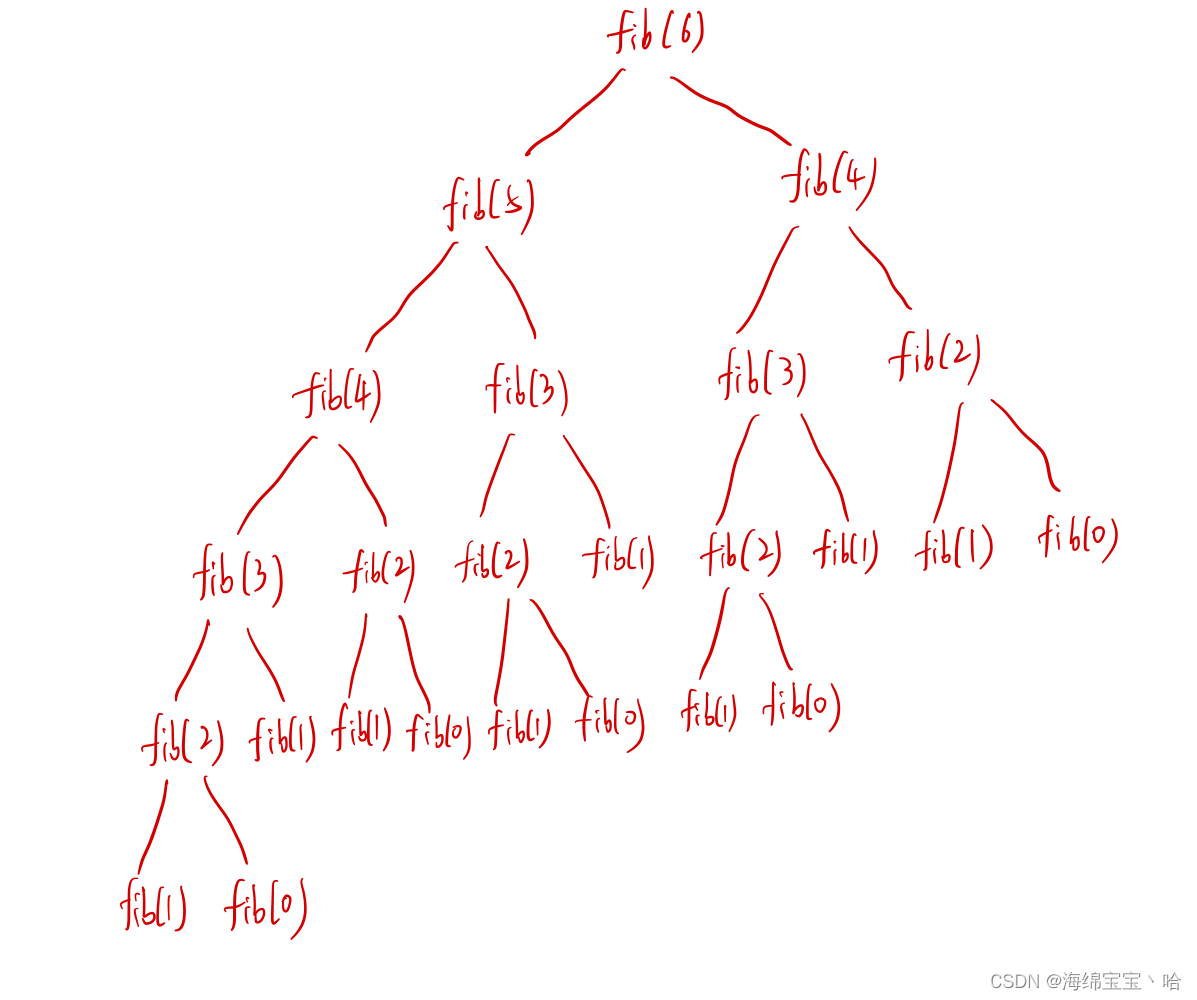
3.1 空间复杂度
- 每次调用函数都要一个空间来存储传进来的整数,并且函数运行完成并返回时,空间被释放,因此空间复杂度为树的深度n nn,即O ( n ) O(n)O(n)
3.2 时间复杂度
- 上图中时间复杂度相当于所有节点的个数,不是完全二叉树,但是还是指数级别的,因此时间复杂度为O ( 2 n ) O(2^n)O(2n)
3.3 问题
非递归时间复杂度和空间复杂度为多少?
代码:
public static int fib(int n){ int front=1; int behind=1; int temp; for(int i = 2;i <= n-1;i++){ temp = front + behind; front = behind; behind = temp; } return behind; }- 空间复杂度:由于程序运行中只用了有限个变量,且与问题规模n无关,所以空间复杂度为O ( 1 ) O(1)O(1)
- 时间复杂度:一层for循环,一共执行了n-2次,所以时间复杂度为O ( n ) O(n)O(n)
版权声明:本文为u012011912原创文章,遵循CC 4.0 BY-SA版权协议,转载请附上原文出处链接和本声明。