最小二乘法和正则化
高斯于1823年在误差e1 ,… , en独立同分布的假定下,证明了最小二乘方法的一个最优性质: 在所有无偏的线性估计类中,最小二乘方法是其中方差最小的!
使用最小二乘法拟和曲线
对于数据( x i , y i ) ( i = 1 , 2 , 3... , m ) (x_i, y_i)(i=1, 2, 3...,m)(xi,yi)(i=1,2,3...,m)
拟合出函数h ( x ) h(x)h(x)
有误差,即残差:r i = h ( x i ) − y i r_i=h(x_i)-y_iri=h(xi)−yi
此时L2范数(残差平方和)最小时,h(x) 和 y 相似度最高,更拟合
一般的H(x)为n次的多项式,H ( x ) = w 0 + w 1 x + w 2 x 2 + . . . w n x n H(x)=w_0+w_1x+w_2x^2+...w_nx^nH(x)=w0+w1x+w2x2+...wnxn
w ( w 0 , w 1 , w 2 , . . . , w n ) w(w_0,w_1,w_2,...,w_n)w(w0,w1,w2,...,wn)为参数
最小二乘法就是要找到一组 w ( w 0 , w 1 , w 2 , . . . , w n ) w(w_0,w_1,w_2,...,w_n)w(w0,w1,w2,...,wn) 使得∑ i = 1 n ( h ( x i ) − y i ) 2 \sum_{i=1}^n(h(x_i)-y_i)^2∑i=1n(h(xi)−yi)2 (残差平方和) 最小
即,求 m i n ∑ i = 1 n ( h ( x i ) − y i ) 2 min\sum_{i=1}^n(h(x_i)-y_i)^2min∑i=1n(h(xi)−yi)2
举例:我们用目标函数y = s i n 2 π x y=sin2{\pi}xy=sin2πx, 加上一个正太分布的噪音干扰,用多项式去拟合【例1.1 11页】
import numpy as np
import scipy as sp
from scipy.optimize import leastsq
import matplotlib.pyplot as plt
%matplotlib inline
ps: numpy.poly1d([1,2,3]) 生成 1 x 2 + 2 x 1 + 3 x 0 1x^2+2x^1+3x^01x2+2x1+3x0
# 目标函数
def real_func(x):
    return np.sin(2*np.pi*x)

# 多项式
def fit_func(p, x):
    f = np.poly1d(p)
    return f(x)

# 残差
def residuals_func(p, x, y): #p应该是初始参数,是多项式前面的系数a,b,c等
    ret = fit_func(p, x) - y
    return ret
# 十个点
x = np.linspace(0, 1, 10)
x_points = np.linspace(0, 1, 1000)
# 加上正态分布噪音的目标函数的值
y_ = real_func(x)
y = [np.random.normal(0, 0.1)+y1 for y1 in y_]

def fitting(M=0):
    """
    M    为 多项式的次数
    """
    # 随机初始化多项式参数
    p_init = np.random.rand(M+1)
    # 最小二乘法
    p_lsq = leastsq(residuals_func, p_init, args=(x, y))
    print('Fitting Parameters:', p_lsq[0])

    # 可视化
    plt.plot(x_points, real_func(x_points), label='real')
    plt.plot(x_points, fit_func(p_lsq[0], x_points), label='fitted curve')
    plt.plot(x, y, 'bo', label='noise')
    plt.legend()
    return p_lsq
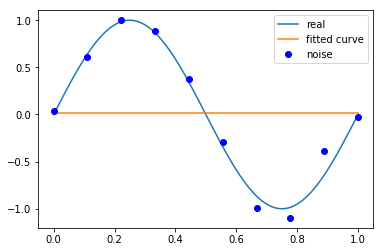
# M=0
p_lsq_0 = fitting(M=0)
Fitting Parameters: [0.01191424]
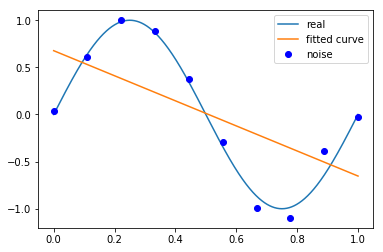
# M=1
p_lsq_1 = fitting(M=1)
Fitting Parameters: [-1.33036473 0.6770966 ]
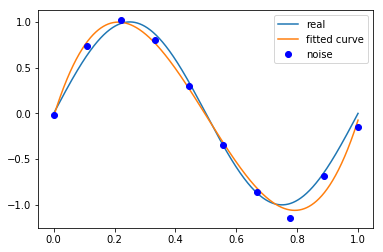
# M=3
p_lsq_3 = fitting(M=3)
Fitting Parameters: [ 21.14354912 -31.85091 10.66661731 -0.03324716]
# M=9
p_lsq_9 = fitting(M=9)
Fitting Parameters: [ 7.45555674e+03 -3.31796363e+04  6.14569910e+04 -6.14712518e+04
  3.59846685e+04 -1.24263822e+04  2.40975039e+03 -2.44841906e+02
  1.50820818e+01  4.16353905e-02]
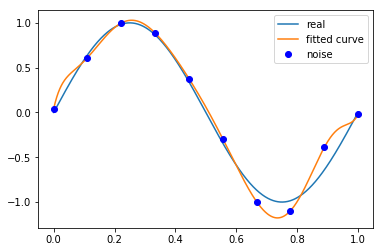
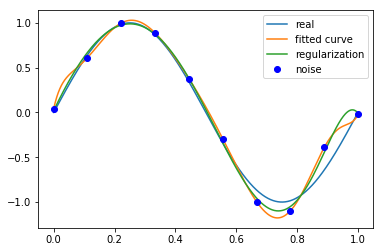
当M=9时,多项式曲线通过了每个数据点,但是造成了过拟合
正则化
结果显示过拟合, 引入正则化项(regularizer),降低过拟合
Q ( x ) = ∑ i = 1 n ( h ( x i ) − y i ) 2 + λ ∣ ∣ w ∣ ∣ 2 Q(x)=\sum_{i=1}^n(h(x_i)-y_i)^2+\lambda||w||^2Q(x)=∑i=1n(h(xi)−yi)2+λ∣∣w∣∣2。
回归问题中,损失函数是平方损失,正则化可以是参数向量的L2范数,也可以是L1范数。
L1: regularization*abs§
L2: 0.5 * regularization * np.square§
regularization = 0.0001

def residuals_func_regularization(p, x, y):
    ret = residuals_func(p, x, y)
    ret = np.append(ret, np.sqrt(0.5*regularization*np.square(p))) # L2范数作为正则化项
    return ret
# 最小二乘法,加正则化项
p_init = np.random.rand(9+1)
p_lsq_regularization = leastsq(residuals_func_regularization, p_init, args=(x, y))
plt.plot(x_points, real_func(x_points), label='real')
plt.plot(x_points, fit_func(p_lsq_9[0], x_points), label='fitted curve')
plt.plot(x_points, fit_func(p_lsq_regularization[0], x_points), label='regularization')
plt.plot(x, y, 'bo', label='noise')
plt.legend()
<matplotlib.legend.Legend at 0x22e88ece9b0>
原文代码作者:https://github.com/wzyonggege/statistical-learning-method
中文注释制作:机器学习初学者