Rust 中级教程 第5课——trait(3)
0x00 开篇
看到这里,我想大家应该对 trait 都有了初步的了解了。本篇文章将向大家介绍下在 Rust 标准库中常用和常见的一些 trait。
0x01 derive
在介绍常用 trait 前,我们先了解下 Derive, Derive 我们常翻译为“派生”。在 Rust 中,有 #[derive] 这样一个属性,通过这个属性,编译器能够提供某些 trait 的基本实现。当然如果在实际开发中需要更复杂的行为,这些 trait 也可以手动实现。
0x02 Debug
源码:
#[doc(alias = "{:?}")]
#[rustc_diagnostic_item = "Debug"]
#[rustc_trivial_field_reads]
pub trait Debug {
    fn fmt(&self, f: &mut Formatter<'_>) -> Result;
}
Debug 是可以与 derive 属性一起使用的。官方提供了默认 {:?} 的实现。在结构体的文章中,我们曾用过这个属性。相对于结构体等一些类型的实例,我们是无法直接通过 println("{:?}")或者 dbg() 打印它们的。这时我们可以为其类型加上 #[derive(Debug)] 属性。
示例代码:
#[derive(Debug)]
struct Rectangle {
    width: u32,
    height: u32,
}

fn main() {
    // 1、Debug
    let rec1 = Rectangle {
        width: 3,
        height: 5,
    };
    println!("{:?}", rec1);

    let rec2 = Rectangle {
        width: 6,
        height: 4,
    };
    dbg!(rec2);
}
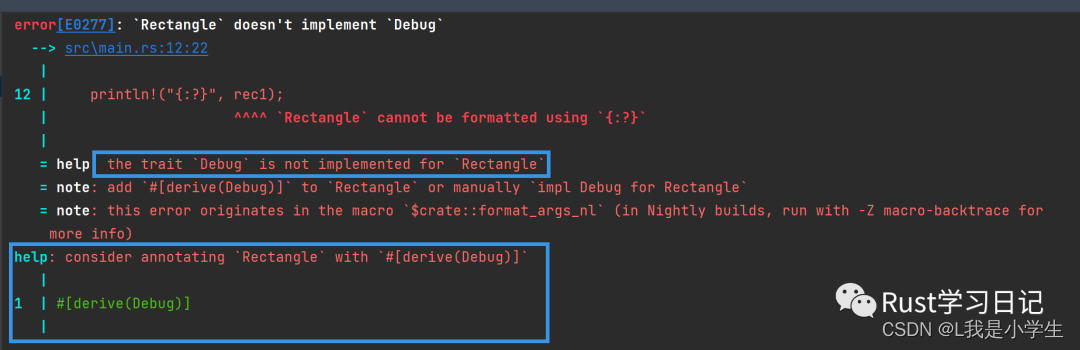
如果我们在打印时,不加 #[derive(Debug)] 属性。则编译器会提示错误the trait Debug is not implemented for Rectangle,并且建议添加 #[derive(Debug)]。

0x00 开篇
看到这里,我想大家应该对 trait 都有了初步的了解了。本篇文章将向大家介绍下在 Rust 标准库中常用和常见的一些 trait。
0x01 derive
在介绍常用 trait 前,我们先了解下 Derive, Derive 我们常翻译为“派生”。在 Rust 中,有 #[derive] 这样一个属性,通过这个属性,编译器能够提供某些 trait 的基本实现。当然如果在实际开发中需要更复杂的行为,这些 trait 也可以手动实现。
0x02 Debug
源码:
#[doc(alias = "{:?}")]
#[rustc_diagnostic_item = "Debug"]
#[rustc_trivial_field_reads]
pub trait Debug {
    fn fmt(&self, f: &mut Formatter<'_>) -> Result;
}
Debug 是可以与 derive 属性一起使用的。官方提供了默认 {:?} 的实现。在结构体的文章中,我们曾用过这个属性。相对于结构体等一些类型的实例,我们是无法直接通过 println("{:?}")或者 dbg() 打印它们的。这时我们可以为其类型加上 #[derive(Debug)] 属性。
示例代码:
#[derive(Debug)]
struct Rectangle {
    width: u32,
    height: u32,
}

fn main() {
    // 1、Debug
    let rec1 = Rectangle {
        width: 3,
        height: 5,
    };
    println!("{:?}", rec1);

    let rec2 = Rectangle {
        width: 6,
        height: 4,
    };
    dbg!(rec2);
}
如果我们在打印时,不加 #[derive(Debug)] 属性。则编译器会提示错误the trait Debug is not implemented for Rectangle,并且建议添加 #[derive(Debug)]。
[外链图片转存失败,源站可能有防盗链机制,建议将图片保存下来直接上传(img-JpN9Fuww-1663479871750)(## Rust 中级教程 第5课——trait(3)
0x00 开篇
看到这里,我想大家应该对 trait 都有了初步的了解了。本篇文章将向大家介绍下在 Rust 标准库中常用和常见的一些 trait。
0x01 derive
在介绍常用 trait 前,我们先了解下 Derive, Derive 我们常翻译为“派生”。在 Rust 中,有 #[derive] 这样一个属性,通过这个属性,编译器能够提供某些 trait 的基本实现。当然如果在实际开发中需要更复杂的行为,这些 trait 也可以手动实现。
0x02 Debug
源码:
#[doc(alias = "{:?}")]
#[rustc_diagnostic_item = "Debug"]
#[rustc_trivial_field_reads]
pub trait Debug {
    fn fmt(&self, f: &mut Formatter<'_>) -> Result;
}
Debug 是可以与 derive 属性一起使用的。官方提供了默认 {:?} 的实现。在结构体的文章中,我们曾用过这个属性。相对于结构体等一些类型的实例,我们是无法直接通过 println("{:?}")或者 dbg() 打印它们的。这时我们可以为其类型加上 #[derive(Debug)] 属性。
示例代码:
#[derive(Debug)]
struct Rectangle {
    width: u32,
    height: u32,
}

fn main() {
    // 1、Debug
    let rec1 = Rectangle {
        width: 3,
        height: 5,
    };
    println!("{:?}", rec1);

    let rec2 = Rectangle {
        width: 6,
        height: 4,
    };
    dbg!(rec2);
}
如果我们在打印时,不加 #[derive(Debug)] 属性。则编译器会提示错误the trait Debug is not implemented for Rectangle,并且建议添加 #[derive(Debug)]。
可以说 Debug trait 方便了我们的调试。
0x03 Eq 和 PartialEq
Eq 是 Equal 的缩写,即这两个是判断是否相等的 trait。他们同样可以与 derive 连用。
源码:
pub trait PartialEq<Rhs: ?Sized = Self> {
    fn eq(&self, other: &Rhs) -> bool;

    fn ne(&self, other: &Rhs) -> bool {
        !self.eq(other)
    }
}

pub trait Eq: PartialEq<Self> {
    fn assert_receiver_is_total_eq(&self) {}
}
如果我们想比较某个类型的两个值 a 和 b是否相等,那么我们就必须为类型实现 PartialEq Trait。可以看到 Eq 和 PartialEq 是父子关系。要实现 Eq 必须在实现 PartialEq 的基础上实现。 Eq 和 PartialEq 来自于抽象代数中的等价关系和局部等价关系。两个都满足了对称性(即 a == b 可以推出 b == a)和传递性(即a == b 和 b == c 可以推出 a == c)。Eq 还需要满足自反性(即 a == a)。在 Rust 中,浮点数类型两个 NAN 是不相等的。Rust 只为其实现了PartialEq。下面是官方源码(来自cmp.rs):
partial_eq_impl! {
        bool char usize u8 u16 u32 u64 u128 isize i8 i16 i32 i64 i128 f32 f64
}
eq_impl! { () bool char usize u8 u16 u32 u64 u128 isize i8 i16 i32 i64 i128 }
我们自己实现 PartialEq 来判断两个三角形是否相似。
// 三角形
struct Triangle {
    a: f64,
    b: f64,
    c: f64,
}

// 自己实现 PartialEq
// 判断三角形相似
impl PartialEq for Triangle {
    fn eq(&self, other: &Self) -> bool {
        let x = self.a / other.a;
        let y = self.b / other.b;
        let z = self.c / other.c;
        return x == y && x == z && y == z;
    }

    fn ne(&self, other: &Self) -> bool {
        return !eq(self, other);
    }
}

fn main() {
    // 相似三角形
    let tri1 = Triangle { a: 3.0, b: 4.0, c: 5.0 };
    let tri2 = Triangle { a: 6.0, b: 8.0, c: 10.0 };
    println!("tri1 和 tri2 相似 ? {}", tri1 == tri2);

    // 运行结果
    // tri1 和 tri2 相似 ? true
}
当然也可以通过 derive 来默认实现结构体的比较。
#[derive(PartialEq)]
struct Rectangle {
    width: u32,
    height: u32,
}

fn main() {
    let rec1 = Rectangle {
        width: 3,
        height: 5,
    };

    let rec2 = Rectangle {
        width: 3,
        height: 5,
    };
    println!("rec1 == rec2 ? {}", rec1 == rec2);
	// 运行结果
    // rec1 == rec2 ? true
}
0x04 Ord 和 PartialOrd
Ord 是 Order 的缩写,即这两个是判断是全序关系的 trait。他们同样可以与 derive 连用。全序关系是指集合内的任何一对元素都是相互可以比较的。Ord 和 PartialOrd 的使用方法同 Eq 和 PartialEq 类似。但是有两个依赖要求,PartialOrd 必须要求类型实现 PartialEq 和 Ord 必须要求类型实现 PartialOrd 和 Eq 。 Ord 中还提供了 max 和 min 方法,更加方便进行比较。
源码:
pub trait PartialOrd<Rhs: ?Sized = Self>: PartialEq<Rhs> {

    fn partial_cmp(&self, other: &Rhs) -> Option<Ordering>;


    fn lt(&self, other: &Rhs) -> bool {
        matches!(self.partial_cmp(other), Some(Less))
    }

    fn le(&self, other: &Rhs) -> bool {
        !matches!(self.partial_cmp(other), None | Some(Greater))
    }

    fn gt(&self, other: &Rhs) -> bool {
        matches!(self.partial_cmp(other), Some(Greater))
    }

    fn ge(&self, other: &Rhs) -> bool {
        matches!(self.partial_cmp(other), Some(Greater | Equal))
    }
}

pub trait Ord: Eq + PartialOrd<Self> {

    fn cmp(&self, other: &Self) -> Ordering;

    fn max(self, other: Self) -> Self
    where
        Self: Sized,
    {
        max_by(self, other, Ord::cmp)
    }


    fn min(self, other: Self) -> Self
    where
        Self: Sized,
    {
        min_by(self, other, Ord::cmp)
    }

    fn clamp(self, min: Self, max: Self) -> Self
    where
        Self: Sized,
    {
        assert!(min <= max);
        if self < min {
            min
        } else if self > max {
            max
        } else {
            self
        }
    }
}
通过derive 为结构体类型添加可以比较的属性。示例代码:
#[derive(PartialEq)]
#[derive(PartialOrd)]
struct Rectangle {
    width: u32,
    height: u32,
}

fn main() {
    let rec1 = Rectangle {
        width: 1,
        height: 5,
    };

    let rec2 = Rectangle {
        width: 3,
        height: 5,
    };
    println!("rec1 > rec2 ? {}", rec1 > rec2);
}
自定义 PartialOrd 的代码我就不贴了。 自定义 PartialOrd 时,需要实现 partial_cmp 方法。示例:有一种物体比较大小取决于价格,它的价格越低就越大。
// 货物
#[derive(PartialEq)]
struct Good {
    price: f64,
}

impl PartialOrd for Good {
    fn partial_cmp(&self, other: &Self) -> Option<Ordering> {
        // 要求价格低的反而大
        return if self.price < other.price {
            Some(Ordering::Greater)
        } else if self.price > other.price {
            Some(Less)
        } else {
            Some(Ordering::Equal)
        };
    }
}

fn main() {
        let good1 = Good {
        price: 1.0
    };

    let good2 = Good {
        price: 2.0
    };
    println!("good1 > good1 ? {}", good1 > good2);
}
// 运行结果
// good1 > good2 ? true
partial_cmp 方法返回值是 Option<Ordering> 类型,这里需要注意下(有关Option类型相关的知识点请前往 Rust 中级教程 第1课)。Option 类型包含一个 Ordering 枚举。如果返回 Greater 表示当前值比相比较的另一个值大,Less 表示当前值比相比较的另一个值小,Equal 则表示相等。
Ordering 官方源码(来自cmp.rs):
pub enum Ordering {
    /// An ordering where a compared value is less than another.
    #[stable(feature = "rust1", since = "1.0.0")]
    Less = -1,
    /// An ordering where a compared value is equal to another.
    #[stable(feature = "rust1", since = "1.0.0")]
    Equal = 0,
    /// An ordering where a compared value is greater than another.
    #[stable(feature = "rust1", since = "1.0.0")]
    Greater = 1,
}
0x05 小结
本篇文章结合官方源码介绍一些比较常见且可以使用 derive 属性一起使用的 trait。由于篇幅有限,下一篇文章则还会继续了解一些常用的 trait,以及使用derive属性时编译器做了什么。另外,所有源码我也迁移到了 github 上面,在之后 github 和 gitee 的源码将同步更新。
0x06 源码)]
可以说 Debug trait 方便了我们的调试。
0x03 Eq 和 PartialEq
Eq 是 Equal 的缩写,即这两个是判断是否相等的 trait。他们同样可以与 derive 连用。
源码:
pub trait PartialEq<Rhs: ?Sized = Self> {
    fn eq(&self, other: &Rhs) -> bool;

    fn ne(&self, other: &Rhs) -> bool {
        !self.eq(other)
    }
}

pub trait Eq: PartialEq<Self> {
    fn assert_receiver_is_total_eq(&self) {}
}
如果我们想比较某个类型的两个值 a 和 b是否相等,那么我们就必须为类型实现 PartialEq Trait。可以看到 Eq 和 PartialEq 是父子关系。要实现 Eq 必须在实现 PartialEq 的基础上实现。 Eq 和 PartialEq 来自于抽象代数中的等价关系和局部等价关系。两个都满足了对称性(即 a == b 可以推出 b == a)和传递性(即a == b 和 b == c 可以推出 a == c)。Eq 还需要满足自反性(即 a == a)。在 Rust 中,浮点数类型两个 NAN 是不相等的。Rust 只为其实现了PartialEq。下面是官方源码(来自cmp.rs):
partial_eq_impl! {
        bool char usize u8 u16 u32 u64 u128 isize i8 i16 i32 i64 i128 f32 f64
}
eq_impl! { () bool char usize u8 u16 u32 u64 u128 isize i8 i16 i32 i64 i128 }
我们自己实现 PartialEq 来判断两个三角形是否相似。
// 三角形
struct Triangle {
    a: f64,
    b: f64,
    c: f64,
}

// 自己实现 PartialEq
// 判断三角形相似
impl PartialEq for Triangle {
    fn eq(&self, other: &Self) -> bool {
        let x = self.a / other.a;
        let y = self.b / other.b;
        let z = self.c / other.c;
        return x == y && x == z && y == z;
    }

    fn ne(&self, other: &Self) -> bool {
        return !eq(self, other);
    }
}

fn main() {
    // 相似三角形
    let tri1 = Triangle { a: 3.0, b: 4.0, c: 5.0 };
    let tri2 = Triangle { a: 6.0, b: 8.0, c: 10.0 };
    println!("tri1 和 tri2 相似 ? {}", tri1 == tri2);

    // 运行结果
    // tri1 和 tri2 相似 ? true
}
当然也可以通过 derive 来默认实现结构体的比较。
#[derive(PartialEq)]
struct Rectangle {
    width: u32,
    height: u32,
}

fn main() {
    let rec1 = Rectangle {
        width: 3,
        height: 5,
    };

    let rec2 = Rectangle {
        width: 3,
        height: 5,
    };
    println!("rec1 == rec2 ? {}", rec1 == rec2);
	// 运行结果
    // rec1 == rec2 ? true
}
0x04 Ord 和 PartialOrd
Ord 是 Order 的缩写,即这两个是判断是全序关系的 trait。他们同样可以与 derive 连用。全序关系是指集合内的任何一对元素都是相互可以比较的。Ord 和 PartialOrd 的使用方法同 Eq 和 PartialEq 类似。但是有两个依赖要求,PartialOrd 必须要求类型实现 PartialEq 和 Ord 必须要求类型实现 PartialOrd 和 Eq 。 Ord 中还提供了 max 和 min 方法,更加方便进行比较。
源码:
pub trait PartialOrd<Rhs: ?Sized = Self>: PartialEq<Rhs> {

    fn partial_cmp(&self, other: &Rhs) -> Option<Ordering>;


    fn lt(&self, other: &Rhs) -> bool {
        matches!(self.partial_cmp(other), Some(Less))
    }

    fn le(&self, other: &Rhs) -> bool {
        !matches!(self.partial_cmp(other), None | Some(Greater))
    }

    fn gt(&self, other: &Rhs) -> bool {
        matches!(self.partial_cmp(other), Some(Greater))
    }

    fn ge(&self, other: &Rhs) -> bool {
        matches!(self.partial_cmp(other), Some(Greater | Equal))
    }
}

pub trait Ord: Eq + PartialOrd<Self> {

    fn cmp(&self, other: &Self) -> Ordering;

    fn max(self, other: Self) -> Self
    where
        Self: Sized,
    {
        max_by(self, other, Ord::cmp)
    }


    fn min(self, other: Self) -> Self
    where
        Self: Sized,
    {
        min_by(self, other, Ord::cmp)
    }

    fn clamp(self, min: Self, max: Self) -> Self
    where
        Self: Sized,
    {
        assert!(min <= max);
        if self < min {
            min
        } else if self > max {
            max
        } else {
            self
        }
    }
}
通过derive 为结构体类型添加可以比较的属性。示例代码:
#[derive(PartialEq)]
#[derive(PartialOrd)]
struct Rectangle {
    width: u32,
    height: u32,
}

fn main() {
    let rec1 = Rectangle {
        width: 1,
        height: 5,
    };

    let rec2 = Rectangle {
        width: 3,
        height: 5,
    };
    println!("rec1 > rec2 ? {}", rec1 > rec2);
}
自定义 PartialOrd 的代码我就不贴了。 自定义 PartialOrd 时,需要实现 partial_cmp 方法。示例:有一种物体比较大小取决于价格,它的价格越低就越大。
// 货物
#[derive(PartialEq)]
struct Good {
    price: f64,
}

impl PartialOrd for Good {
    fn partial_cmp(&self, other: &Self) -> Option<Ordering> {
        // 要求价格低的反而大
        return if self.price < other.price {
            Some(Ordering::Greater)
        } else if self.price > other.price {
            Some(Less)
        } else {
            Some(Ordering::Equal)
        };
    }
}

fn main() {
        let good1 = Good {
        price: 1.0
    };

    let good2 = Good {
        price: 2.0
    };
    println!("good1 > good1 ? {}", good1 > good2);
}
// 运行结果
// good1 > good2 ? true
partial_cmp 方法返回值是 Option<Ordering> 类型,这里需要注意下(有关Option类型相关的知识点请前往 Rust 中级教程 第1课)。Option 类型包含一个 Ordering 枚举。如果返回 Greater 表示当前值比相比较的另一个值大,Less 表示当前值比相比较的另一个值小,Equal 则表示相等。
Ordering 官方源码(来自cmp.rs):
pub enum Ordering {
    /// An ordering where a compared value is less than another.
    #[stable(feature = "rust1", since = "1.0.0")]
    Less = -1,
    /// An ordering where a compared value is equal to another.
    #[stable(feature = "rust1", since = "1.0.0")]
    Equal = 0,
    /// An ordering where a compared value is greater than another.
    #[stable(feature = "rust1", since = "1.0.0")]
    Greater = 1,
}
0x05 小结
本篇文章结合官方源码介绍一些比较常见且可以使用 derive 属性一起使用的 trait。由于篇幅有限,下一篇文章则还会继续了解一些常用的 trait,以及使用derive属性时编译器做了什么。另外,所有源码我也迁移到了 github 上面,在之后 github 和 gitee 的源码将同步更新。
0x06 源码)
可以说 Debug trait 方便了我们的调试。
0x03 Eq 和 PartialEq
Eq 是 Equal 的缩写,即这两个是判断是否相等的 trait。他们同样可以与 derive 连用。
源码:
pub trait PartialEq<Rhs: ?Sized = Self> {
    fn eq(&self, other: &Rhs) -> bool;

    fn ne(&self, other: &Rhs) -> bool {
        !self.eq(other)
    }
}

pub trait Eq: PartialEq<Self> {
    fn assert_receiver_is_total_eq(&self) {}
}
如果我们想比较某个类型的两个值 a 和 b是否相等,那么我们就必须为类型实现 PartialEq Trait。可以看到 Eq 和 PartialEq 是父子关系。要实现 Eq 必须在实现 PartialEq 的基础上实现。 Eq 和 PartialEq 来自于抽象代数中的等价关系和局部等价关系。两个都满足了对称性(即 a == b 可以推出 b == a)和传递性(即a == b 和 b == c 可以推出 a == c)。Eq 还需要满足自反性(即 a == a)。在 Rust 中,浮点数类型两个 NAN 是不相等的。Rust 只为其实现了PartialEq。下面是官方源码(来自cmp.rs):
partial_eq_impl! {
        bool char usize u8 u16 u32 u64 u128 isize i8 i16 i32 i64 i128 f32 f64
}
eq_impl! { () bool char usize u8 u16 u32 u64 u128 isize i8 i16 i32 i64 i128 }
我们自己实现 PartialEq 来判断两个三角形是否相似。
// 三角形
struct Triangle {
    a: f64,
    b: f64,
    c: f64,
}

// 自己实现 PartialEq
// 判断三角形相似
impl PartialEq for Triangle {
    fn eq(&self, other: &Self) -> bool {
        let x = self.a / other.a;
        let y = self.b / other.b;
        let z = self.c / other.c;
        return x == y && x == z && y == z;
    }

    fn ne(&self, other: &Self) -> bool {
        return !eq(self, other);
    }
}

fn main() {
    // 相似三角形
    let tri1 = Triangle { a: 3.0, b: 4.0, c: 5.0 };
    let tri2 = Triangle { a: 6.0, b: 8.0, c: 10.0 };
    println!("tri1 和 tri2 相似 ? {}", tri1 == tri2);

    // 运行结果
    // tri1 和 tri2 相似 ? true
}
当然也可以通过 derive 来默认实现结构体的比较。
#[derive(PartialEq)]
struct Rectangle {
    width: u32,
    height: u32,
}

fn main() {
    let rec1 = Rectangle {
        width: 3,
        height: 5,
    };

    let rec2 = Rectangle {
        width: 3,
        height: 5,
    };
    println!("rec1 == rec2 ? {}", rec1 == rec2);
	// 运行结果
    // rec1 == rec2 ? true
}
0x04 Ord 和 PartialOrd
Ord 是 Order 的缩写,即这两个是判断是全序关系的 trait。他们同样可以与 derive 连用。全序关系是指集合内的任何一对元素都是相互可以比较的。Ord 和 PartialOrd 的使用方法同 Eq 和 PartialEq 类似。但是有两个依赖要求,PartialOrd 必须要求类型实现 PartialEq 和 Ord 必须要求类型实现 PartialOrd 和 Eq 。 Ord 中还提供了 max 和 min 方法,更加方便进行比较。
源码:
pub trait PartialOrd<Rhs: ?Sized = Self>: PartialEq<Rhs> {

    fn partial_cmp(&self, other: &Rhs) -> Option<Ordering>;


    fn lt(&self, other: &Rhs) -> bool {
        matches!(self.partial_cmp(other), Some(Less))
    }

    fn le(&self, other: &Rhs) -> bool {
        !matches!(self.partial_cmp(other), None | Some(Greater))
    }

    fn gt(&self, other: &Rhs) -> bool {
        matches!(self.partial_cmp(other), Some(Greater))
    }

    fn ge(&self, other: &Rhs) -> bool {
        matches!(self.partial_cmp(other), Some(Greater | Equal))
    }
}

pub trait Ord: Eq + PartialOrd<Self> {

    fn cmp(&self, other: &Self) -> Ordering;

    fn max(self, other: Self) -> Self
    where
        Self: Sized,
    {
        max_by(self, other, Ord::cmp)
    }


    fn min(self, other: Self) -> Self
    where
        Self: Sized,
    {
        min_by(self, other, Ord::cmp)
    }

    fn clamp(self, min: Self, max: Self) -> Self
    where
        Self: Sized,
    {
        assert!(min <= max);
        if self < min {
            min
        } else if self > max {
            max
        } else {
            self
        }
    }
}
通过derive 为结构体类型添加可以比较的属性。示例代码:
#[derive(PartialEq)]
#[derive(PartialOrd)]
struct Rectangle {
    width: u32,
    height: u32,
}

fn main() {
    let rec1 = Rectangle {
        width: 1,
        height: 5,
    };

    let rec2 = Rectangle {
        width: 3,
        height: 5,
    };
    println!("rec1 > rec2 ? {}", rec1 > rec2);
}
自定义 PartialOrd 的代码我就不贴了。 自定义 PartialOrd 时,需要实现 partial_cmp 方法。示例:有一种物体比较大小取决于价格,它的价格越低就越大。
// 货物
#[derive(PartialEq)]
struct Good {
    price: f64,
}

impl PartialOrd for Good {
    fn partial_cmp(&self, other: &Self) -> Option<Ordering> {
        // 要求价格低的反而大
        return if self.price < other.price {
            Some(Ordering::Greater)
        } else if self.price > other.price {
            Some(Less)
        } else {
            Some(Ordering::Equal)
        };
    }
}

fn main() {
        let good1 = Good {
        price: 1.0
    };

    let good2 = Good {
        price: 2.0
    };
    println!("good1 > good1 ? {}", good1 > good2);
}
// 运行结果
// good1 > good2 ? true
partial_cmp 方法返回值是 Option<Ordering> 类型,这里需要注意下(有关Option类型相关的知识点请前往 Rust 中级教程 第1课)。Option 类型包含一个 Ordering 枚举。如果返回 Greater 表示当前值比相比较的另一个值大,Less 表示当前值比相比较的另一个值小,Equal 则表示相等。
Ordering 官方源码(来自cmp.rs):
pub enum Ordering {
    /// An ordering where a compared value is less than another.
    #[stable(feature = "rust1", since = "1.0.0")]
    Less = -1,
    /// An ordering where a compared value is equal to another.
    #[stable(feature = "rust1", since = "1.0.0")]
    Equal = 0,
    /// An ordering where a compared value is greater than another.
    #[stable(feature = "rust1", since = "1.0.0")]
    Greater = 1,
}
0x05 小结
本篇文章结合官方源码介绍一些比较常见且可以使用 derive 属性一起使用的 trait。由于篇幅有限,下一篇文章则还会继续了解一些常用的 trait,以及使用derive属性时编译器做了什么。另外,所有源码我也迁移到了 github 上面,在之后 github 和 gitee 的源码将同步更新。