133.克隆图
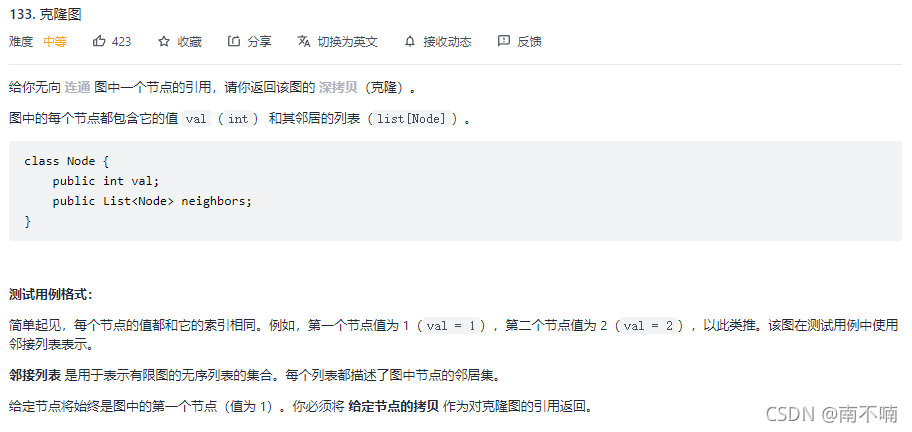
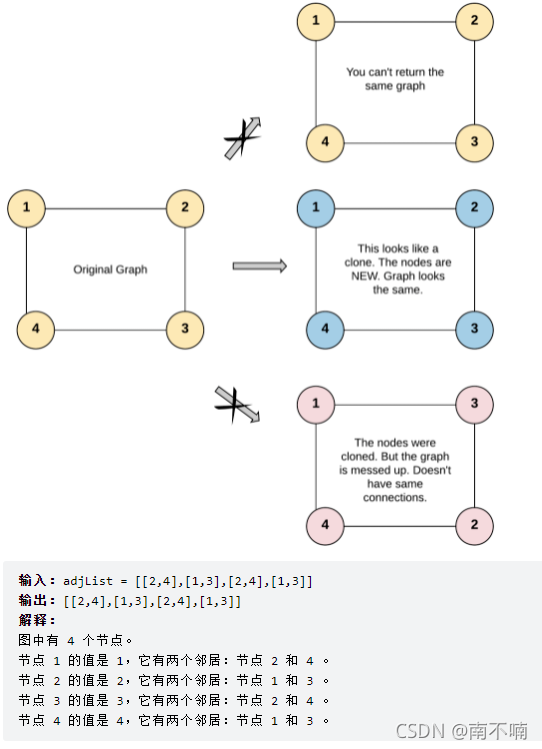

法一:深度搜索
class Solution {
public:
    unordered_map<Node*, Node*> visited;
    Node* cloneGraph(Node* node) {
        if (node == nullptr) {
            return node;
        }

        // 如果该节点已经被访问过了,则直接从哈希表中取出对应的克隆节点返回
        if (visited.find(node) != visited.end()) {
            return visited[node];
        }

        // 克隆节点,注意到为了深拷贝我们不会克隆它的邻居的列表
        Node* cloneNode = new Node(node->val);
        // 哈希表存储
        visited[node] = cloneNode;

        // 遍历该节点的邻居并更新克隆节点的邻居列表
        for (auto& neighbor: node->neighbors) {
            cloneNode->neighbors.emplace_back(cloneGraph(neighbor));
        }
        return cloneNode;
    }
};
class Solution {
public:
    unordered_map<Node* ,Node*>hash;
    Node* cloneGraph(Node* node) {
        if(!node) return NULL;
        return dfs(node);
    }
    Node* dfs(Node* node)
    {
        //node节点已经被访问过了,直接从哈希表hash中取出对应的克隆节点返回。
        if(hash[node])  return hash[node];
        Node* clone = new Node(node->val); //克隆节点
        hash[node] = clone;                //建立源节点到克隆节点的映射
        for(Node* ver: node->neighbors)    //克隆边
        {
            clone->neighbors.push_back(dfs(ver));
        }
        return clone;
    }
};
138.复制带随机指针的链表


回溯+哈希表
class Solution {
public:
    unordered_map<Node*, Node*> cachedNode;

    Node* copyRandomList(Node* head) {
        if (head == nullptr) {
            return nullptr;
        }
        if (!cachedNode.count(head)) {
            Node* headNew = new Node(head->val);
            cachedNode[head] = headNew;
            headNew->next = copyRandomList(head->next);
            headNew->random = copyRandomList(head->random);
        }
        return cachedNode[head];
    }
};
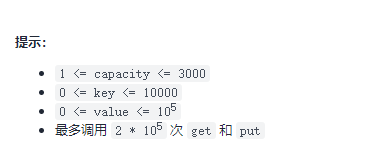
146.LRU缓存机制(手写双向链表)

struct DLinkedNode {
    int key, value;
    DLinkedNode* prev;
    DLinkedNode* next;
    DLinkedNode(): key(0), value(0), prev(nullptr), next(nullptr) {}
    DLinkedNode(int _key, int _value): key(_key), value(_value), prev(nullptr), next(nullptr) {}
};

class LRUCache {
private:
    unordered_map<int, DLinkedNode*> cache;
    DLinkedNode* head;
    DLinkedNode* tail;
    int size;
    int capacity;

public:
    LRUCache(int _capacity): capacity(_capacity), size(0) {
        // 使用伪头部和伪尾部节点
        head = new DLinkedNode();
        tail = new DLinkedNode();
        head->next = tail;
        tail->prev = head;
    }

    int get(int key) {
        if (!cache.count(key)) {
            return -1;
        }
        // 如果 key 存在,先通过哈希表定位,再移到头部
        DLinkedNode* node = cache[key];
        moveToHead(node);
        return node->value;
    }

    void put(int key, int value) {
        if (!cache.count(key)) {
            // 如果 key 不存在,创建一个新的节点
            DLinkedNode* node = new DLinkedNode(key, value);
            // 添加进哈希表
            cache[key] = node;
            // 添加至双向链表的头部
            addToHead(node);
            ++size;
            if (size > capacity) {
                // 如果超出容量,删除双向链表的尾部节点
                DLinkedNode* removed = removeTail();
                // 删除哈希表中对应的项
                cache.erase(removed->key);
                // 防止内存泄漏
                delete removed;
                --size;
            }
        }
        else {
            // 如果 key 存在,先通过哈希表定位,再修改 value,并移到头部
            DLinkedNode* node = cache[key];
            node->value = value;
            moveToHead(node);
        }
    }

    void addToHead(DLinkedNode* node) {
        node->prev = head;
        node->next = head->next;
        head->next->prev = node;
        head->next = node;
    }

    void removeNode(DLinkedNode* node) {
        node->prev->next = node->next;
        node->next->prev = node->prev;
    }

    void moveToHead(DLinkedNode* node) {
        removeNode(node);
        addToHead(node);
    }

    DLinkedNode* removeTail() {
        DLinkedNode* node = tail->prev;
        removeNode(node);
        return node;
    }
};
202.快乐数

法一:快慢指针
class Solution {
public:
    int bitSquareSum(int n) {
        int sum = 0;
        while(n > 0)
        {
            int bit = n % 10;
            sum += bit * bit;
            n = n / 10;
        }
        return sum;
    }

    bool isHappy(int n) {
        int slow = n, fast = n;
        do{
            slow = bitSquareSum(slow);
            fast = bitSquareSum(fast);
            fast = bitSquareSum(fast);
        }while(slow != fast);

        return slow == 1;
    }
};
法二:哈希表
class Solution {
public:
    int find(int x){    //求一个数每个位置上的数字的平方和
        int res=0;
        while(x){
            res+=(x%10)*(x%10);
            x/=10;
        }
        return res;
    }

    bool isHappy(int n) {
        unordered_set<int> hash;    //将每个答案存进哈希表,方便后续判断
        int t=find(n);
        while(t>1){
            if(hash.count(t))   //判断此结果是否在哈希表中出现过
            return false;
            hash.insert(t); //插入元素
            t=find(t);
        }

        return true;
    }
};
版权声明:本文为qq_41191468原创文章,遵循CC 4.0 BY-SA版权协议,转载请附上原文出处链接和本声明。