窗口函数、grouping运算符、存储过程、预处理声明
1. 窗口函数
1.1. 的概念与基本使用
窗口函数也叫 OLAP(OnLine AnalyticalProcessing) 函数,,意思是对数据库数据进行实时分析处理。
select 对整张表进行查询,而窗口函数对一部分数据进行汇总、计算和排序。
基本语法:
窗口函数名 OVER (PARTITION BY 列名
                  ORDER BY 排序用列名)
PARTITION BY 能够设定窗口对象范围。
ORDER BY 能够指定按照哪一列、何种顺序进行排序。
两者至少选其一。
举例:
select product_name,product_type,sale_price,
		rank() over (partition by product_type
					 order by sale_price) as ranking
from product;

product_name|product_type|sale_price|ranking|
------------+------------+----------+-------+
圆珠笔         |办公用品        |       100|      1|
打孔器         |办公用品        |       500|      2|
叉子          |厨房用具        |       500|      1|
擦菜板         |厨房用具        |       880|      2|
菜刀          |厨房用具        |      3000|      3|
高压锅         |厨房用具        |      6800|      4|
T恤          |衣服          |      1000|      1|
运动T恤        |衣服          |      4000|      2|

partition by product_type : 一个商品种类就是一个小的"窗口"。partition by 分组后得到3个集合。
order by 可以指定关键字ASC/DESC来指定升序/降序。默认ASC 升序。
1.2. 窗口函数分为两类
1.2.1. 将SUM、MAX、MIN等聚合函数用在窗口函数中
聚合函数在窗口函数使用时,计算的是累积到当前行的所有的数据的聚合
select product_id,product_name,sale_price,
		sum(sale_price) over (order by product_id) as cur_sum,
		avg(sale_price) over (order by product_id) as cur_avg,
		max(sale_price) over (order by sale_price) as cur_max
from product;

product_id|product_name|sale_price|cur_sum|cur_avg  |cur_max|
----------+------------+----------+-------+---------+-------+
0008      |圆珠笔         |       100|  16780|2097.5000|    100|
0002      |打孔器         |       500|   1500| 750.0000|    500|
0006      |叉子          |       500|  15800|2633.3333|    500|
0007      |擦菜板         |       880|  16680|2382.8571|    880|
0001      |T恤          |      1000|   1000|1000.0000|   1000|
0004      |菜刀          |      3000|   8500|2125.0000|   3000|
0003      |运动T恤        |      4000|   5500|1833.3333|   4000|
0005      |高压锅         |      6800|  15300|3060.0000|   6800|
分析:
order by product_id 求sum(sale_price),avg(sale_price);
接下来 order by sale_price,求max(sale_price),不影响前面的结果。
1.2.2. RANK、DENSE_RANK、ROW_NUMBER等排序用的专用窗口函数
3个函数的区别:对于记录 [10,10,10,30]
- RANK 函数:1 位、1 位、1 位、4 位
- DENSE_RANK函数:1 位、1 位、1 位、2 位
- ROW_NUMBER函数:1 位、2 位、3 位、4 位
select product_id,product_name,sale_price,
		rank() over (order by sale_price) as ranking,
		dense_rank() over (order by sale_price) as dense_ranking,
		row_number() over (order by sale_price) as row_numbering
from product;

product_id|product_name|sale_price|ranking|dense_ranking|row_numbering|
----------+------------+----------+-------+-------------+-------------+
0008      |圆珠笔         |       100|      1|            1|            1|
0002      |打孔器         |       500|      2|            2|            2|
0006      |叉子          |       500|      2|            2|            3|
0007      |擦菜板         |       880|      4|            3|            4|
0001      |T恤          |      1000|      5|            4|            5|
0004      |菜刀          |      3000|      6|            5|            6|
0003      |运动T恤        |      4000|      7|            6|            7|
0005      |高压锅         |      6800|      8|            7|            8|
1.3. 窗口函数应用:计算移动平均
聚合函数在窗口函数使用时,除了可以计算累计到当前行的所有数据的集合之外,还可以指定汇总范围,这个范围叫 框架 (frame)。
rows n preceding : 将框架指定为 当前n行+自身
between n preceding and n following:将框架指定为 当前n行+之后n行+自身
... over (order by 列名
		  rows n preceding)...

... over (order by 列名
		  rows between n preceding and n following)...
select product_id,product_name,sale_price,
		avg(sale_price) over (order by product_id
							  rows 2 preceding) as moving_avg
from product;

product_id|product_name|sale_price|moving_avg|
----------+------------+----------+----------+
0001      |T恤          |      1000| 1000.0000|
0002      |打孔器         |       500|  750.0000|	-- = (1000+500)/2
0003      |运动T恤        |      4000| 1833.3333|	-- =(1000+500+4000)/3
0004      |菜刀          |      3000| 2500.0000|	-- =(500+4000+3000)/3
0005      |高压锅         |      6800| 4600.0000|
0006      |叉子          |       500| 3433.3333|
0007      |擦菜板         |       880| 2726.6667|
0008      |圆珠笔         |       100|  493.3333|

--------------------------------------------------------------------------------------
select product_id,product_name,sale_price,
		avg(sale_price) over (order by product_id
							  rows between 1 preceding and 1 following) as moving_avg
from product;
product_id|product_name|sale_price|moving_avg|
----------+------------+----------+----------+
0001      |T恤          |      1000|  750.0000|		-- =(1000+500)/2
0002      |打孔器         |       500| 1833.3333|	-- =(1000+500+4000)/3
0003      |运动T恤        |      4000| 2500.0000|	-- =(500+4000+3000)/3
0004      |菜刀          |      3000| 4600.0000|
0005      |高压锅         |      6800| 3433.3333|
0006      |叉子          |       500| 2726.6667|
0007      |擦菜板         |       880|  493.3333|
0008      |圆珠笔         |       100|  490.0000|
窗口函数只能用于select语句中。窗口函数中的order by 不影响数据的最终排序,它只决定窗口函数按照什么顺序计算。要跟from、group by 语句之后的order by 区分开来。
2. GROUPING运算符
只使用group by子句和聚合函数是无法同时得出小计和合计的。
想要同时得到就要用grouping运算符。
- 通常的计算合计:
分别计算出合计行和按照商品种类进行汇总的结果,然后通过union all连接在一起
select '合计' as product_type, sum(sale_price)`在这里插入代码片`
from Product
union all
select product_type, sum(sale_price)
from Product
group by product_type;

product_type|sum(sale_price)|
------------+---------------+
合计          |          16780|
衣服          |           5000|
办公用品        |            600|
厨房用具        |          11180|
- 使用rollup:同时得出合计和小计
select product_type,sum(sale_price) as sum_price
from product
group by product_type with rollup;

product_type|sum_price|
------------+---------+
办公用品        |      600|
厨房用具        |    11180|
衣服          |     5000|
            |    16780|		-- 总计


select product_type,regist_date,sum(sale_price) as sum_price
from product
group by product_type, regist_date with rollup;

product_type|regist_date|sum_price|
------------+-----------+---------+
办公用品        | 2009-09-11|      500|
办公用品        | 2009-11-11|      100|
办公用品        |           |      600|  --小计:办公用品
厨房用具        | 2008-04-28|      880|
厨房用具        | 2009-01-15|     6800|
厨房用具        | 2009-09-20|     3500|
厨房用具        |           |    11180|	--小计:厨房用具
衣服          |           |     4000|
衣服          | 2009-09-20|     1000|
衣服          |           |     5000|	--小计:衣服
            |           |    16780|		--合计
相当于3种聚合:1.group by ()
             2.group by (product_type)
             3.group by (product_type, regist_date)
2.1. grouping函数的用法与三种grouping字符:rollup、cube、grouping sets
grouping函数:让null更加容易分辨。超级记录产生的null返回1,其他为0
select grouping(product_type) as product_type,
grouping(regist_date) as regist_date,
sum(sale_price) as sum_price
from Product
group by product_type, regist_date with rollup;

product_type|regist_date|sum_price|
------------+-----------+---------+
          0|          0|      500|
          0|          0|      100|
          0|          1|      600|
          0|          0|      880|
          0|          0|     6800|
          0|          0|     3500|
          0|          1|    11180|
          0|          0|     4000|
          0|          0|     1000|
          0|          1|     5000|
          1|          1|    16780|

在超级记录分组记录的键值中插入恰当的字符串
select case when grouping(product_type) = 1
           then '商品种类 合计'
			else product_type end as product_type,
	   case when grouping(regist_date) = 1
	        then '登记日期 合计'
			else regist_date  end as regist_date,
	   sum(sale_price) as sum_price
from Product
group by product_type, regist_date with rollup;

product_type|regist_date|sum_price|
------------+-----------+---------+
办公用品        |2009-09-11 |      500|
办公用品        |2009-11-11 |      100|
办公用品        |登记日期 合计    |      600|
厨房用具        |2008-04-28 |      880|
厨房用具        |2009-01-15 |     6800|
厨房用具        |2009-09-20 |     3500|
厨房用具        |登记日期 合计    |    11180|
衣服          |           |     4000|
衣服          |2009-09-20 |     1000|
衣服          |登记日期 合计    |     5000|
商品种类 合计     |登记日期 合计    |    16780|
cube:用数据来搭积木
group by cube(product_type, regist_date)
这里的cube按以下4种方式聚合:
1.group by()
2.group by(product_type)
3.group by(regist_date)
4.group by(product_type, regist_date)
所谓cube,就是将group by子句中的聚合键的所有可能的组合的汇总结果集中到一个结果中。因此,组合的个数就是2的n次方(n为聚合键的个数)。grouping sets用于从中取出个别条件对应的不固定结果.
! mysql 8.0 不支持 cube
https://dev.mysql.com/doc/refman/8.0/en/group-by-modifiers.html
https://blog.csdn.net/qq_41805514/article/details/81777946
3. 存储过程和函数
原文链接:https://blog.csdn.net/Bb15070047748/article/details/106292488
存储过程是一组为了完成特定功能的sql语句,编译后存储在数据库中。用户指定存储过程的名字并给定参数来调用执行。
- 语法
CREATE PROCEDURE procedure_name ([parameters[,...]])
begin
-- SQL语句
end ;
- 示例
create procedure test1()
begin
	select 'hello';
end;
-- 调用存储过程
call test1();

hello|
-----+
hello|
3.1. 存储过程的语法:declare,set,into,传递参数,if,case,while,loop,repeat,游标
- declare :声明变量
CREATE PROCEDURE test2 ()
begin
	declare num int default 0;		-- 声明变量,赋默认值为0
	select num+10;
end ;

call test2();			-- 调用存储过程

num+10|
------+
    10|
- set:赋值操作
CREATE PROCEDURE test3 ()
begin
	declare num int default 0;
	set num =20;			-- 给num变量赋值
	select num;
end ;

call test3();
num|
---+
 20|
- into:赋值
CREATE PROCEDURE test4 ()
begin
	declare num int default 0;
	select count(1) into num from student;
	select num;
end ;

call test4();
- 传递参数
in:该参数可以作为输入,也就是需要调用方传入值 , 默认
out:该参数作为输出,也就是该参数可以作为返回值
inout:既可以作为输入参数,也可以作为输出参数
-- 定义一个输入参数
CREATE PROCEDURE test6 (in id int)
begin
	declare class_name varchar(30);

	if id=1 then
		set class_name='哇塞,Java大佬!';
	elseif id=2 then
		set class_name='原来是UI的啊';
	else
		set class_name='不用想了,肯定是产品小样';
	end if;

	select class_name;
end ;

call test6(3);

class_name  |
------------+
不用想了,肯定是产品小样|
-- 定义一个输入参数和一个输出参数
CREATE PROCEDURE test7 (in id int,out class_name varchar(100))
begin
	if id=1 then
		set class_name='哇塞,Java大佬!';
	elseif id=2 then
		set class_name='原来是UI的啊';
	else
		set class_name='不用想了,肯定是产品小样';
	end if;

end ;

call test7(1,@class_name);	-- 创建会话变量
select @class_name;		-- 引用会话变量

@class_name|
-----------+
哇塞,Java大佬! |
存储过程优点
1、增强sql语言的功能和灵活性,通过控制语句的编写完成复杂的判断和运算。
2、标准组件式编程,存储过程复用率高,且易于维护,无需修改应用源代码。
3、较快的执行速度,存储过程是预编译的,节省了编译时间。
4、减少网络流量,无需多次将数据传入程序运算,只需调用存储过程。大大降低网络负载。
5、限制访问权限,进一步保证数据安全。
原文链接:https://blog.csdn.net/better_zhang/article/details/121842697
公司开发不使用存储过程的原因:业务逻辑应该放到业务层,不应把业务滞留到数据库来处理,造成业务和数据库严重耦合。
4. 预处理声明 PREPARE Statement
https://www.cnblogs.com/geaozhang/p/9891338.html
1、即时 SQL
一条 SQL 在 DB 接收到最终执行完毕返回,大致的过程如下:
1. 词法和语义解析;
2. 优化 SQL 语句,制定执行计划;
3. 执行并返回结果;
如上,一条 SQL 直接是走流程处理,一次编译,单次运行,此类普通语句被称作 Immediate Statements (即时 SQL)。
2、预处理 SQL
但是,绝大多数情况下,某需求某一条 SQL 语句可能会被反复调用执行,或者每次执行的时候只有个别的值不同(比如 select 的 where 子句值不同,update 的 set 子句值不同,insert 的 values 值不同)。如果每次都需要经过上面的词法语义解析、语句优化、制定执行计划等,则效率就明显不行了。
所谓预编译语句就是将此类 SQL 语句中的值用占位符替代,可以视为将 SQL 语句模板化或者说参数化,一般称这类语句叫Prepared Statements。
预编译语句的优势在于归纳为:一次编译、多次运行,省去了解析优化等过程;此外预编译语句能防止 SQL 注入。
- MySQL PREPARE Statement 使用步骤如下:
- PREPARE – 准备需要执行的语句预处理声明。
- EXECUTE – 执行预处理声明。
- DEALLOCATE PREPARE –释放预处理声明。
-- 1.定义预处理声明
PREPARE stmt1 FROM
	'SELECT
   	    product_id,
            product_name
	FROM product
        WHERE product_id = ?';

-- 2.声明变量 pcid,代表商品编号,并将其值设置为 0005
SET @pcid = '0005';

-- 3.执行预处理声明
EXECUTE stmt1 USING @pcid;

product_id|product_name|
----------+------------+
0005      |高压锅         |

-- 4.为变量 pcid 分配另外一个商品编号
SET @pcid = '0008';

-- 5.使用新的商品编号执行预处理声明
EXECUTE stmt1 USING @pcid;

product_id|product_name|
----------+------------+
0008      |圆珠笔         |

-- 6.释放预处理声明以释放其占用的资源
DEALLOCATE PREPARE stmt1;
5. 习题
5.1. 说出执行结果
SELECT  product_id
       ,product_name
       ,sale_price
       ,MAX(sale_price) OVER (ORDER BY product_id) AS Current_max_price
  FROM product;

product_id|product_name|sale_price|Current_max_price|
----------+------------+----------+-----------------+
0001      |T恤          |      1000|             1000|
0002      |打孔器         |       500|             1000|
0003      |运动T恤        |      4000|             4000|
0004      |菜刀          |      3000|             4000|
0005      |高压锅         |      6800|             6800|
0006      |叉子          |       500|             6800|
0007      |擦菜板         |       880|             6800|
0008      |圆珠笔         |       100|             6800|
按照 product_id 升序,对累计到当前行的所有sale_price求最大值。
5.2. 继续使用product表,计算出按照登记日期(regist_date)升序进行排列的各日期的销售单价(sale_price)的总额
排序是需要将登记日期为NULL 的“运动 T 恤”记录排在第 1 位(也就是将其看作比其他日期都早)
 select product_id,product_name,sale_price,regist_date,
 		sum(sale_price) over (order by regist_date) as cur_sum
 from product;

product_id|product_name|sale_price|regist_date|cur_sum|
----------+------------+----------+-----------+-------+
0003      |运动T恤        |      4000|           |   4000|
0007      |擦菜板         |       880| 2008-04-28|   4880|
0005      |高压锅         |      6800| 2009-01-15|  11680|
0002      |打孔器         |       500| 2009-09-11|  12180|
0001      |T恤          |      1000| 2009-09-20|  16680|
0004      |菜刀          |      3000| 2009-09-20|  16680|
0006      |叉子          |       500| 2009-09-20|  16680|
0008      |圆珠笔         |       100| 2009-11-11|  16780|
5.3. 思考题
- 窗口函数不指定PARTITION BY的效果是什么?
答:不分组,则计算范围是累积到当前行的所有记录的集合。 - 为什么说窗口函数只能在SELECT子句中使用?实际上,在ORDER BY 子句使用系统并不会报错。
答:Windowed functions are defined in the ANSI spec to logically execute after the processing of GROUP BY, HAVING, WHERE.,所以窗口函数原则上只能写在select子句中。但是按照sql执行顺序,写在order by 里也可以。
https://stackoverflow.com/questions/14111321/windowed-functions-can-only-appear-in-the-select-or-order-by-clauses
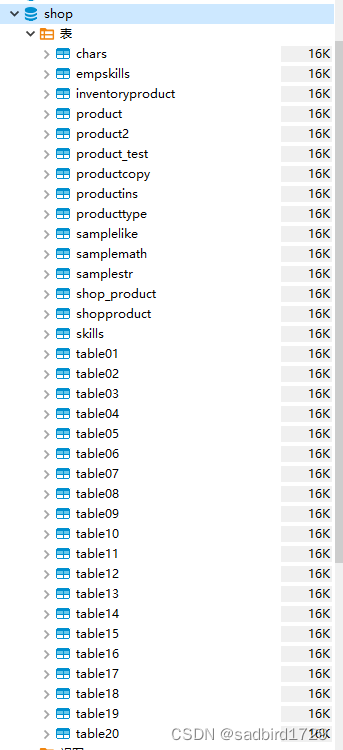
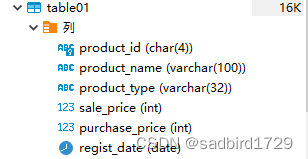
5.4. 使用存储过程创建20个与 shop.product 表结构相同的表
思路:
- 使用存储过程实现,存储过程中写个20次循环,每次循环更新table名字,创建一个table。
- 因为table_name 是变量,不能直接 create table table_name,通过搜索得知可以使用CONCAT()+预处理声明 实现。
create procedure test5_4 ()
begin

	declare i int;
	declare table_name VARCHAR(20);
	set i = 01;

	while i <= 20 do
	set table_name = CONCAT('table',i);
	set @csql = CONCAT('create table ',table_name,' like shop.product');
	prepare create_stmt from @csql;
	execute create_stmt;
	set i = i+1;
	end while;

end ;

call test5_4();
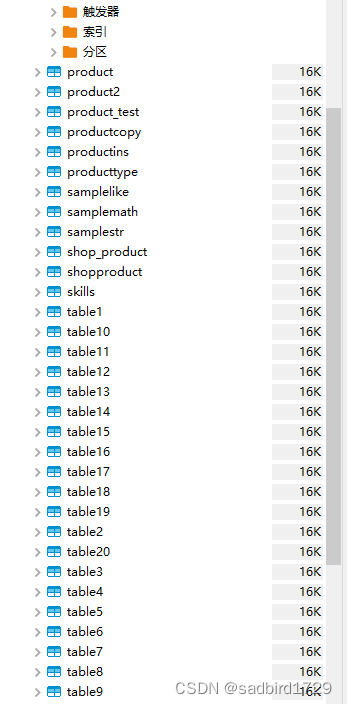
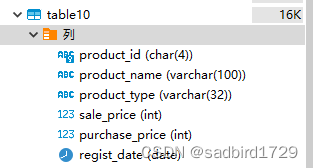
结果发现table1-table9编号没有补零,应该为tabel01-tabel09,需要实现占位2字符。
思路:
MySQL类型转换函数参数 : CAST(xxx AS 类型) , CONVERT(xxx,类型)
这个类型 可以是以下值其中的 一个:
BINARY[(N)]
CHAR[(N)]
DATE
DATETIME
DECIMAL
SIGNED[INTEGER]
TIME
UNSIGNED [INTEGER]LPAD(str,len,padstr)
返回字符串str,将其左填充字符串padstr至len个字符的长度。 如果str大于len,则返回值缩短为len个字符。select cast('01'+1 as char); cast('01'+1 as char)| --------------------+ 2 | select LPAD(cast('01'+1 as char),2,0); LPAD(cast('01'+1 as char),2,0)| ------------------------------+ 02 | select LPAD(cast('01'+12 as char),2,0); LPAD(cast('01'+12 aschar),2,0)| -------------------------------+ 13 |
重新修改:
create procedure test5_4 ()
begin

	declare i CHAR(2);
	declare table_name VARCHAR(20);
	set i = '01';

	while i <= 20 do
	set table_name = CONCAT('table',i);
	set @csql = CONCAT('create table ',table_name,' like shop.product');
	prepare create_stmt from @csql;
	execute create_stmt;
	set i = LPAD(cast(i+1 as char),2,0);
	end while;

end ;

call test5_4();
这样就正确实现了前缀编号补零。