第一次将例程跑起来了,有些兴趣。
参考的是如下URL:
http://www.yidianzixun.com/article/0KNz7OX1
本来是比较Keras和Tensorflow的,我现在的水平,只能是跑通一个算一个啦。
因为要比较CPU和GPU的性能,两个DOCKER如下:
tensorflow/tensorflow:1.12.0-gpu-py3
tensorflow/tensorflow:1.12.0-py3
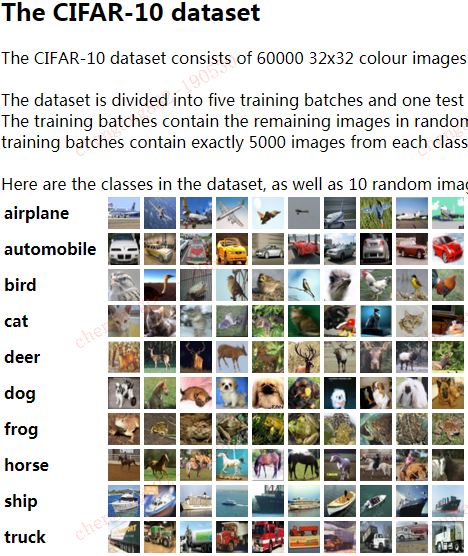
CIFAR-10的数据自已从网上下载,所以出现如下错误时,要自己更改成一个内网URL地址:
Traceback (most recent call last):
  File "train_network_tf.py", line 26, in <module>
    split = tf.keras.datasets.cifar10.load_data()
  File "/usr/local/lib/python3.5/dist-packages/tensorflow/python/keras/datasets/cifar10.py", line 40, in load_data
    path = get_file(dirname, origin=origin, untar=True)
  File "/usr/local/lib/python3.5/dist-packages/tensorflow/python/keras/utils/data_utils.py", line 251, in get_file
    raise Exception(error_msg.format(origin, e.errno, e.reason))
Exception: URL fetch failure on https://www.cs.toronto.edu/~kriz/cifar-10-python.tar.gz: None -- [Errno -3] Temporary failure in name resolution
/usr/local/lib/python3.5/dist-packages/tensorflow/python/keras/datasets/cifar10.py这个文件40行是一个网址,更改一下就OK了。
一,modle层实现代码
pyimagesearch/minivggnettf.py
# import the necessary packages
import tensorflow as tf

class MiniVGGNetTF:
    @staticmethod
    def build(width, height, depth, classes):
        # initialize the input shape and channel dimension, assuming
        # TensorFlow/channels-last ordering
        inputShape = (height, width, depth)
        chanDim = -1

        # define the model input
        inputs = tf.keras.layers.Input(shape=inputShape)

        # first (CONV => RELU) * 2 => POOL layer set
        x = tf.keras.layers.Conv2D(32, (3, 3), padding="same")(inputs)
        x = tf.keras.layers.Activation("relu")(x)
        x = tf.keras.layers.BatchNormalization(axis=chanDim)(x)
        x = tf.keras.layers.Conv2D(32, (3, 3), padding="same")(x)
        x = tf.keras.layers.Lambda(lambda t: tf.nn.crelu(x))(x)
        x = tf.keras.layers.BatchNormalization(axis=chanDim)(x)
        x = tf.keras.layers.MaxPooling2D(pool_size=(2, 2))(x)
        x = tf.keras.layers.Dropout(0.25)(x)

        # second (CONV => RELU) * 2 => POOL layer set
        x = tf.keras.layers.Conv2D(64, (3, 3), padding="same")(x)
        x = tf.keras.layers.Lambda(lambda t: tf.nn.crelu(x))(x)
        x = tf.keras.layers.BatchNormalization(axis=chanDim)(x)
        x = tf.keras.layers.Conv2D(64, (3, 3), padding="same")(x)
        x = tf.keras.layers.Lambda(lambda t: tf.nn.crelu(x))(x)
        x = tf.keras.layers.BatchNormalization(axis=chanDim)(x)
        x = tf.keras.layers.MaxPooling2D(pool_size=(2, 2))(x)
        x = tf.keras.layers.Dropout(0.25)(x)

        # first (and only) set of FC => RELU layers
        x = tf.keras.layers.Flatten()(x)
        x = tf.keras.layers.Dense(512)(x)
        x = tf.keras.layers.Lambda(lambda t: tf.nn.crelu(x))(x)
        x = tf.keras.layers.BatchNormalization()(x)
        x = tf.keras.layers.Dropout(0.5)(x)

        # softmax classifier
        x = tf.keras.layers.Dense(classes)(x)
        x = tf.keras.layers.Activation("softmax")(x)

        # create the model
        model = tf.keras.models.Model(inputs, x, name="minivggnet_tf")

        # return the constructed network architecture
        return model
二,数据训练
train_network_tf.py
# USAGE
# python train_network_tf.py

# set the matplotlib backend so figures can be saved in the background
import matplotlib
matplotlib.use("Agg")

# import the necessary packages
from pyimagesearch.minivggnettf import MiniVGGNetTF
from sklearn.preprocessing import LabelBinarizer
from sklearn.metrics import classification_report
import matplotlib.pyplot as plt
import tensorflow as tf
import numpy as np
import argparse

# construct the argument parser and parse the arguments
ap = argparse.ArgumentParser()
ap.add_argument("-p", "--plot", type=str, default="plot_tf.png",
    help="path to output loss/accuracy plot")
args = vars(ap.parse_args())

# load the training and testing data, then scale it into the
# range [0, 1]
print("[INFO] loading CIFAR-10 data...")
split = tf.keras.datasets.cifar10.load_data()
((trainX, trainY), (testX, testY)) = split
trainX = trainX.astype("float") / 255.0
testX = testX.astype("float") / 255.0

# convert the labels from integers to vectors
lb = LabelBinarizer()
trainY = lb.fit_transform(trainY)
testY = lb.transform(testY)

# initialize the label names for the CIFAR-10 dataset
labelNames = ["airplane", "automobile", "bird", "cat", "deer",
    "dog", "frog", "horse", "ship", "truck"]

# initialize the initial learning rate, total number of epochs to
# train for, and batch size
INIT_LR = 0.01
EPOCHS = 5
BS = 32

# initialize the optimizer and model
print("[INFO] compiling model...")
opt = tf.keras.optimizers.SGD(lr=INIT_LR, decay=INIT_LR / EPOCHS)
model = MiniVGGNetTF.build(width=32, height=32, depth=3,
    classes=len(labelNames))
model.compile(loss="categorical_crossentropy", optimizer=opt,
    metrics=["accuracy"])

# train the network
print("[INFO] training network for {} epochs...".format(EPOCHS))
H = model.fit(trainX, trainY, validation_data=(testX, testY),
    batch_size=BS, epochs=EPOCHS, verbose=1)

# evaluate the network
print("[INFO] evaluating network...")
predictions = model.predict(testX, batch_size=32)
print(classification_report(testY.argmax(axis=1),
    predictions.argmax(axis=1), target_names=labelNames))

# plot the training loss and accuracy
plt.style.use("ggplot")
plt.figure()
plt.plot(np.arange(0, EPOCHS), H.history["loss"], label="train_loss")
plt.plot(np.arange(0, EPOCHS), H.history["val_loss"], label="val_loss")
plt.plot(np.arange(0, EPOCHS), H.history["acc"], label="train_acc")
plt.plot(np.arange(0, EPOCHS), H.history["val_acc"], label="val_acc")
plt.title("Training Loss and Accuracy on Dataset")
plt.xlabel("Epoch #")
plt.ylabel("Loss/Accuracy")
plt.legend(loc="lower left")
plt.savefig(args["plot"])
三,结果对比:
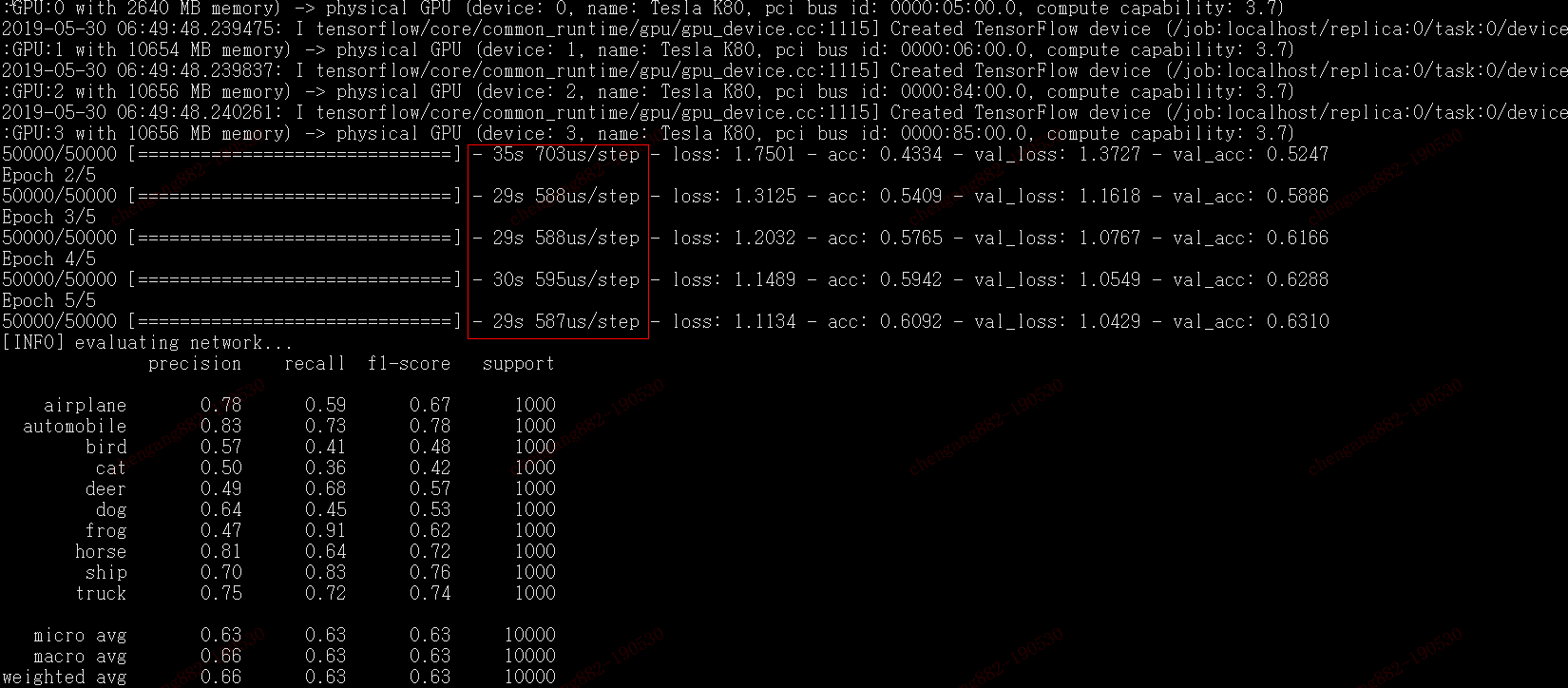
当使用GPU吧,一个批次完成需要30秒上下。
而只使用CPU的话,一个批次完成则需要330秒以上。
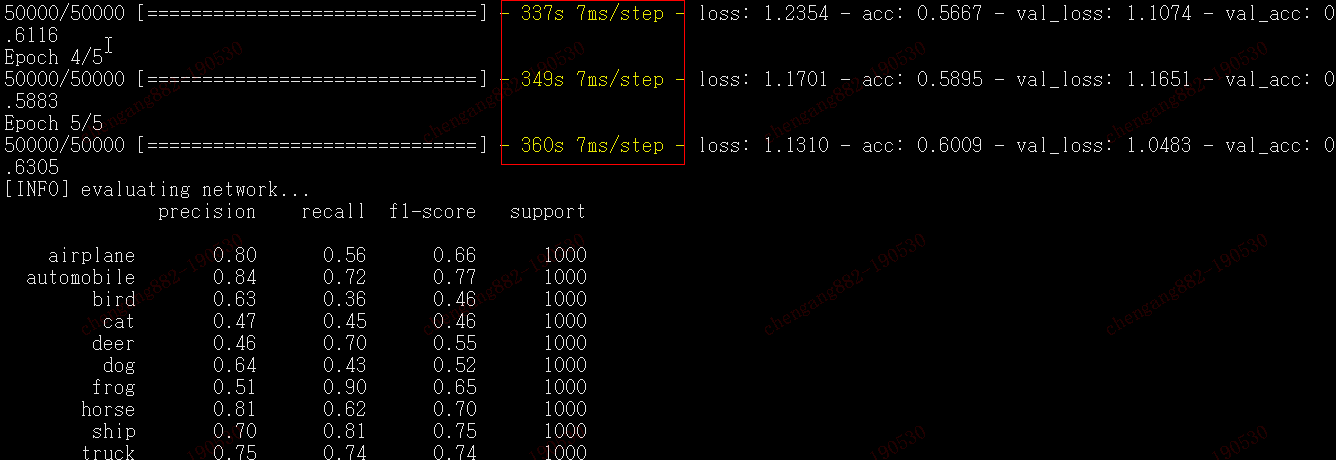
效率提高10倍以上啊。
转载于:https://www.cnblogs.com/aguncn/p/10949579.html