一、环境说明
- 本文是 LeetCode1773. 统计匹配检索规则的物品数量。
- 模拟。
- 测试环境:Visual Studio 2019。
二、思路分析
直接匹配
朴素的思维模式是一次遍历:
简单匹配一下,r u l e K e y ruleKeyruleKey和i t e m s itemsitems的规则,规则匹配,再匹配属性。
hash表
直观的简化做法是hash思想:
建立一个h a s h m a p hashmaphashmap,把r u l e K e y ruleKeyruleKey映射为i t e m itemitem对应属性的下标。题目给出i t e m s [ i ] = [ t y p e i , c o l o r i , n a m e i ] items[i] = [typei, colori, namei]items[i]=[typei,colori,namei],我们要做的,就是把t y p e 、 c o l o r 、 n a m e type、color、nametype、color、name依次映射为0 , 1 , 2 0,1,20,1,2。这一步帮我们省略了规则匹配,接下来只用匹配属性即可。
三、代码展示
直接匹配:
// 类型type 颜色color 名称name
class Solution {
public:
    int countMatches(vector<vector<string>>& items, string ruleKey, string ruleValue) {
        int ans = 0;
        for(int i =0;i<items.size();i++){
            if("color"==ruleKey){
                if(items[i][1]==ruleValue){
                    ans++;
                }//物品颜色
            }else if("type"==ruleKey){
                if(items[i][0]==ruleValue){
                    ans++;
                }
            }else{//name
                if(items[i][2]==ruleValue){
                    ans++;
                }
            }
        }
        return ans;
    }
};
哈希表:
class Solution {
public:
    int countMatches(vector<vector<string>>& items, string ruleKey, string ruleValue) {
        unordered_map<string,int> hash = {{"type",0},{"color",1},{"name",2}};
        int ans = 0,index = hash[ruleKey];
        for(auto x:items){
            if(x[index] == ruleValue) ans++;
        }
        return ans;
    }
};
四、博主致语
理解思路很重要!
欢迎读者在评论区留言,作为日更博主,看到就会回复的。
五、AC
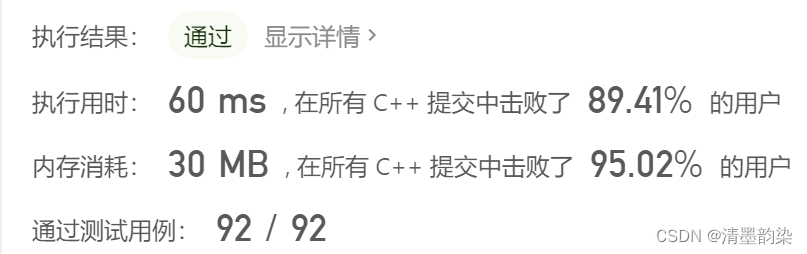
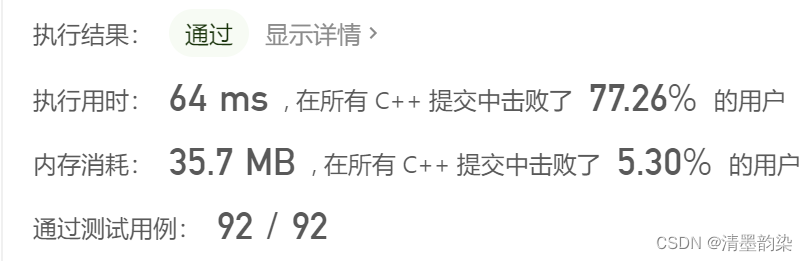
六、复杂度分析
- 时间复杂度:O ( n ) O(n)O(n) ,n nn是物品数量。直接匹配和哈希表,都只进行一次遍历。时间复杂度是O ( n ) O(n)O(n)。
- 空间复杂度:O ( 1 ) O(1)O(1),除了若干变量使用的常量空间,没有使用额外的线性空间。特别的,本题h a s h hashhash表也是常量级空间∣ C ∣ = 3 |C|=3∣C∣=3。
版权声明:本文为Innocence02原创文章,遵循CC 4.0 BY-SA版权协议,转载请附上原文出处链接和本声明。