java 原文件通过编译器编译为.class 二进制文件,在通过 jvm 解释器将二进制文件转换成可执行文件,进行执行
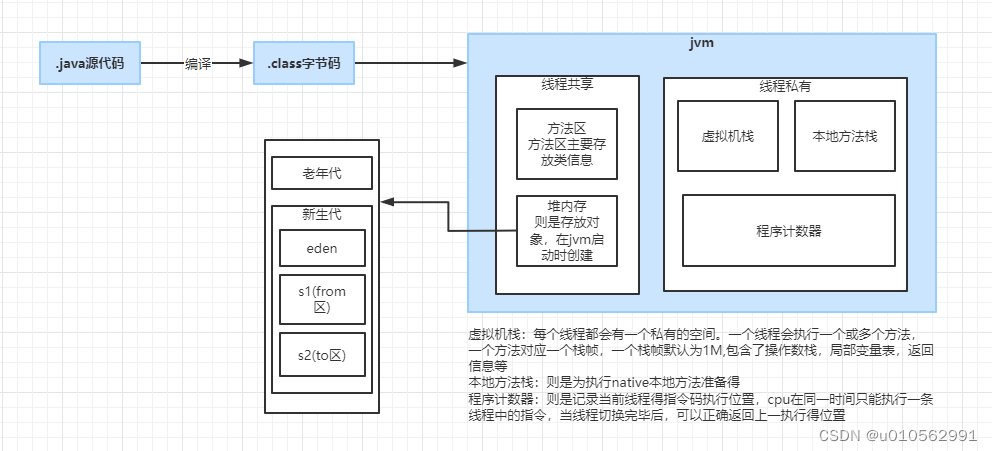
创建一个 test.java 得源文件:
public class test {
public static void main(String[] args) {
     int a = 10;
     a = 100;
     int b = 10;
    int c = a + b;
    System.out.print(c);
}
}
打开 cmd,通过 javac test.java 编译为.class 文件,javap -v test.class > test.txt 命令可以得到 text.class 二进制的指令码
Classfile /D:/project/xuexi/test.class
  Last modified 2022-8-13; size 405 bytes
  MD5 checksum 3f86f6f81a0a9a0c4ed96e26c2f29d3a
  Compiled from "test.java"
public class test
  minor version: 0
  major version: 52
  flags: ACC_PUBLIC, ACC_SUPER
Constant pool:
   #1 = Methodref          #5.#14         // java/lang/Object."<init>":()V
   #2 = Fieldref           #15.#16        // java/lang/System.out:Ljava/io/PrintStream;
   #3 = Methodref          #17.#18        // java/io/PrintStream.print:(I)V
   #4 = Class              #19            // test
   #5 = Class              #20            // java/lang/Object
   #6 = Utf8               <init>
   #7 = Utf8               ()V
   #8 = Utf8               Code
   #9 = Utf8               LineNumberTable
  #10 = Utf8               main
  #11 = Utf8               ([Ljava/lang/String;)V
  #12 = Utf8               SourceFile
  #13 = Utf8               test.java
  #14 = NameAndType        #6:#7          // "<init>":()V
  #15 = Class              #21            // java/lang/System
  #16 = NameAndType        #22:#23        // out:Ljava/io/PrintStream;
  #17 = Class              #24            // java/io/PrintStream
  #18 = NameAndType        #25:#26        // print:(I)V
  #19 = Utf8               test
  #20 = Utf8               java/lang/Object
  #21 = Utf8               java/lang/System
  #22 = Utf8               out
  #23 = Utf8               Ljava/io/PrintStream;
  #24 = Utf8               java/io/PrintStream
  #25 = Utf8               print
  #26 = Utf8               (I)V
{
  public test();
    descriptor: ()V
    flags: ACC_PUBLIC
    Code:
      stack=1, locals=1, args_size=1
         0: aload_0
         1: invokespecial #1                  // Method java/lang/Object."<init>":()V
         4: return
      LineNumberTable:
        line 3: 0

  public static void main(java.lang.String[]);
    descriptor: ([Ljava/lang/String;)V
    flags: ACC_PUBLIC, ACC_STATIC
    Code:
      stack=2, locals=4, args_size=1
         0: bipush        10
         2: istore_1
         3: bipush        100
         5: istore_1
         6: bipush        10
         8: istore_2
         9: iload_1
        10: iload_2
        11: iadd
        12: istore_3
        13: getstatic     #2                  // Field java/lang/System.out:Ljava/io/PrintStream;
        16: iload_3
        17: invokevirtual #3                  // Method java/io/PrintStream.print:(I)V
        20: return
      LineNumberTable:
        line 6: 0
        line 7: 3
        line 8: 6
        line 9: 9
        line 10: 13
        line 11: 20
}
SourceFile: "test.java"
我们可以参照指令码表 (https://www.cnblogs.com/cycheng/p/14469871.html),查看每条指令是什么意思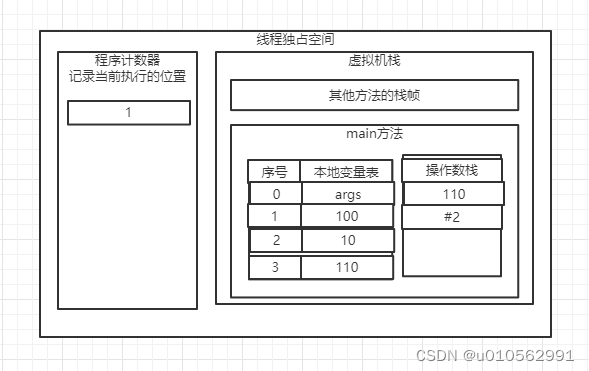
执行时,
3: bipush 100 将 100 压入操作数栈,程序计数器变为 3
5: istore_1 将 100 放入到本地变量表 1,清空操作数栈,程序计数器变为 5
6: bipush 10 同上执行
8: istore_2 同上执行
9: iload_1
10: iload_2
11: iadd
12: istore_3
将本地变量表位置 1,2 加载到操作数栈,进行相加操作,然后放入本地变量表位置 3
小结:
主要是说明,jvm 如何执行字节码文件,而 jvm 针对不同的操作系统又有不同的实现,所以也是 java 能够实现一处编写,处处运行的原因
版权声明:本文为u010562991原创文章,遵循CC 4.0 BY-SA版权协议,转载请附上原文出处链接和本声明。