一、什么是反射
在运行状态中,对任意一个类,都能知道这个类的所有属性和方法;对于任意一个对象,都能够调用它的任意方法和属性;这种动态获取信息以及动态调用对象方法的功能为java语言反射机制
二、反射的三种方式
- 第一种方式
public class ReflectSample {
    public static void main(String[] args) throws ClassNotFoundException, IllegalAccessException, InstantiationException, NoSuchMethodException, InvocationTargetException, NoSuchFieldException {

        Robot r = new Robot();
        Class rc = r.getClass();
        System.out.println("Class name is " + rc.getName());
        //获取类名
    }
}
此种方式明显已经创建了对象,再进行反射,反而显得多此一举,于是一般不采用这种方式
- 第二种方式
public class ReflectSample {
    public static void main(String[] args) throws ClassNotFoundException, IllegalAccessException, InstantiationException, NoSuchMethodException, InvocationTargetException, NoSuchFieldException {
        Class rc = Robot.class;
        System.out.println("Class name is " + rc.getName());
        //获取类名
    }
}
此种方式需要导入类的包,依赖性太强,一般也不采用
- 第三种方式
public class ReflectSample {
    public static void main(String[] args) throws ClassNotFoundException, IllegalAccessException, InstantiationException, NoSuchMethodException, InvocationTargetException, NoSuchFieldException {

        Class rc = Class.forName("com.imooc.javabasic.reflect.Robot");
        //根据类的全路径名获取Class
        System.out.println("Class name is " + rc.getName());
    }
}
注:Class.forName()方法需要抛出ClassNotFoundException
三、通过反射获取构造方法
public class Robot {
    private String name;

    public Robot(String name) {
        System.out.println("默认的构造方法:"+name);
    }
    public Robot(){
        System.out.println("无参的构造方法");
    }
    public Robot(int age){
        System.out.println("有一个参数的构造方法:"+age);
    }
    public Robot(String name,int age){
        System.out.println("有多个参数构造方法:"+name+","+age);
    }

    protected Robot(boolean n){
        System.out.println("受保护的构造方法:"+n);
    }
    private Robot(char c){
        System.out.println("私有的构造方法:"+c);
    }


    public void sayHi(String helloSentence){
        System.out.println(helloSentence+" "+name);
    }
    private String throwHello(String tag){
        return "Hello "+tag;
    }
    static {
        System.out.println("Hello Robot");
    }
}
public class ReflectSample {
    public static void main(String[] args) throws ClassNotFoundException, IllegalAccessException, InstantiationException, NoSuchMethodException, InvocationTargetException, NoSuchFieldException {
        Class rc = Class.forName("com.imooc.javabasic.reflect.Robot");
        System.out.println("Class name is " + rc.getName());

        System.out.println("所有构造方法");
        Constructor[] constructors = rc.getDeclaredConstructors();
        //获取所有构造方法
        for (Constructor c:constructors){
            System.out.println(c);
        }

        System.out.println("所有公共构造方法");
        constructors = rc.getConstructors();
        //获取所有公共构造方法
        for (Constructor c:constructors){
            System.out.println(c);
        }

        System.out.println("获取公共、无参的构造方法");
        Constructor constructor = rc.getConstructor(null);
        //无参的构造方法,类型是一个null,也可以不写,此处为构造器参数的类型
        System.out.println(constructor);
        Object object = constructor.newInstance();
        //newInstance是Constructor类的方法,创建该构造方法的声明类的新实例,并用指定的初始化参数初始化该实例
        Robot robot = (Robot) object;
        System.out.println(robot);

        System.out.println("获取私有的构造方法");
        constructor = rc.getDeclaredConstructor(char.class);
        System.out.println(constructor);
        constructor.setAccessible(true);//默认为false,调用私有会报错,设为true,暴力访问,忽略修饰符
        object = constructor.newInstance('男');//参数为构造方法的初始化参数
        robot = (Robot) object;
        System.out.println(robot);
    }
}
运行结果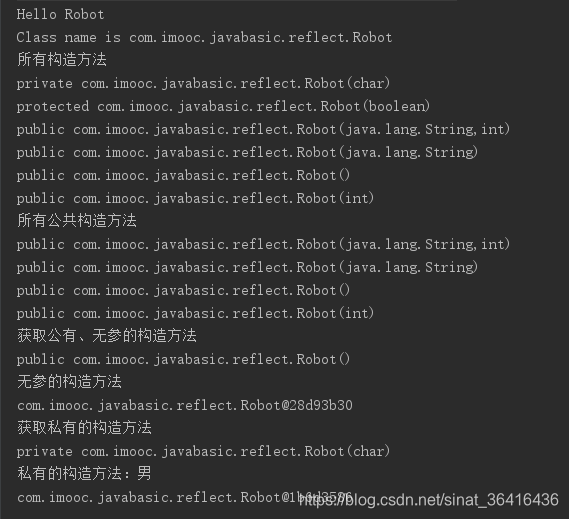
四、通过反射获取成员变量
public class Robot {
    private String name;
    public int number;
    protected int age;
    char gender;

    public Robot(){}

    @Override
    public String toString() {
        return "Robot{" +
                "name='" + name + '\'' +
                ", number=" + number +
                ", age=" + age +
                ", gender=" + gender +
                '}';
    }
    public void sayHi(String helloSentence){
        System.out.println(helloSentence+" "+name);
    }
    private String throwHello(String tag){
        return "Hello "+tag;
    }
    static {
        System.out.println("Hello Robot");
    }
}
public class ReflectSample {
    public static void main(String[] args) throws ClassNotFoundException, IllegalAccessException, InstantiationException, NoSuchMethodException, InvocationTargetException, NoSuchFieldException {
        Class rc = Class.forName("com.imooc.javabasic.reflect.Robot");
        System.out.println("Class name is " + rc.getName());

        System.out.println("获取所有公有的字段");
        Field[] fieldArray = rc.getFields();
        for(Field f : fieldArray){
            System.out.println(f);
        }
        System.out.println("获取所有的字段(包括私有、受保护、默认的)");
        fieldArray = rc.getDeclaredFields();
        for(Field f : fieldArray){
            System.out.println(f);
        }
        System.out.println("获取公有字段并调用");
        Field f = rc.getField("number");
        System.out.println(f);
        //获取一个对象
        Object obj = rc.getConstructor().newInstance();//实例化Robot,Robot robot = new Robot();
        //为字段设置值
        f.set(obj, 1);//为Robot对象中的number属性赋值–》robot.number = 1
        //验证
        Robot robot = (Robot) obj;
        System.out.println("编号:" + robot.number);


        System.out.println("获取私有字段并调用");
        f = rc.getDeclaredField("name");
        System.out.println(f);
        f.setAccessible(true);//设为true,可以访问私有
        f.set(obj,"小爱");
        System.out.println("验证:" + robot);
    }
}
运行结果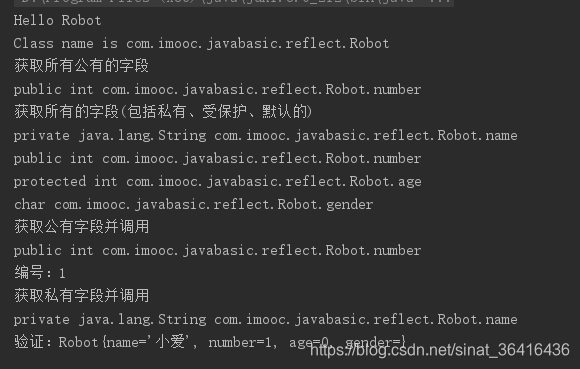
五、通过反射获取方法
public class Robot {
    private String name;
    public int number;
    protected int age;
    char gender;

    public Robot(){}

    @Override
    public String toString() {
        return "Robot{" +
                "name='" + name + '\'' +
                ", number=" + number +
                ", age=" + age +
                ", gender=" + gender +
                '}';
    }
    protected void show(){
        System.out.println("受保护,无参");
    }
    void play(){
        System.out.println("默认,无参");
    }
    public void sayHi(String helloSentence){
        System.out.println(helloSentence+" "+name);
    }
    private String throwHello(String tag){
        return "Hello "+tag;
    }
    static {
        System.out.println("Hello Robot");
    }
}
public class ReflectSample {
    public static void main(String[] args) throws ClassNotFoundException, IllegalAccessException, InstantiationException, NoSuchMethodException, InvocationTargetException, NoSuchFieldException {
        Class rc = Class.forName("com.imooc.javabasic.reflect.Robot");
        System.out.println("Class name is " + rc.getName());

        System.out.println("获取所有的公共方法");
        rc.getMethods();
        Method[] methodArray = rc.getMethods();
        for(Method m : methodArray){
            System.out.println(m);
        }
        System.out.println("获取所有的方法");
        methodArray = rc.getDeclaredMethods();
        for(Method m : methodArray){
            System.out.println(m);
        }
        System.out.println("获取公有的sayHi()方法");
//        Robot r = (Robot) rc.newInstance();
//        r.sayHi("hello");//这句不是反射,不能调用私有方法
        Method m = rc.getMethod("sayHi", String.class);//第二个参数为形参的Class类型对象
        System.out.println(m);
        //实例化一个Robot对象
        Object obj = rc.getConstructor().newInstance();
        Robot r = (Robot) obj;
        Field name = rc.getDeclaredField("name");
        name.setAccessible(true);
        name.set(r,"Alice");
        m.invoke(obj, "welcome");
        //可获取public 以及继承实现的方法,不能获取私有

        System.out.println("获取私有的throwHello()方法");
        m = rc.getDeclaredMethod("throwHello", String.class);
        //可获取public protected private 方法,不能获取继承或实现的方法
        System.out.println(m);
        m.setAccessible(true);//解除私有限定
        Object result = m.invoke(obj, "Bob");//第一个为要调用的对象,第二个为方法的实参
        System.out.println("返回:" + result);
    }
}
运行结果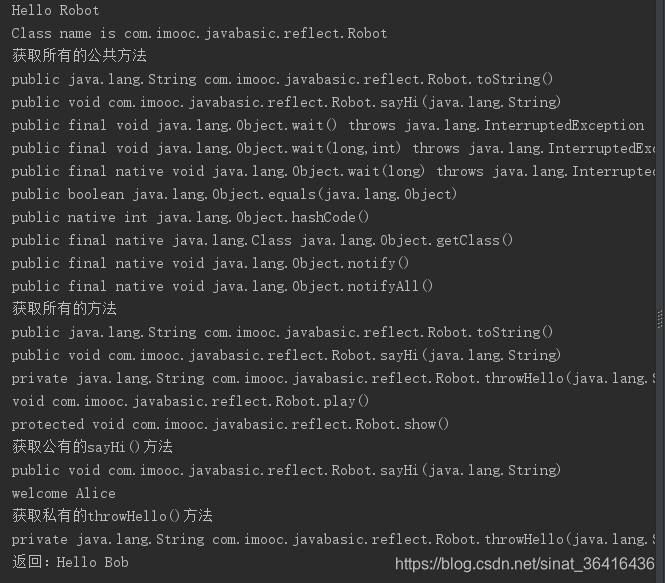
六、通过反射运行配置文件
public class Robot {
    public void show(){
        System.out.println("Hello!!");
    }
    static {
        System.out.println("Hello Robot");
    }
}
public class ReflectSample {
    public static void main(String[] args) throws ClassNotFoundException, IllegalAccessException, InstantiationException, NoSuchMethodException, InvocationTargetException, NoSuchFieldException, IOException {
//        Class rc = Class.forName("com.imooc.javabasic.reflect.Robot");
//        System.out.println("Class name is " + rc.getName());
        //通过反射获取Class对象
        Class rc = Class.forName(getValue("className"));//"com.imooc.javabasic.reflect.Robot"
        //2获取show()方法
        Method m = rc.getMethod(getValue("methodName"));//show
        //3.调用show()方法
        m.invoke(rc.getConstructor().newInstance());
    }

    public static String getValue(String key) throws IOException {
        Properties pro = new Properties();//获取配置文件的对象
        FileReader in = new FileReader(System.getProperty("user.dir")+"/src/"+"test.txt");//获取输入流
        pro.load(in);//将流加载到配置文件对象中
        in.close();
        return pro.getProperty(key);//返回根据key获取的value值
    }
}
test.txt
className = com.imooc.javabasic.reflect.Robot
methodName = show
运行结果: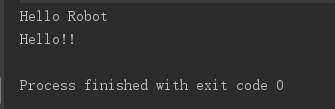
七、总结
反射机制相关类
| 类名 | 用途 |
|---|---|
| Class类 | 代表类的实体,在运行的Java应用程序中表示类和接口 |
| Field类 | 代表类的成员变量(成员变量也称为类的属性) |
| Method类 | 代表类的方法 |
| Constructor类 | 代表类的构造方法 |
Class类
Class代表类的实体,在运行的Java应用程序中表示类和接口。
相关的方法
| 方法 | 用途 |
|---|---|
| getClassLoader() | 获得类的加载器 |
| getClasses() | 返回一个数组,数组中包含该类中所有公共类和接口类的对象 |
| getDeclaredClasses() | 返回一个数组,数组中包含该类中所有类和接口类的对象 |
| forName(String className) | 根据类名返回类的对象 |
| getName() | 获得类的完整路径名字 |
| newInstance() | 创建类的实例 |
| getPackage() | 获得类的包 |
| getSimpleName() | 获得类的名字 |
| getSuperclass() | 获得当前类继承的父类的名字 |
| getInterfaces() | 获得当前类实现的类或是接口 |
属性相关的方法
| 方法 | 用途 |
|---|---|
| getField(String name) | 获得某个公有的属性对象 |
| getFields() | 获得所有公有的属性对象 |
| getDeclaredField(String name) | 获得某个属性对象 |
| getDeclaredFields() | 获得所有属性对象 |
构造器相关的方法
| 方法 | 用途 |
|---|---|
| getConstructor(Class…<?> parameterTypes) | 获得该类中与参数类型匹配的公有构造方法 |
| getConstructors() | 获得该类的所有公有构造方法 |
| getDeclaredConstructor(Class…<?> parameterTypes) | 获得该类中与参数类型匹配的构造方法 |
| getDeclaredConstructors() | 获得该类所有构造方法 |
方法相关的方法
| 方法 | 用途 |
|---|---|
| getMethod(String name, Class…<?> parameterTypes) | 获得该类某个公有的方法或继承实现的方法 |
| getMethods() | 获得该类所有公有的方法以及继承实现的方法 |
| getDeclaredMethod(String name, Class…<?> parameterTypes) | 获得该类某个方法,不能获取继承实现的方法 |
| getDeclaredMethods() | 获得该类所有方法,不能获取继承实现的方法 |
Field类
Field代表类的成员变量(成员变量也称为类的属性)。
| 方法 | 用途 |
|---|---|
| equals(Object obj) | 属性与obj相等则返回true |
| get(Object obj) | 获得obj中对应的属性值 |
| set(Object obj, Object value) | 为obj设置对应属性值 |
Method类
Method代表类的方法。
| 方法 | 用途 |
|---|---|
| invoke(Object obj, Object… args) | 传递方法所属对象及方法实参,并调用对应的方法 |
Constructor类
Constructor代表类的构造器。
| 方法 | 用途 |
|---|---|
| newInstance(Object… initargs) | 根据传递的参数创建类的对象,参数为构造方法初始化参数 |
版权声明:本文为sinat_36416436原创文章,遵循CC 4.0 BY-SA版权协议,转载请附上原文出处链接和本声明。