string简单介绍:
string类需要包含头文件string,string类封装了串的属性并提供了一系列允许访问这些属性的函数。
细节: string并非是一个独立的类,而是类模板basic_string的一个特化实例。
构造函数的原型:
sting(); //默认构造函数,建立一个长度为0的串
string(const string& str); //赋值拷贝
string(const char* s); //用指针s所指向的字符串常量初始化string类的对象。
string(const string& str , size_t pos , size_t n); //将对象str中的串从位置pos开始取n个字符,用来初始化string类的对象
string(const char* s,size_t n); //用指针s指向的字符串中的前n个字符初始化string类的对象。
string(size_t n, char c); //将参数c中的字符重复n次,用来初始化string类的对象。
注意:string类接收const char*类型的构造函数,因此字符串常量和用字符数组表示的字符串变量都可以隐含地转换为string对象。
如下代码所示:
#include<iostream>
#include<string>
using namespace std;

void testString1()
{
	string s1;
	string s2("Hello world!");
	string s3(s2);

	getline(cin, s1);

	cout << s1 << endl;
	cout << s2 << endl;
	cout << s3 << endl;

	string s4(s2, 2, 6);
	cout << s4 << endl;

	string s5(s2, 2);
	cout << s5 << endl;

	string s6(s2, 2, 100);
	cout << s6 << endl;

	string s7("Hello String", 3);
	cout << s7 << endl;

	string s8(10, 'i');
	cout << s8 << endl;


}

int main()
{
	testString1();

	return 0;
}
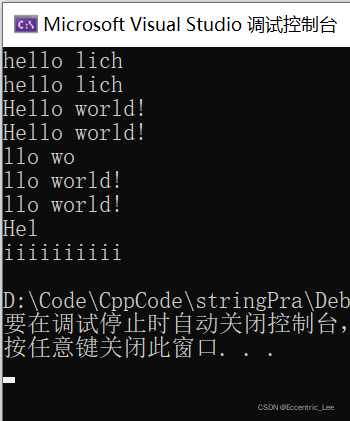
运行结果如下:
常用的函数:
void testString2()
{
	string s1;
	getline(cin ,s1);	//如果单独使用cin不包含作为结尾标识符的\0

	cout << s1.size() << endl;
	cout << s1.length() << endl;
	cout << s1.max_size() << endl; //返回容器s1可容纳的最多元素个数
	cout << s1 << endl;

	cout << s1.capacity() << endl;	//返回容器s1在需要重新分配更多存储空间之前能够存储的元素总数
	s1.clear();
	cout << "s1:" << s1 << endl;
	cout << s1.capacity() << endl;
}

int main()
{
	testString2();

	return 0;
}
运行如下: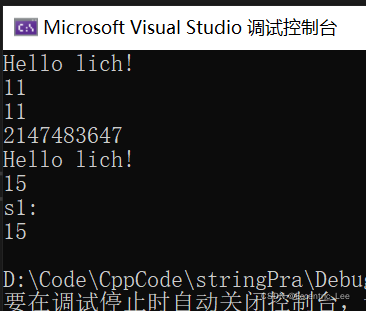
void testString3()
{
	string s1("Hello lich");
	cout << s1 << endl;

	for (size_t i = 0; i < s1.size(); i++)
	{
		cout << s1.operator[](i) << " ";
	}
	cout << endl;
	for (size_t i = 0; i < s1.size(); i++)
	{
		cout << s1[i] << " ";
	}
	cout << endl;

	for (size_t i = 0; i < s1.size(); ++i)
	{
		s1[i] += 1;
	}
	cout << endl;
	cout << s1 << endl;

	for (size_t i = 0; i < s1.size(); i++)
	{
		s1.at(i) -= 1;	//at(n)表示返回下标为n的元素的引用
	}
	cout << endl;
	cout << s1 << endl;

}
int main()
{
	testString3();

	return 0;
}
运行结果如下: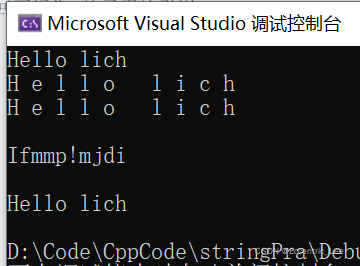
void testString4()
{
	string s1;
	s1.push_back('h');	//push_back()插入字符
	s1.append("ello lich ");
	cout << s1 << endl;

	s1 += ':';
	s1 += "studying cpp.";

	cout << s1 << endl;
}
int main()
{
	testString4();

	return 0;
运行结果如下: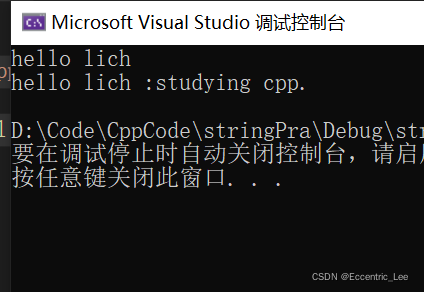
reserve()函数:申请存储字节空间
void test_string3()
{
	string s;
	s.reserve(1000);
	//申请至少能存储1000个字符的空间
	size_t sz = s.capacity();


	for (int i = 0; i < 1000; i++)
	{
		s += 'd';
		if (sz != s.capacity())
		{
			sz = s.capacity();
			cout << "capacity change():" << sz << '\n';
		}
	}
}

int main()
{
	string s1("hello lich");
	test_string3();

	return 0;
}
**resize()函数:**将有效字符的个数该成n个,多出的空间用字符c填充
void test_string4()
{
	string s1;
	s1.reserve(100); //申请100个字符的存储空间
	cout << s1.capacity() << endl;

	string s2;
	s2.resize(100, 'x');
	cout << s2 << endl;
	cout << s2.capacity() << endl;

	string s3("hello lich");
	cout << s3.capacity() << endl;
	s3.resize(100);
	cout << s3 << endl;
	cout << s3.capacity() << endl;

	string s5("hello world");
	s5.resize(5);
	cout << s5 << endl;
	cout << s5.size() << endl;
	cout << s5.capacity() << endl;


}
int main()
{
	string s1("hello lich");
	test_string4();

	return 0;
}
运行如下: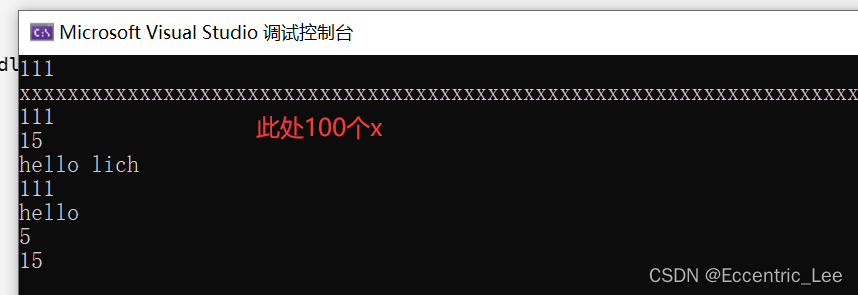
c_str()函数: 返回C格式字符串
我们常用到c_str的形式如:string file(“test.txt”); FILE fout = fopen(file.c_str(), “w”);* 读取文件时,将文件名转化为C格式字符串。
find()函数与substr()函数:
void test_string5()
{
	//取出后缀
	string file("test.cpp.zip");
	size_t pos = file.rfind('.');
	if (pos != string::npos)
	{
		string suffix = file.substr(pos);
		cout << suffix << endl;
	}
}
int main()
{
	string s1("hello lich");
	test_string5();

	return 0;
}
运行如下: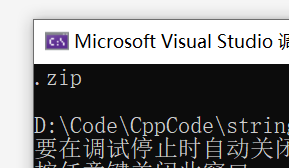
void test_string6()
{
	string url("https://editor.csdn.net/md?articleId=123302085");

	size_t pos1 = url.find(':');
	string protocal = url.substr(0, pos1);
	size_t pos2=url.find('/',pos1+3);
	string domain = url.substr(pos1 + 3, pos2 - (pos1 + 3));

	cout << protocal << endl;
	cout << domain << endl;
}
运行结果: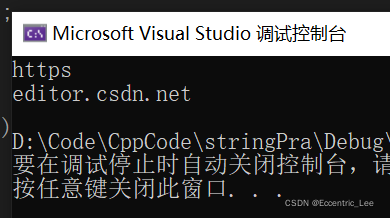
insert()函数:
void test_string7()
{
	string s("hello lich");
	s += ' ';
	s += "!!!!";
	cout << endl;

	s.insert(0, 2, 'w');
	s.insert(s.begin(), 'o');
	s.insert(0, "test");
	cout << s << endl;

	//中间位置插入
	s.insert(4, "****");
	cout << s << endl;
}
int main()
{
	string s1("hello lich");
	test_string7();

	return 0;
}
运行结果如下: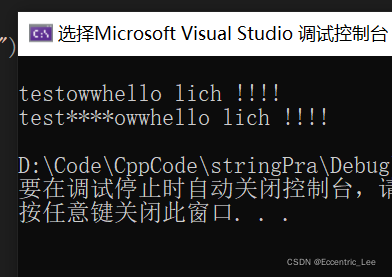
earse()函数:
void test_string8()
{
	string s("hello lich");
	s.erase(0, 2);
	cout << s << endl;
	s.erase(s.size() -1, 1);
	cout << s << endl;

	string s1("hello string");

	s1.erase(0, 3);
	cout << s1 << endl;

	s1.erase(3);
	cout << s1 << endl;

}
int main()
{
	string s1("hello lich");
	test_string8();

	return 0;
}
运行结果如下: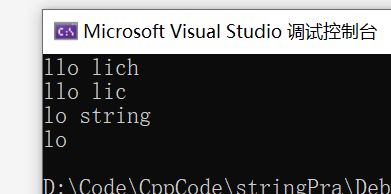
遍历字符串的几种方式:
#include<iostream>
#include<string>
using namespace std;

//遍历字符串
void test_string1()
{
	string s1("hello world");

	//case 1:下标方式
	for (size_t i = 0; i < s1.size(); i++)
	{
		s1[i] += 1;
	}
	for (size_t i = 0; i < s1.size(); i++)
	{
		cout << s1[i] << " ";
	}
	cout << endl;

	//case 2:迭代器
	string::iterator it = s1.begin();
	while (it != s1.end())
	{
		*it -= 1;
		++it;
	}
	cout << endl;
	it = s1.begin(); //迭代器的实质是指针,回到起始位置

	while (it != s1.end())
	{
		cout << *it << " ";
		it++;
	}
	cout << endl;

	//case 3:C++11中auto 范围for往后自动迭代,自动判断结束
	for (auto& e : s1)
	{
		e += 1;
	}
	for (auto e : s1)
	{
		cout << e << " ";
	}
	cout << endl;

}

int main()
{
	test_string1();

	return 0;
}
运行代码如下: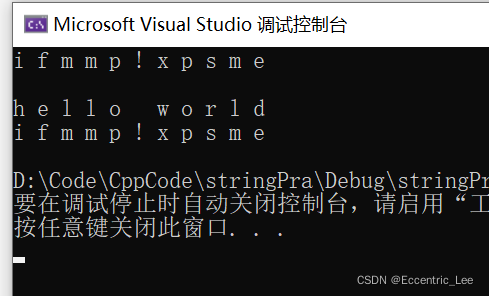
其中迭代器iterator也有两种,分别为:string::iterator 和 string::const_iterator ,前者字符串内容可以修改,后者内容不可以修改。
如下代码所示:
void test_string2(const string& s)
{
	//等价于:string::const_iteratot it=s.begin();
	auto it = s.begin();
	while (it != s.end())
	{
		//无法修改字符串中的内容
		cout << *it << " ";
		it++;
	}
	cout << endl;

	//反向迭代器
	string::const_reverse_iterator rit = s.rbegin();
	while (rit != s.rend())
	{
		cout << *rit << " ";
		rit++;
	}
	cout << endl;

}

int main()
{
	string s1("hello lich");
	test_string2(s1);

	return 0;
}
运行如下: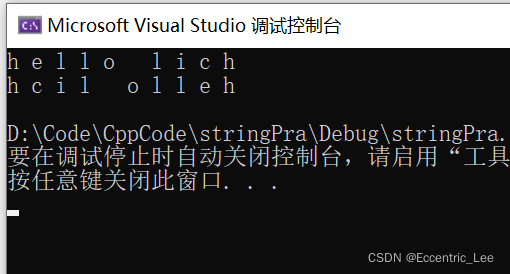
C++找字串:
int frequency(char* substr, char* str)
{
	int n = 0, s1 = 0, s2 = 0;
	s1 = strlen(str);
	s2 = strlen(substr);

	while (s1 >= s2)//字符串长度小于字串就放弃找字串
	{

		str = strstr(str, substr);
		if (str != 0)
		{
			n++;
			str += s2;//长串从找到子串的位置开始后移一个子串的长度
		}
		else
		{
			break;
		}

	}

	return n;
}
int main()
{
	char sub[128], str[1024];
	cin.getline(sub, 128);     // 输入子串
	cin.getline(str, 1024);     // 输入长串
	int n = frequency(sub, str);
	cout << n << endl;     // 输出次数
	return 0;
}
结果如下: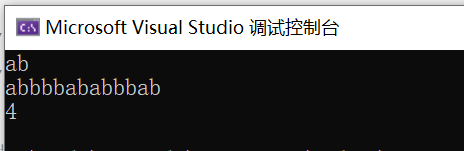
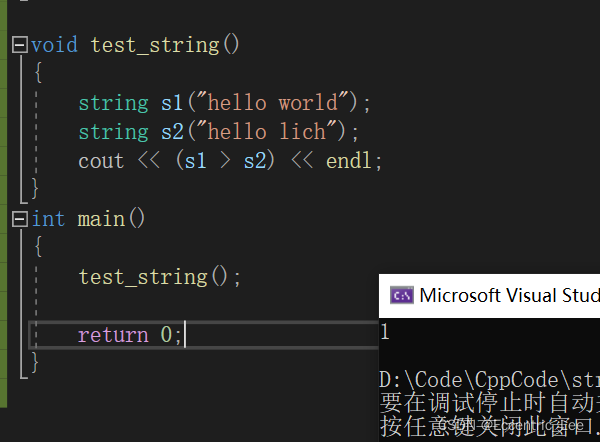
字符串的比较大小: