写在前面:本博客为本人原创,严禁任何形式的转载!本博客只允许放在博客园(.cnblogs.com),如果您在其他网站看到这篇博文,请通过下面这个唯一的合法链接转到原文!
本博客全网唯一合法URL:http://www.cnblogs.com/acm-icpcer/p/9173880.html
基于C++语言实现的PL/0语言的算术表达式的自下而上的语法分析程序。该语言的其他语法实现思想与此一致,故不赘述。
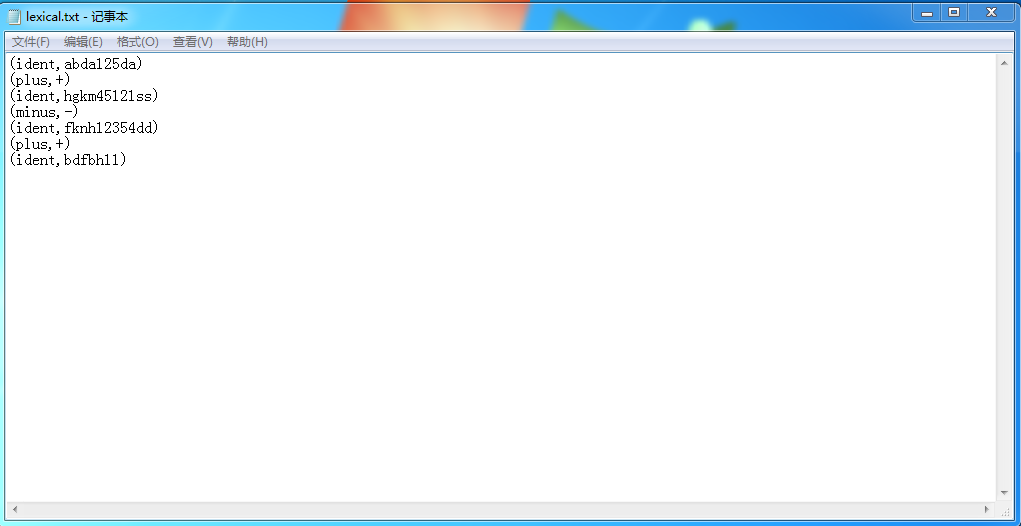
运行此程序前,必须先将代码通过:【编译原理】c++实现词法分析器的词法分析,生成词法表(词法表是txt文件,为了语法分析成功,务必删除文件中最后空着的一行,即文件末尾不可以留空白行)。生成的该词法表为此程序的必要输入。
产生式:
S->X(AX)*|AX(AX)*
X->Y(MY)*
Y->I|N|(S)
A->+|-
M->*|/
C->=|#||>=
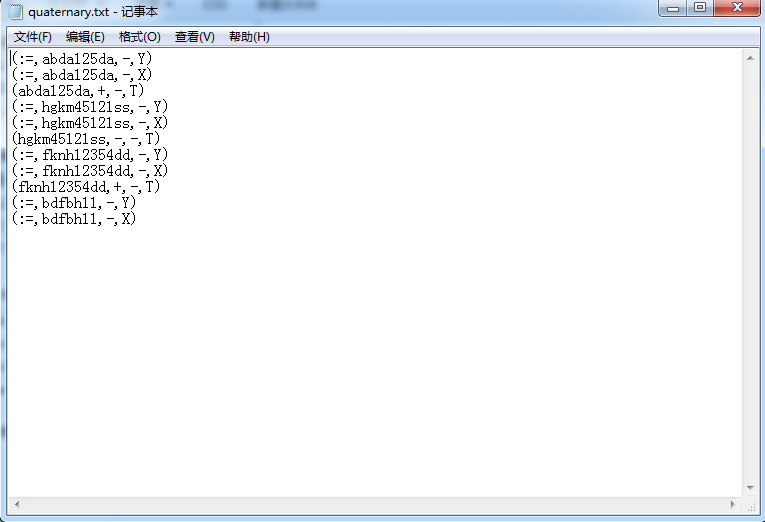
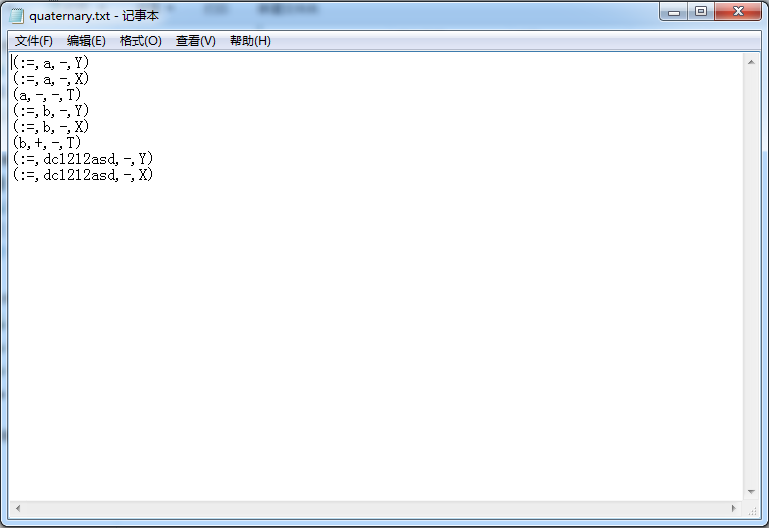
本次的代码主要是在【编译原理】c++实现自下而上语法分析器的基础上,伴随着归约的过程,增加了生成四元式的过程,也就是一边归约一边生成中间代码。
Talk is cheap, show you my source code:
/*
this code was first initiated by TZ,COI,HZAU
contact email:xmb028@163.com
personal website:wnm1503303791.github.io
personal blogs:www.cnblogs.com/acm-icpcer/
this code has been posted on my personal blog,checking url:www.cnblogs.com/acm-icpcer/p/9173880.html
Copyright 2018/6/12 TZ.
All Rights Reserved.
*/
#include
#include
#include
#include
#include
#include
#include
#include
#include
#include
#include
#include
#include
#include
#include
#include
using namespace std;
//预处理函数
bool preproccess(char *a,char *b,char *c)
{
int i1=,i2=;//i2为原串指针
memset(b,,'\0');
while(a[i2]!=',')
{
b[i1]=a[i2];
++i1,++i2;
}
b[i1]='\0';
i1=;i2++;
while(a[i2]!=')')
{
c[i1]=a[i2];
++i1,++i2;
}
c[i1]='\0';
//cout<
return true;
}
fstream f2("stack.txt", ios::out);//打开文件,供写
fstream f3("quaternary.txt", ios::out);//打开文件,供写
static int mcount=;//存储打印次数
//当移进或者归约时打印栈内情况,以供分析
bool outf(int head,char data[][],fstream &f)
{
f<
f<
for(int i=head;i>=;i--)
{
f<
}
mcount++;
f<
return true;
}
//四元式写入文件函数1
bool outf2(int top,char dt[][],fstream &f)
{
/*
char arg1[1024],arg2[1024],op[1024];
memset(arg1,sizeof(arg1),'\0');
strcpy(arg1,dt[top]);
memset(op,sizeof(op),'\0');
strcpy(op,dt[top-1]);
memset(arg2,sizeof(arg2),'\0');
strcpy(arg2,dt[top-2]);
f<
*/
f<
return true;
}
//四元式写入文件函数2
bool outf3(int top,char dt[][],fstream &f)
{
f<
return true;
}
//四元式写入文件函数3
bool outf4(int top,char dt[][],fstream &f,char T)
{
f<
return true;
}
//“策略”设计模式,面向对象方法
class presentation
{
private:
char data[][];//栈
char dt[][];//四元式栈
fstream *infile;//词法分析表
int head,top;//两个栈的栈顶指针
public:
//first initiated the object
presentation(fstream *in_f)
{
this->infile=in_f;
memset(data,sizeof(data),'\0');
memset(dt,sizeof(dt),'\0');
head=top=-;
}
bool push()
{
head++;
top++;
infile->getline(data[head],);
char t1[],t2[];//存放字符标志
preproccess(data[head],t1,t2);
cout<
memset(data[head],,'\0');
strcpy(data[head],t1);
memset(dt[top],,'\0');
strcpy(dt[top],t2);
cout<
}
/*
S->X(AX)*|AX(AX)*
X->Y(MY)*
Y->I|N|(S)
A->+|-
M->*|/
C->=|#||>=
*/
//归约函数
bool reduce()
{
//S->X(AX)*|AX(AX)*
if( head>=&&
(!strcmp(data[head],"X"))&&
(!strcmp(data[head-],"plus")||!strcmp(data[head-],"minus"))&&
(!strcmp(data[head-],"X"))&&
(!strcmp(data[head-],"plus")||!strcmp(data[head-],"minus"))&&
(!strcmp(data[head-],"X"))
)
{
memset(data[head],,'\0');
memset(data[head-],,'\0');
memset(data[head-],,'\0');
memset(data[head-],,'\0');
memset(data[head-],,'\0');
head=head-+;
strcpy(data[head],"S");//归约
/*
stack description:
top-> arg
op
top-2-> arg
op
arg
*/
if(outf2(top,dt,f3)&&outf2(top-,dt,f3))
{
top==-;
memset(dt,sizeof(dt),'\0');
}
return true;
}
if( head>=&&
(!strcmp(data[head],"X"))&&
(!strcmp(data[head-],"plus")||!strcmp(data[head-],"minus"))&&
(!strcmp(data[head-],"X"))
)
{
memset(data[head],,'\0');
memset(data[head-],,'\0');
memset(data[head-],,'\0');
head=head-+;
strcpy(data[head],"S");
if(outf2(top,dt,f3))
{
top==-;
memset(dt,sizeof(dt),'\0');
}
return true;
}
if( head>=&&/*top>=3*/
(!strcmp(data[head],"plus")||!strcmp(data[head],"minus"))&&
(!strcmp(data[head-],"X"))&&
(!strcmp(data[head-],"plus")||!strcmp(data[head-],"minus"))&&
(!strcmp(data[head-],"X"))
)
{
memset(data[head],,'\0');
memset(data[head-],,'\0');
memset(data[head-],,'\0');
memset(data[head-],,'\0');
head=head-+;
strcpy(data[head],"S");
if(outf3(top,dt,f3)&&outf3(top-,dt,f3))
{
top==-;
memset(dt,sizeof(dt),'\0');
}
return true;
}
if( head>=&&
(!strcmp(data[head],"plus")||!strcmp(data[head],"minus"))&&
(!strcmp(data[head-],"X"))
)
{
memset(data[head],,'\0');
memset(data[head-],,'\0');
head=head-+;
strcpy(data[head],"S");
if(outf3(top,dt,f3))
{
top==-;
memset(dt,sizeof(dt),'\0');
}
return true;
}
//X->Y(MY)*
if( head>=&&
(!strcmp(data[head],"Y"))&&
(!strcmp(data[head-],"times")||!strcmp(data[head-],"slash"))&&
(!strcmp(data[head-],"Y"))&&
(!strcmp(data[head-],"times")||!strcmp(data[head-],"slash"))&&
(!strcmp(data[head-],"Y"))
)
{
memset(data[head],,'\0');
memset(data[head-],,'\0');
head=head-+;
strcpy(data[head],"X");
/*
current stack description:
top-> arg
op
top-2-> arg
op
arg
*/
if(outf2(top,dt,f3)&&outf2(top-,dt,f3))
{
top==-;
memset(dt,sizeof(dt),'\0');
}
return true;
}
if( head>=&&
(!strcmp(data[head],"Y"))&&
(!strcmp(data[head-],"times")||!strcmp(data[head-],"slash"))&&
(!strcmp(data[head-],"Y"))
)
{
memset(data[head],,'\0');
memset(data[head-],,'\0');
memset(data[head-],,'\0');
head=head-+;
strcpy(data[head],"X");
/*
current stack description:
top->arg
op
arg
*/
if(outf2(top,dt,f3))
{
top==-;
memset(dt,sizeof(dt),'\0');
}
return true;
}
if( head>=&&(!strcmp(data[head],"Y"))
)
{
memset(data[head],,'\0');
head=head-+;
strcpy(data[head],"X");
if(outf4(top,dt,f3,'X'))
{
top==-;
memset(dt,sizeof(dt),'\0');
}
return true;
}
//Y->I|N|(S)
if( head>=&&(!strcmp(data[head],"ident"))
)
{
memset(data[head],,'\0');
head=head-+;
strcpy(data[head],"Y");
if(outf4(top,dt,f3,'Y'))
{
top==-;
memset(dt,sizeof(dt),'\0');
}
return true;
}
if( head>=&&(!strcmp(data[head],"number"))
)
{
memset(data[head],,'\0');
head=head-+;
strcpy(data[head],"Y");
if(outf4(top,dt,f3,'Y'))
{
top==-;
memset(dt,sizeof(dt),'\0');
}
return true;
}
if( head>=&&
(!strcmp(data[head],"rparen"))&&
(!strcmp(data[head-],"S"))&&
(!strcmp(data[head-],"lparen"))
)
{
memset(data[head],,'\0');
memset(data[head-],,'\0');
memset(data[head-],,'\0');
head=head-+;
strcpy(data[head],"Y");
return true;
}
return false;
}
//遍历栈
bool visit_data()
{
cout<
for(int i=head;i>=;i--)
{
cout<
}
return true;
}
//主控函数
bool mainf()
{
while(!infile->eof())
{
push();
bool t=reduce();
outf(head,data,f2);
//每当移进结束时就检查一下是否有可规约串
while(t)//防止规约嵌套
{
t=reduce();
outf(head,data,f2);
}
//visit_data();
}
visit_data();
bool flag=false;
for(int i=head;i>=;i--)
{
if(!strcmp(data[i],"S"))
{
flag=true;
}
if( strcmp(data[i],"S")&&
strcmp(data[i],"X")&&
strcmp(data[i],"A")&&
strcmp(data[i],"Y")&&
strcmp(data[i],"M")&&
strcmp(data[i],"C")
)
{
return false;
}
}
return flag;
/*
while(head>0)
{
bool t=reduce();
//每当移进结束时就检查一下是否有可规约串
while(t)//防止规约嵌套
{
t=reduce();
}
//visit_data();
outf(head,data,f2);
}
*/
}
};
int main()
{
fstream f1;
f1.open("lexical.txt", ios::in);//打开词法分析表,供读
presentation* s1=new presentation(&f1);
bool result=s1->mainf();
if(result)
cout<
else
cout<
f1.close();
f2.close();
return ;
}
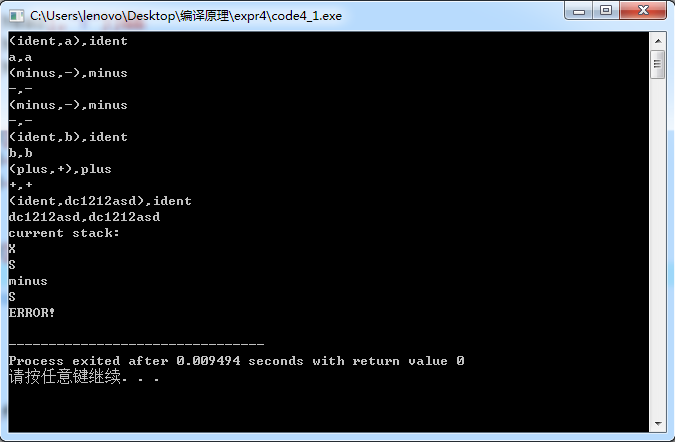
运行示例:
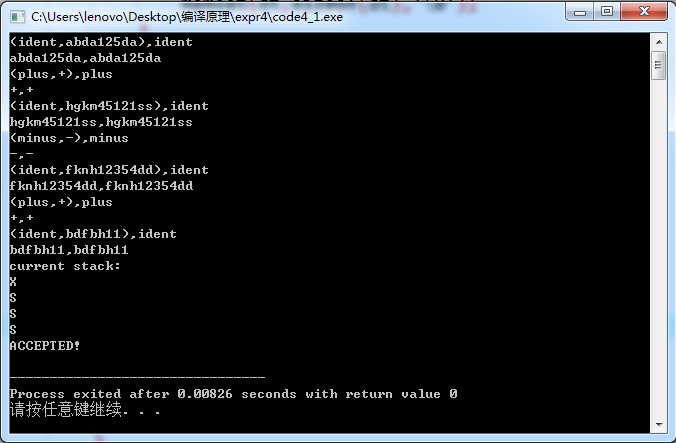
(1)合法的语句:
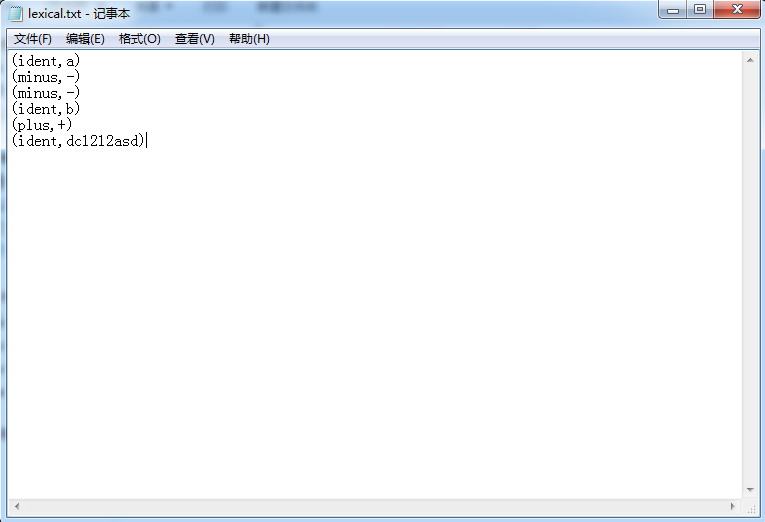
(2)不合法的语句:
tz@COI HZAU
2018/6/12
现代编译原理——第二章:语法分析之LL(K)
转自: http://www.cnblogs.com/BlackWalnut/p/4472122.html LL(K)语法分析技术是建立在预测分析的技术之上的.我们先来了解预测分析技术.考虑以下文法: ...
编译原理 #04# 中缀表达式转化为四元式(JavaScript实现)
// 实验存档 运行截图: 代码中的总体转化流程:中缀表达式字符串→tokens→逆波兰tokens(即后缀表达式)→四元式. 由后缀表达式写出四元式非常容易,比较繁琐的地方在于中缀转逆波兰,这里采用 ...
编译原理实验之SLR1文法分析
---内容开始--- 这是一份编译原理实验报告,分析表是手动造的,可以作为借鉴. 基于 SLR(1) 分析法的语法制导翻译及中间代码生成程序设计原理与实现1 .理论传授语法制导的基本概念,目标代码结 ...
编译原理(一)绪论概念&;文法与语言
绪论概念&文法与语言 以老师PPT为标准,借鉴部分教材内容,AlvinZH学习笔记. 绪论基本概念 1. 低级语言:字位码.机器语言.汇编语言.与特定的机器有关,功效高,但使用复杂.繁琐.费时 ...
MOOC 编译原理笔记(一):编译原理概述以及程序设计语言的定义
编译原理概述 什么是编译程序 编译程序指:把某一种高级语言程序等价地转换成另一张低级语言程序(如汇编语言或机器代码)的程序. 高级语言程序-翻译->机器语言程序-运行->结果. 其中编译程 ...
编译原理_P1004
龙书相关知识点总结 //*************************引论***********************************// 1. 编译器(compiler):从一中语言( ...
python实现算术表达式的词法语法语义分析(编译原理应用)
本学期编译原理的一个大作业,我的选题是算术表达式的词法语法语义分析,当时由于学得比较渣,只用了递归下降的方法进行了分析. 首先,用户输入算术表达式,其中算术表达式可以包含基本运算符,括号,数字,以及用 ...
《编译原理》控制流语句 if 和 while 语句的翻译 - 例题解析
控制流语句 if 和 while 语句的翻译 - 例题解析 将 if 和 while 语句翻译成四元式 注:不同教材会有小差异,使用 _ 或者 - ,如果是 -,请注意区分 - ...
Java 实现《编译原理》中间代码生成 -逆波兰式生成与计算 - 程序解析
Java 实现中间代码生成 -逆波兰式生成与计算 - 程序解析 编译原理学习笔记 (一)逆波兰式是什么? 逆波兰式(Reverse Polish notation,RPN,或逆 ...
随机推荐
安裝 14.04.1 Ubuntu 到 Lenovo thinkpad t460p
在 Lenovo Thinkpad T460p 安裝 ubuntu, BIOS 需要做一些設定, 沒設定的現象:不斷地停在 usb disk 設定 可以 使用 usb disk install 了!
iframe框架在IE浏览器,360兼容浏览器下将白色背景设为透明色
iframe在大部分浏览 ...
定时任务 Crontab命令 详解
crontab是Unix和Linux用于设置周期性被执行的指令,是互联网很常用的技术,很多任务都会设置在crontab循环执行,如果不使用 crontab,那么任务就是常驻程序,这对你的程序要求比较高 ...
php拓展ssh功能
1.下载拓展ssh需要的两个软件包,libssh2和ssh2. libssh2下载地址:http://pan.baidu.com/s/1hq7XOhu libssh2官网下载地址:http://www ...
【ASP.NET Web API教程】2.3.7 创建首页
原文:[ASP.NET Web API教程]2.3.7 创建首页 注:本文是[ASP.NET Web API系列教程]的一部分,如果您是第一次看本博客文章,请先看前面的内容. Part 7: Crea ...
maven 项目中使用 jstl标签
在pom.xml文件下面增加如下的依赖包: javax.servlet
voa 2015 / 4 / 14
Even with falling oil prices and strong U.S. growth, the head of the International Monetary Fund sai ...
Typecho——数据库无法连接问题
报错 对不起,无法连接数据库,请先检查数据库配置再继续进行安装 解决方案 创建数据库 reate database databaseName; 远程权限 开启远程权限 GRANT ALL PRIVIL ...
maven 总结整理(二)——download source code
当我们用maven下载jar包时,有时希望下载jar包的源代码,此时可以在pom.xml文件中,进行设置. WebProject&l ...
sysbench压力工具报错:
[root@ sysbench-]# /usr/local/sysbench/bin/sysbench --version : cannot open shared object file: No s ...