以下是一个对线性表的初始化、取值、查找、插入和删除的实现过程,接下来我们主要讨论这5个主要操作的实现。现在我们来单独看一下每一个操作是怎么实现的。
(1)初始化
顺序表的初始化操作就是构造出一个空的顺序表,首先我们对顺序表进行初始化,代码如下:
typedef struct SequentialList
 {
 	int actualLength;//定义最初始的实际长度
 	int data[LIST_MAX_LENGTH];//最大长度
 }*SequentialListPtr;
(2)取值
接下来就是取值,我们需要输出顺序表的顺序,可以通过设计一个函数来进行判断,是否可以装下顺序表的实际长度。代码:
void outputList(SequentialListPtr paraList)//设计一个函数,输出所有包含的顺序表,并进行判断是否可以装下整个线性表的实际长度
 {
 	for(int i=0;i<paraList->actualLength;i++)
 	{
 		printf("%d",paraList->data[i]);
	 }//of for i
	 printf("\r\n");
  }
此外,我们还需要把每一块的地址给打印出来:
void outputmemory(SequentialListPtr paraListPtr)
{
printf("the address of the structure: %ld\r\n",paraListPtr);
printf("the address of the actualLength: %ld\r\n",¶ListPtr->actualLength);
printf("the address of the data: %ld\r\n",¶ListPtr->data);
printf("the address of the actual data: %ld\r\n",¶ListPtr->data[0]);
printf("the address of the second data: %d\r\n",¶ListPtr->data[1]);
}//of outputmemory我们将地址存放到data数组中,以此查找:
	SequentialListPtr sequentialListInit(int paraData[],int paraLength)
	{
		SequentialListPtr resultPtr = (SequentialList*)malloc(sizeof(SequentialList));
		for (int i=0;i<paraLength;i++)
		{
			resultPtr->data[i]=paraData[i];
		}//of for i
		resultPtr->actualLength = paraLength;
		return resultPtr;
	}//of sequentialListInit
(3)插入
我们接下来就要设计插入的函数了,将原先已经存放好的顺序表进行插入:
	void sequentialListInsert(SequentialListPtr paraListPtr,int paraPosition,int paraValue)//对顺序表的长度进行判断,如果不能则无法插入
	{
		//step 1.对存储空间进行检查
		if(paraListPtr->actualLength>=LIST_MAX_LENGTH)
		{
			printf("Cannot insert element: list full.\r\n");
			return;
		}//of if

		//step 2.对存储位置进行检查
		if(paraPosition<0)
		{
			printf("cannot insert element: nagative position unsupported.");
		}
		if(paraPosition>paraListPtr->actualLength)
		{
			printf("Cannot insert element: the position %d is bigger than the list length %d.\r\n",paraPosition, paraListPtr->actualLength);
			return;
		}//of if

		//step 3.移动剩余的部分
		for(int i=paraListPtr->actualLength;i>paraPosition;i--)
		{
			paraListPtr->data[i] = paraListPtr->data[i-1];
		}//of for i

		//step 4.开始插入
		paraListPtr->data[paraPosition]= paraValue;

		//更新顺序表的长度
		paraListPtr->actualLength ++;


		 }//of sequentialListInsert
插入之后我们还要设计一个测试插入的函数来验证:
void sequentialInsertTest()
		  {
		  	int i;
		  	int tempArray[5]={3,5,2,7,4};

		  	printf("----sequentialInsertTest begins. ----\r\n");

		  	//进行初始化.
		  	SequentialListPtr tempList = sequentialListInit(tempArray,5);
		  	printf("After initialization, the list is:");
		  	outputList(tempList);

		  	//插入第一个.
		  	printf("now insert to the first,the list is:");
		  	sequentialListInsert(tempList,0,8);
		  	outputList(tempList);

		  	//插入最后一个.
		  	printf("now insert to the last,the list is:");
		  	sequentialListInsert(tempList,6,9);
		  	outputList(tempList);

		  	//插入尾端.
		  	printf("now insert beyond the tail.\r\n");
		  	sequentialListInsert(tempList,8,9);
		  	printf("the list is:");
		  	outputList(tempList);

		  	//插入位置0-4,程序位置10-14
		  	for(i = 0;i<5;i++)
		  	{
		  		printf("Inserting %d.\r\n",(i+10));
		  		sequentialListInsert(tempList,0,(i+10));
		  		outputList(tempList);
			  }//of for i
			  printf("---- sequentialInsertTest ends. ----\r\n");
			   }//of sequentialInsertTest
(4)删除
我们需要设计一个删除测试的函数以及测试删除的函数:
int sequentialListDelete(SequentialListPtr paraListPtr,int paraPosition)//设计一个删除测试的函数
                {
                    //step 1.存储位置的检查.
                    if(paraPosition<0)//如果位置无效则需说明无效位置
                    {
                        printf("Invalid position: %d.\r\n",paraPosition);
                        return -1;

                    }//of if

                    //step 2.移动剩余的部分.
                    int resultValue = paraListPtr->data[paraPosition];
                    for(int i = paraPosition; i<paraListPtr->actualLength;i++);
                    {
                            int i=5;
                        paraListPtr->data[i] = paraListPtr->data[i+1];
                    }//of for i

                    //step 3.更新顺序表的长度.
                    paraListPtr->actualLength --;

                    //step 4.返回结果.
                    return resultValue;
                     }//of sequatialListDelete


                     /**
                      * 测试删除功能.
                      */
                      void sequentialDeleteTest()
                      {
                          int tempArray[5] = {3,5,2,7,4};
                          printf("After initialization, the list is:");

                          //初始化.
                          SequentialListPtr tempList = sequentialListInit(tempArray,5);
                          printf("After initialization, the list is:");
                          outputList(tempList);

                          //删除第一个.
                          printf("now delete the first,the list is:");
                          sequentialListDelete(tempList,0);
                          outputList(tempList);

                          //删除最后一个.
                          printf("now delete the last,the list is:");
                          sequentialListDelete(tempList,3);
                          outputList(tempList);

                          //依次删除.
                          printf("now delete the second,the list is:");
                          sequentialListDelete(tempList,1);
                          outputList(tempList);

                          //同理.
                          printf("now delete the 5th,the list is:");
                          sequentialListDelete(tempList,5);
                          outputList(tempList);

                          //(此处省略).
                          printf("now delete the (-6)th,the list is:");
                          sequentialListDelete(tempList,-6);
                          outputList(tempList);

                          printf("---- sequentialDeleteTest ends. ----\r\n");

                          outputmemory(tempList);
                           }//of sequentialDeleteTest
最后我们将函数放到主函数里面便可以正常的实现各个功能了。
int main()//最后放到主函数里面编译并运行
	                    {
	                    	sequentialInsertTest();
	                    	sequentialDeleteTest();
						}//of main
对于GetElement(L,i)函数,即返回线性表L中下标为i的元素:
int getElement(SequentialListPtr paraListPtr, int paraPosition) {

    if (paraPosition < 0) {
        printf("Invalid position: %d.\r\n", paraPosition);
        return -1;
    }

    if (paraPosition >= paraListPtr->actualLength) {
        printf("Cannot delete element: the position %d is beyond the list length %d.\r\n", paraPosition, paraListPtr->actualLength);
        return -1;
    }

	return paraListPtr->data[paraPosition];
}
同理,LocateElement(L,e),在线性表L里查找指定元素e,若查找成功,返回e在L中的坐标,若查找不成功,则返回-1
int locateElement(SequentialListPtr paraListPtr, int paraValue) {
	for (int i = 0; i < paraListPtr->actualLength; i ++) {
		if (paraListPtr->data[i] == paraValue) {
			return i;
		}
	}
清零函数:
void clearList(SequentialListPtr paraListPtr) {
	paraListPtr->actualLength = 0;
}
以下是总代码:
#include<stdio.h>
#include<malloc.h>
#define LIST_MAX_LENGTH 10
/**
* 顺序表的基本操作包括初始化,取值,查找 ,插入,删除
*/
typedef struct SequentialList
{
int actualLength;//定义最初始的实际长度
int data[LIST_MAX_LENGTH];//最大长度
}*SequentialListPtr;
/**
* 输出顺序表
*/
void outputList(SequentialListPtr paraList)//设计一个函数,输出所有包含的顺序表,并进行判断是否可以装下整个线性表的实际长度
{
for(int i=0;i<paraList->actualLength;i++)
{
printf("%d",paraList->data[i]);
}//of for i
printf("\r\n");
}
/**
*为输出的线性表请求出一块地址
*/
void outputmemory(SequentialListPtr paraListPtr)
{
printf("the address of the structure: %ld\r\n",paraListPtr);
printf("the address of the actualLength: %ld\r\n",¶ListPtr->actualLength);
printf("the address of the data: %ld\r\n",¶ListPtr->data);
printf("the address of the actual data: %ld\r\n",¶ListPtr->data[0]);
printf("the address of the second data: %d\r\n",¶ListPtr->data[1]);
}//of outputmemory
/**
*Initialize a sequential list. No error checking for this function.
*@param paraListPtr The pointer to the list. It must be a pointer to change the list.
*@param paraValues An int array storing all elements.
*/
SequentialListPtr sequentialListInit(int paraData[],int paraLength)
{
SequentialListPtr resultPtr = (SequentialList*)malloc(sizeof(SequentialList));
for (int i=0;i<paraLength;i++)
{
resultPtr->data[i]=paraData[i];
}//of for i
resultPtr->actualLength = paraLength;
return resultPtr;
}//of sequentialListInit
/**
*Insert an element into a sequential linear list.
*@param paraListPtr the pointer to the list. it must be a pointer to change the list.
*@param para Values the value to be inserted.
*/
void sequentialListInsert(SequentialListPtr paraListPtr,int paraPosition,int paraValue)//对顺序表的长度进行判断,如果不能则无法插入
{
//step 1.对存储空间进行检查
if(paraListPtr->actualLength>=LIST_MAX_LENGTH)
{
printf("Cannot insert element: list full.\r\n");
return;
}//of if
//step 2.对存储位置进行检查
if(paraPosition<0)
{
printf("cannot insert element: nagative position unsupported.");
}
if(paraPosition>paraListPtr->actualLength)
{
printf("Cannot insert element: the position %d is bigger than the list length %d.\r\n",paraPosition, paraListPtr->actualLength);
return;
}//of if
//step 3.移动剩余的部分
for(int i=paraListPtr->actualLength;i>paraPosition;i--)
{
paraListPtr->data[i] = paraListPtr->data[i-1];
}//of for i
//step 4.开始插入
paraListPtr->data[paraPosition]= paraValue;
//更新顺序表的长度
paraListPtr->actualLength ++;
}//of sequentialListInsert
/**
* 设计一个测试插入的函数
*/
void sequentialInsertTest()
{
int i;
int tempArray[5]={3,5,2,7,4};
printf("----sequentialInsertTest begins. ----\r\n");
//进行初始化.
SequentialListPtr tempList = sequentialListInit(tempArray,5);
printf("After initialization, the list is:");
outputList(tempList);
//插入第一个.
printf("now insert to the first,the list is:");
sequentialListInsert(tempList,0,8);
outputList(tempList);
//插入最后一个.
printf("now insert to the last,the list is:");
sequentialListInsert(tempList,6,9);
outputList(tempList);
//插入尾端.
printf("now insert beyond the tail.\r\n");
sequentialListInsert(tempList,8,9);
printf("the list is:");
outputList(tempList);
//插入位置3.
for(i = 0;i<5;i++)
{
printf("Inserting %d.\r\n",(i+10));
sequentialListInsert(tempList,0,(i+10));
outputList(tempList);
}//of for i
printf("---- sequentialInsertTest ends. ----\r\n");
}//of sequentialInsertTest
/**
*delete an element from a sequential linear list.
*@param paraListPtr the pointer to the list.it must be a pointer to change the list.
*@param paraPosition the position,e.g,0 stands for inserting at the first position.
*@return the delete value.
*/
int sequentialListDelete(SequentialListPtr paraListPtr,int paraPosition)//设计一个删除测试的函数
{
//step 1.存储位置的检查.
if(paraPosition<0)//如果位置无效则需说明无效位置
{
printf("Invalid position: %d.\r\n",paraPosition);
return -1;
}//of if
//step 2.移动剩余的部分.
int resultValue = paraListPtr->data[paraPosition];
for(int i = paraPosition; i<paraListPtr->actualLength;i++);
{
int i=5;
paraListPtr->data[i] = paraListPtr->data[i+1];
}//of for i
//step 3.更新顺序表的长度.
paraListPtr->actualLength --;
//step 4.返回结果.
return resultValue;
}//of sequatialListDelete
/**
* 测试删除功能.
*/
void sequentialDeleteTest()
{
int tempArray[5] = {3,5,2,7,4};
printf("After initialization, the list is:");
//初始化.
SequentialListPtr tempList = sequentialListInit(tempArray,5);
printf("After initialization, the list is:");
outputList(tempList);
//删除第一个.
printf("now delete the first,the list is:");
sequentialListDelete(tempList,0);
outputList(tempList);
//删除最后一个.
printf("now delete the last,the list is:");
sequentialListDelete(tempList,3);
outputList(tempList);
//依次删除.
printf("now delete the second,the list is:");
sequentialListDelete(tempList,1);
outputList(tempList);
//同理.
printf("now delete the 5th,the list is:");
sequentialListDelete(tempList,5);
outputList(tempList);
//(此处省略).
printf("now delete the (-6)th,the list is:");
sequentialListDelete(tempList,-6);
outputList(tempList);
printf("---- sequentialDeleteTest ends. ----\r\n");
outputmemory(tempList);
}//of sequentialDeleteTest
int main()//最后放到主函数里面编译并运行
{
sequentialInsertTest();
sequentialDeleteTest();
}//of main运行结果如下: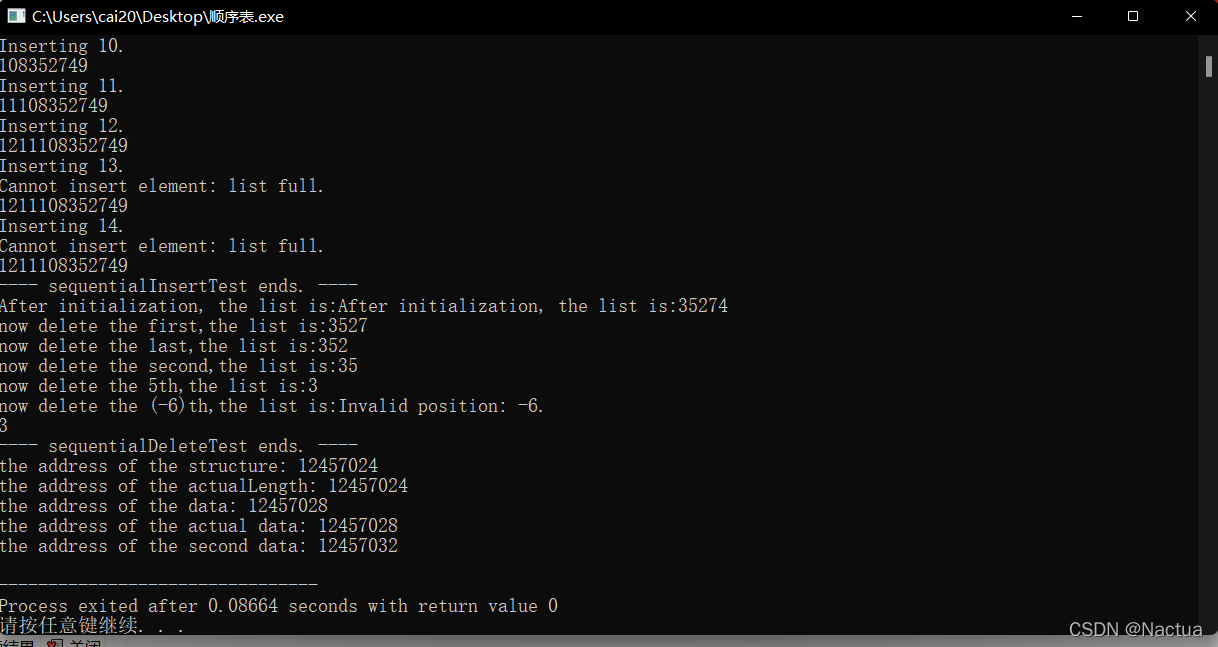
版权声明:本文为Nactua原创文章,遵循CC 4.0 BY-SA版权协议,转载请附上原文出处链接和本声明。