Mybatis的多表查询
表设计,User(用户表),UserRelation(用户关系表),Authority(用户权限表),UserInfo(用户信息表)
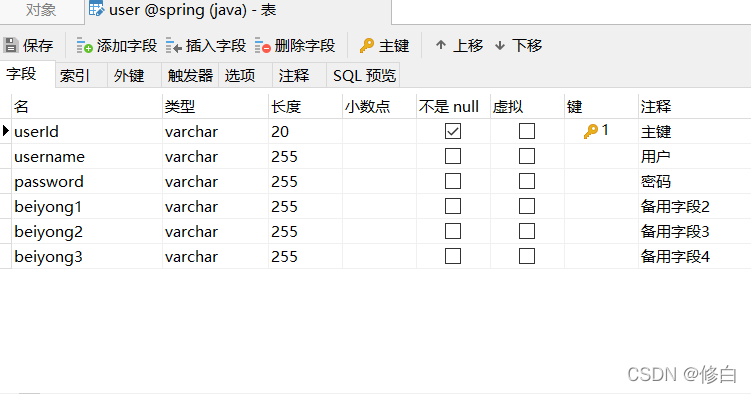

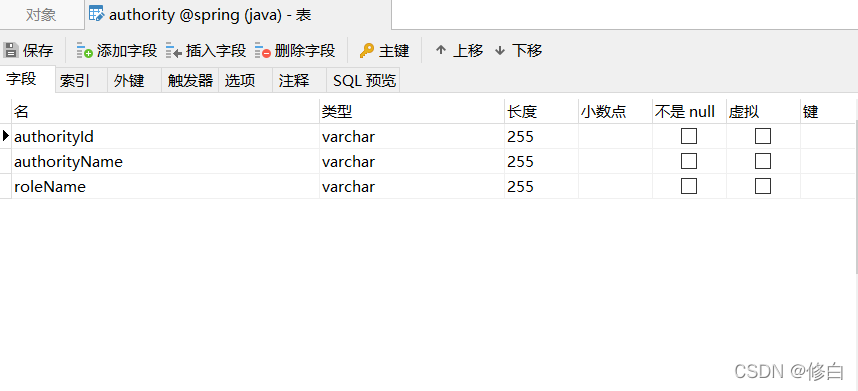

设计实体类
@Data
@AllArgsConstructor
@NoArgsConstructor
@ApiModel("用户实体类")
//使用者实体类
public class User {

    @ApiModelProperty("userId")
    private String userId;
    @ApiModelProperty("用户名")
    private String username;
    @ApiModelProperty("密码")
    private String password;

    @ApiModelProperty("备用字段")
    private String beiyong1;
    @ApiModelProperty("备用字段")
    private String beiyong2;
    @ApiModelProperty("备用字段")
    private String beiyong3;

    //这个好像不符合设计逻辑
    @ApiModelProperty("user连接关系表字段")
    private User_relation userRelation;

    @ApiModelProperty("用户权限表")
    private Authority authority;

    @ApiModelProperty("用户信息表")
    private UserInfo userInfo;

}
@Data
@AllArgsConstructor
@NoArgsConstructor
@ApiModel("用户联系中间实体类")
public class User_relation {

    @ApiModelProperty("中间表id")
    private int urId;
    @ApiModelProperty("连接user表字段")
    private String userId;
    @ApiModelProperty("连接authority表字段")
    private String authorityId;
    @ApiModelProperty("连接user")
    private String uInfoId;

    @ApiModelProperty("用户权限表")
    private Authority authority;

    @ApiModelProperty("用户信息表")
    private UserInfo userInfo;

}
@Data
@AllArgsConstructor
@NoArgsConstructor
@ApiModel("用户权限实体类")
public class Authority {

    @ApiModelProperty("权限id")
    private String authorityId;
    @ApiModelProperty("权限名")
    private String authorityName;
    @ApiModelProperty("角色名")
    private String roleName;

}
@Data
@AllArgsConstructor
@NoArgsConstructor
//注册页面需要的数据
@ApiModel("用户信息实体类")
public class UserInfo {
    @ApiModelProperty("uInfoId")
    private String uInfoId;
    @ApiModelProperty("邮箱")
    private String email;
    @ApiModelProperty("电话号码")
    private int phonoNumber;
    @ApiModelProperty("昵称")
    private String nackName;
}
Mapper接口的编写
@Repository
@Mapper
//user用户查询
//与resources里面的mappers的UserMapper.xml绑定

public interface UserMapper {

    //增加--@Insert("INSERT INTO spring.user (username,password) VALUES (#{one},#{two})")

    public int userAdd(@Param("userId") String userId,@Param("username") String user, @Param("password") String password);


    //删除,删除全部数据--@Delete("DELETE FROM spring.user WHERE username = #{one}")

    public int userDelete(@Param("username") String user);


    //修改--@Update("UPDATE spring.user SET password = #{two} WHERE username = #{one}")

    public int userUpdate(@Param("username") String user, @Param("login.password") String password);


    //查询全部--@Select("SELECT * FROM spring.user")

    public List<User> userQueAll();


    //查询一个数据--@Select("SELECT * FROM spring.user where username=#{one}")

    public User userQueOne(@Param("username") String user);


    //查询用户表和权限表的字段

    public List<User> userAuthor();

    public List<User> userAuthorThree();

    public User userInfo();

    public User userInfoThree();
}
XML编写
这是两表查询–具体看sql语句–下面两个返回的结果是一样的–但是数组的关系不一样
    <!--连表查询-按照结果嵌套查询-->
<!--    两表联查-只能查询到需要的数据,其他的数据不显示-->
<!--    查询用户和权限-->
    <select id="userAuthor" resultMap="UserAuthor">
        select u.username,u.`password`,a.authorityName
        from user u,authority a,user_relation ur
        where u.userId=ur.userId
          and a.authorityId=ur.authorityId
    </select>
    <resultMap id="UserAuthor" type="User">
        <result column="userId" property="userId"></result>
        <result column="username" property="username"></result>
        <result column="password" property="password"></result>
        <association property="authority" javaType="Authority">
            <result column="authorityId" property="authorityId"></result>
            <result column="authorityName" property="authorityName"></result>
            <result column="roleName" property="roleName"></result>
        </association>
    </resultMap>
结果为
User(userId=null,
username=111,
password=222,
beiyong1=null,
beiyong2=null,
beiyong3=null,
userRelation=null,
authority=Authority(authorityId=null, authorityName=ROLE_ADMIN, roleName=null),
userInfo=null)
分段如下
User(userId=null,
username=111,
password=222,
beiyong1=null,
beiyong2=null,
beiyong3=null,
userRelation=null,
authority=Authority(authorityId=null, authorityName=ROLE_ADMIN, roleName=null),
userInfo=null)
<!--    三表联查-->
    <select id="userAuthorThree" parameterType="String" resultMap="userAuthorMap">
            select u.username,u.`password`,a.authorityName,ur.userId,ur.authorityId
            from user u,authority a,user_relation ur
            where u.userId=ur.userId
            and a.authorityId=ur.authorityId
    </select>
    <resultMap id="userAuthorMap" type="User">
        <!--property表示com.domain.Student的字段,coloum为表中的字段,进行配置映射-->
        <!--主键字段-->
        <id column="userId" property="userId"></id>
        <!--非主键字段-->
        <result column="username" property="username"></result>
        <result column="password" property="password"></result>
        <result column="beiyong1" property="beiyong1"></result>
        <result column="beiyong2" property="beiyong2"></result>
        <result column="beiyong3" property="beiyong3"></result>
        <association property="userRelation" javaType="User_relation">
            <result column="urId" property="urId"></result>
            <result column="userId" property="userId"></result>
            <result column="authorityId" property="authorityId"></result>
            <result column="uInfoId" property="uInfoId"></result>
            <association property="authority" javaType="Authority">
                <result column="authorityId" property="authorityId"></result>
                <result column="authorityName" property="authorityName"></result>
                <result column="roleName" property="roleName"></result>
            </association>
        </association>
    </resultMap>
上下两种是一样的,上一个是三层循环的嵌套,下面是两层的表查询–查询结果一样,查询结构不一样
<!--    三表联查-非嵌套式-->
    <select id="userAuthorThree" parameterType="String" resultMap="userAuthorMap">
            select u.username,u.`password`,a.authorityName,ur.userId,ur.authorityId
            from user u,authority a,user_relation ur
            where u.userId=ur.userId
            and a.authorityId=ur.authorityId
    </select>
    <resultMap id="userAuthorMap" type="User">
        <!--property表示com.domain.Student的字段,coloum为表中的字段,进行配置映射-->
        <!--主键字段-->
        <id column="userId" property="userId"></id>
        <!--非主键字段-->
        <result column="username" property="username"></result>
        <result column="password" property="password"></result>
        <result column="beiyong1" property="beiyong1"></result>
        <result column="beiyong2" property="beiyong2"></result>
        <result column="beiyong3" property="beiyong3"></result>
        <association property="userRelation" javaType="User_relation">
            <result column="urId" property="urId"></result>
            <result column="userId" property="userId"></result>
            <result column="authorityId" property="authorityId"></result>
            <result column="uInfoId" property="uInfoId"></result>
        </association>
        <association property="authority" javaType="Authority">
            <result column="authorityId" property="authorityId"></result>
            <result column="authorityName" property="authorityName"></result>
            <result column="roleName" property="roleName"></result>
        </association>
    </resultMap>
结果为
User(userId=1111,
username=阿大撒,
password=阿斯顿撒,
beiyong1=null,
beiyong2=null,
beiyong3=null,
userRelation=User_relation(urId=0, userId=1111, authorityId=002, uInfoId=null, authority=Authority(authorityId=002, authorityName=ROLE_USER, roleName=null), userInfo=null),
authority=null,
userInfo=null)
我分段一下–对应User表的字段
User(userId=1111,
username=阿大撒,
password=阿斯顿撒,
beiyong1=null,
beiyong2=null,
beiyong3=null,
userRelation=User_relation(urId=0, userId=1111, authorityId=002, uInfoId=null, authority=Authority(authorityId=002, authorityName=ROLE_USER, roleName=null), userInfo=null),
authority=null,
userInfo=null)
上下对比对比
User(userId=f34c822e,
username=111,
password=222,
beiyong1=null,
beiyong2=null,
beiyong3=null,
userRelation=User_relation(urId=0, userId=f34c822e, authorityId=001, uInfoId=null, authority=null, userInfo=null),
authority=Authority(authorityId=001, authorityName=ROLE_ADMIN, roleName=null),
userInfo=null)
分段
User(userId=f34c822e,
username=111,
password=222,
beiyong1=null,
beiyong2=null,
beiyong3=null,
userRelation=User_relation(urId=0, userId=f34c822e, authorityId=001, uInfoId=null, authority=null, userInfo=null),
authority=Authority(authorityId=001, authorityName=ROLE_ADMIN, roleName=null),
userInfo=null)
下面两个返回的结果是一样的–但是数组的关系不一样
<!--    用户信息两表联查-->
    <select id="userInfo" resultMap="uUserInfo">
        select u.username,u.`password`,uf.email,uf.nackName,uf.phonoNumber
        from user u,userinfo uf,user_relation ur
        where u.userId=ur.userId
          and uf.uInfoId=ur.uInfoId
    </select>
    <resultMap id="uUserInfo" type="User">
        <result column="userId" property="userId"></result>
        <result column="username" property="username"></result>
        <result column="password" property="password"></result>
        <association property="userInfo" javaType="UserInfo">
            <result column="uInfoId" property="uInfoId"></result>
            <result column="email" property="email"></result>
            <result column="phonoNumber" property="phonoNumber"></result>
            <result column="nackName" property="nackName"></result>
        </association>
    </resultMap>
结果为
User(userId=null,
username=111,
password=222,
beiyong1=null,
beiyong2=null,
beiyong3=null,
userRelation=null,
authority=null,
userInfo=UserInfo(uInfoId=null, email=13123, phonoNumber=1111, nackName=12312))
分段
User(userId=null,
username=111,
password=222,
beiyong1=null,
beiyong2=null,
beiyong3=null,
userRelation=null,
authority=null,
userInfo=UserInfo(uInfoId=null, email=13123, phonoNumber=1111, nackName=12312))
    <!--    用户信息三表联查-->
    <select id="userInfoThree" parameterType="String" resultMap="uUserInfoMap">
        select u.username,u.`password`,uf.email,uf.nackName,uf.phonoNumber
        from user u,userinfo uf,user_relation ur
        where u.userId=ur.userId
          and uf.uInfoId=ur.uInfoId
    </select>
    <resultMap id="uUserInfoMap" type="User">
        <!--property表示com.domain.Student的字段,coloum为表中的字段,进行配置映射-->
        <!--主键字段-->
        <id column="userId" property="userId"></id>
        <!--非主键字段-->
        <result column="username" property="username"></result>
        <result column="password" property="password"></result>
        <association property="userRelation" javaType="User_relation">
            <result column="urId" property="urId"></result>
            <result column="userId" property="userId"></result>
            <result column="authorityId" property="authorityId"></result>
            <result column="uInfoId" property="uInfoId"></result>
            <association property="userInfo" javaType="UserInfo">
                <result column="uInfoId" property="uInfoId"></result>
                <result column="email" property="email"></result>
                <result column="nackName" property="nackName"></result>
                <result column="phonoNumber" property="phonoNumber"></result>
            </association>
        </association>
    </resultMap>
结果为
User(userId=null,
username=111,
password=222,
beiyong1=null,
beiyong2=null,
beiyong3=null,
userRelation=User_relation(urId=0, userId=null, authorityId=null, uInfoId=null, authority=null, userInfo=UserInfo(uInfoId=null, email=13123, phonoNumber=1111, nackName=12312)),
authority=null,
userInfo=null)
分段后
User(userId=null,
username=111,
password=222,
beiyong1=null,
beiyong2=null,
beiyong3=null,
userRelation=User_relation(urId=0, userId=null, authorityId=null, uInfoId=null, authority=null, userInfo=UserInfo(uInfoId=null, email=13123, phonoNumber=1111, nackName=12312)),
authority=null,
userInfo=null)
输入值的多表查询方法
<!--    用户权限表,查单条数据-->
    <select id="userAuthorOne" parameterType="String" resultMap="UserAuthorO">
        select u.username,u.`password`,a.authorityName
        from user u,authority a,user_relation ur
        where u.userId=ur.userId
          and a.authorityId=ur.authorityId
          and u.username = #{username}
    </select>
    <resultMap id="UserAuthorO" type="User">
        <result column="userId" property="userId"></result>
        <result column="username" property="username"></result>
        <result column="password" property="password"></result>
        <association property="authority" javaType="Authority">
            <result column="authorityId" property="authorityId"></result>
            <result column="authorityName" property="authorityName"></result>
            <result column="roleName" property="roleName"></result>
        </association>
    </resultMap>
都与User实体类对应
多表查询结构解析一
两表查询
三表嵌套查询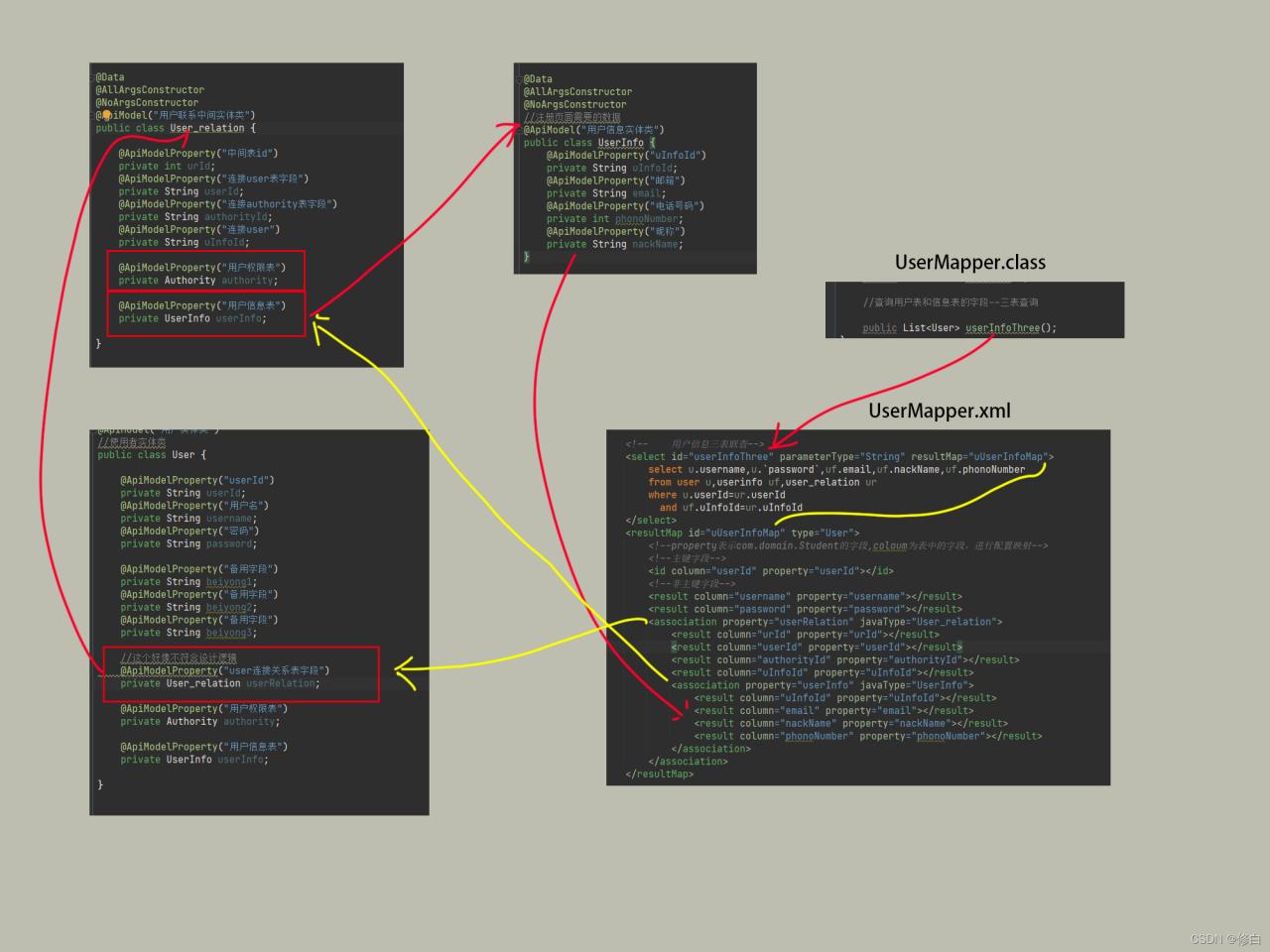
版权声明:本文为weixin_45309354原创文章,遵循CC 4.0 BY-SA版权协议,转载请附上原文出处链接和本声明。