# Softmax example in TF using the classical Iris dataset
# Download iris.data from https://archive.ics.uci.edu/ml/datasets/Iris
# Be sure to remove the last empty line of it before running the example

# 1、导入必要的包
import tensorflow as tf
import os

# 2、定义权重和偏置
# this time weights form a matrix, not a column vector, one "weight vector" per class.
W = tf.Variable(tf.zeros([4, 3]), name="weights")
# so do the biases, one per class.
b = tf.Variable(tf.zeros([3]), name="bias")

# 3、定义拟合关系,这里为线性函数
def combine_inputs(X):
    return tf.matmul(X, W) + b

# 4、定义激活函数,是在拟合函数的结果上塞入激活函数(获得分类结果)
def inference(X):
    return tf.nn.softmax(combine_inputs(X))

# 5、定义损失函数
def loss(X, Y):
    return tf.reduce_mean(tf.nn.sparse_softmax_cross_entropy_with_logits(logits=combine_inputs(X), labels=Y))

# 6、定义读取CSV工具函数,tensorflow的数据输入
# 关于读取问题的详细介绍 https://blog.csdn.net/zzk1995/article/details/54292859
def read_csv(batch_size, file_name, record_defaults):
    filename_queue = tf.train.string_input_producer([os.path.dirname(os.path.abspath(__file__)) + "/" + file_name])

    reader = tf.TextLineReader()
    key, value = reader.read(filename_queue)

    # decode_csv will convert a Tensor from type string (the text line) in
    # a tuple of tensor columns with the specified defaults, which also
    # sets the data type for each column
    decoded = tf.decode_csv(value, record_defaults=record_defaults)

    # batch actually reads the file and loads "batch_size" rows in a single tensor
    return tf.train.shuffle_batch(decoded,
                                  batch_size=batch_size,
                                  capacity=batch_size * 50,
                                  min_after_dequeue=batch_size)

# 7、读取文件内容
def inputs():

    sepal_length, sepal_width, petal_length, petal_width, label =\
        read_csv(100, "iris.data", [[0.0], [0.0], [0.0], [0.0], [""]])

    # convert class names to a 0 based class index.
    label_number = tf.to_int32(tf.argmax(tf.to_int32(tf.stack([
        tf.equal(label, ["Iris-setosa"]),
        tf.equal(label, ["Iris-versicolor"]),
        tf.equal(label, ["Iris-virginica"])
    ])), 0))

    # Pack all the features that we care about in a single matrix;
    # We then transpose to have a matrix with one example per row and one feature per column.
    features = tf.transpose(tf.stack([sepal_length, sepal_width, petal_length, petal_width]))

    return features, label_number

# 8、训练模型
def train(total_loss):
    learning_rate = 0.01
    return tf.train.GradientDescentOptimizer(learning_rate).minimize(total_loss)

# 9、评估模型
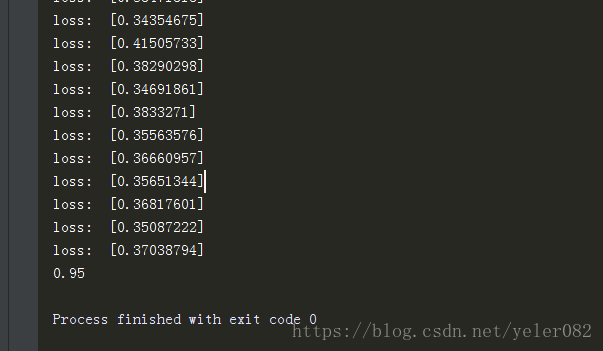
def evaluate(sess, X, Y):
    predicted = tf.cast(tf.arg_max(inference(X), 1), tf.int32)
    print(sess.run(tf.reduce_mean(tf.cast(tf.equal(predicted, Y), tf.float32))))

# 10、执行调用整个过程
# Launch the graph in a session, setup boilerplate
with tf.Session() as sess:

    tf.initialize_all_variables().run()

    X, Y = inputs()

    total_loss = loss(X, Y)
    train_op = train(total_loss)

    coord = tf.train.Coordinator()
    threads = tf.train.start_queue_runners(sess=sess, coord=coord)

    # actual training loop
    training_steps = 1000
    for step in range(training_steps):
        sess.run([train_op])
        # for debugging and learning purposes, see how the loss gets decremented thru training steps
        if step % 10 == 0:
            print("loss: ", sess.run([total_loss]))

    evaluate(sess, X, Y)

    coord.request_stop()
    coord.join(threads)
    sess.close()
版权声明:本文为yeler082原创文章,遵循CC 4.0 BY-SA版权协议,转载请附上原文出处链接和本声明。