关于Rouge
Rouge(Recall-Oriented Understudy for Gisting Evaluation),是评估自动文摘以及机器翻译的一组指标,它通过将自动生成的摘要或翻译 与 一组参考摘要(通常是人工生成的)进行比较计算,得出相应的分值,以衡量自动生成的摘要或翻译与参考摘要之间的相似度。
Rouge-1,Rouge-2, Rouge-N
Rouge-N 定义
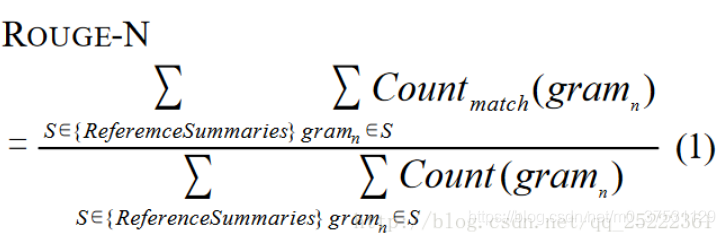
分母是参考摘要中n-gram的total个数,分子是参考摘要和自动摘要共有的n-gram的个数。即召回率。
Rouge-N: 是对应的Rouge-1 : 1-gram, Rouge-2: 2-gram,Rouge-3: 3-gram。
举例:
自动摘要Y(自动生成的):the cat was found under the bed.
参考摘要X: the cat was under the bed.
| # | 1-gram | reference-1-gram | 2-gram | reference-2-gram |
|---|---|---|---|---|
| 1 | the | the | the cat | the cat |
| 2 | cat | cat | cat was | cat was |
| 3 | was | was | was found | was under |
| 4 | found | under | found under | under the |
| 5 | under | the | under the | the bed |
| 6 | the | bed | the bed | |
| 7 | bed | |||
| count | 7 | 6 | 6 | 5 |
R o u g e − 1 ( X , Y ) = 6 / 6 = 1.0 Rouge-1(X,Y) = 6/6=1.0Rouge−1(X,Y)=6/6=1.0 分子是带测评的摘要和参考摘要都出现的1-gram的个数,分母是参考摘要中1-gram的个数。(其实分母也可以是带测评摘要的,但是精确率和召回率之间,我们更关心召回率Recall, 这和上面的公式相同),同样R o u g e − 2 ( X , Y ) = 4 / 5 = 0.8 Rouge-2(X,Y) = 4/5=0.8Rouge−2(X,Y)=4/5=0.8
Rouge-L
L即是LCS(longest common subsequence,最长公共子序列)的首字母。因为Rouge-L使用了最长公共子序列,Rouge-L计算方式: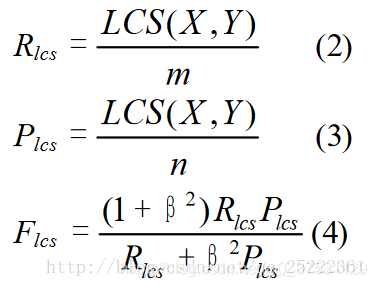
其中LCS(X,Y)是X和Y 的最长公共子序列的长度, m和n分别表示参考摘要和自动摘要的长度(一般就是所含词的个数),R l c s , P l c s R_{lcs},P_{lcs}Rlcs,Plcs分别表示召回率和准确率。最后F l c s F_{lcs}Flcs即是我们所说的Rouge-L. 在DUC中,β \betaβ被设置为一个很大的数,所以Rouge-L几乎只考虑R l c s R_{lcs}Rlcs,与上面所说的一般只考虑召回率对应。
Rouge-L的改进版Rouge-W
针对Rouge-L存在的问题,提出了改进版Rouge-W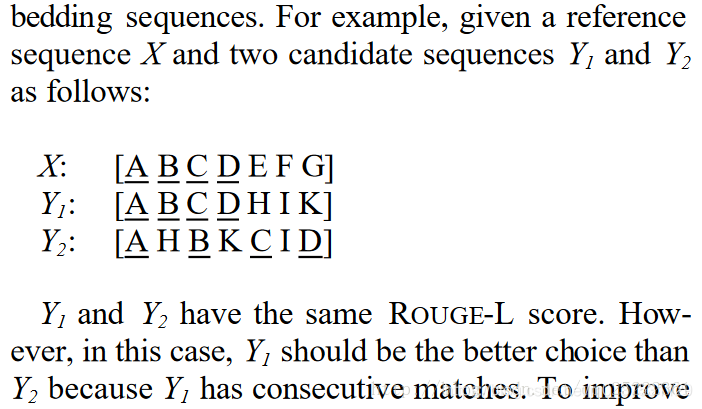
上图中,X是参考文摘,Y 1 , Y 2 Y_1, Y_2Y1,Y2 是两个待评测文摘,明显Y 1 Y_1Y1 要优于Y 2 Y_2Y2,因为Y 1 Y_1Y1 可以和参考摘要X连续匹配,但是Rouge_L(X,Y1)=Rouge_L(X,Y2),针对这个问题论文作者提出了改进的方案—加权最长公共子序列(Weighted Longest Common Subsequence)。关于Rouge-W的详细内容请参看论文[3]。
Rouge-S
即使用了skip-grams,在参考摘要和待评测摘要进行匹配时,不要求gram之间必须是连续的,可以“跳过”几个单词,比如skip-bigram,在产生grams时,允许最多跳过两个词。比如“cat in the hat”的 skip-bigrams 就是 “cat in, cat the, cat hat, in the, in hat, the hat”.