# 逻辑回归
## 逻辑回归处理二元分类
%matplotlib inlineimportmatplotlib.pyplot as plt#显示中文
from matplotlib.font_manager importFontProperties
font=FontProperties(fname=r"c:\windows\fonts\msyh.ttc", size=10)
importnumpy as np
plt.figure()
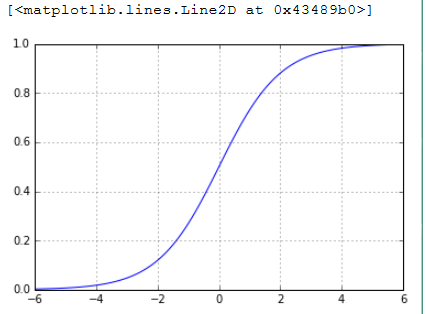
plt.axis([-6,6,0,1])
plt.grid(True)
X=np.arange(-6,6,0.1)
y=1/(1+np.e**(-X))
plt.plot(X,y,'b-')
## 垃圾邮件分类
importpandas as pd
df=pd.read_csv('SMSSpamCollection',delimiter='\t',header=None)
df.head()

from sklearn.feature_extraction.text importTfidfVectorizerfrom sklearn.linear_model.logistic importLogisticRegressionfrom sklearn.cross_validation importtrain_test_split#用pandas加载数据.csv文件,然后用train_test_split分成训练集(75%)和测试集(25%):
X_train_raw, X_test_raw, y_train, y_test = train_test_split(df[1],df[0])#我们建一个TfidfVectorizer实例来计算TF-IDF权重:
vectorizer=TfidfVectorizer()
X_train=vectorizer.fit_transform(X_train_raw)
X_test=vectorizer.transform(X_test_raw)#LogisticRegression同样实现了fit()和predict()方法
classifier=LogisticRegression()
classifier.fit(X_train,y_train)
predictions=classifier.predict(X_test)for i ,prediction in enumerate(predictions[-5:]):print '预测类型:%s.信息:%s' %(prediction,X_test_raw.iloc[i])
输出结果:
预测类型:ham.信息:Waiting in e car 4 my mum lor. U leh? Reach home already?
预测类型:ham.信息:Dear got train and seat mine lower seat
预测类型:spam.信息:I just really need shit before tomorrow and I know you won't be awake before like 6
预测类型:ham.信息:What should i eat fo lunch senor
预测类型:ham.信息:645
## 二元分类效果评估方法
#混淆矩阵
from sklearn.metrics importconfusion_matriximportmatplotlib.pyplot as plt
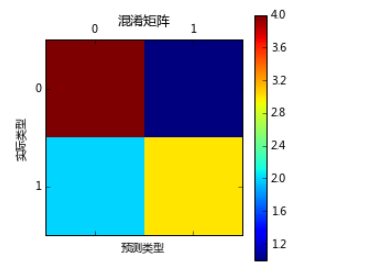
y_test= [0, 0, 0, 0, 0, 1, 1, 1, 1, 1]
y_pred= [0, 1, 0, 0, 0, 0, 0, 1, 1, 1]
confusion_matrix=confusion_matrix(y_test,y_pred)print confusion_matrix
plt.matshow(confusion_matrix)
plt.title(u'混淆矩阵')
plt.colorbar()
plt.ylabel(u'实际类型')
plt.xlabel(u'预测类型')
plt.show()
## 准确率
importpandas as pdimportnumpy as npfrom sklearn.feature_extraction.text importTfidfVectorizerfrom sklearn.linear_model.logistic importLogisticRegressionfrom sklearn.cross_validation importtrain_test_split,cross_val_score
df=pd.read_csv('SMSSpamCollection',delimiter='\t',names=["label","message"])
X_train_raw, X_test_raw, y_train, y_test= train_test_split(df['message'], df['label'])
vectorizer=TfidfVectorizer()
X_train=vectorizer.fit_transform(X_train_raw)
X_test=vectorizer.transform(X_test_raw)
classifier=LogisticRegression()
classifier.fit(X_train,y_train)
scores=cross_val_score(classifier,X_train,y_train,cv=5)print '准确率',np.mean(scores),scores
输出结果:
准确率 0.954292731612 [ 0.96057348 0.96052632 0.94617225 0.95808383 0.94610778]
## 精确率和召回率
scikit-learn结合真实类型数据,提供了一个函数来计算一组预测值的精确率和召回率。
%matplotlib inlineimportnumpy as npimportpandas as pdfrom sklearn.feature_extraction.text importTfidfVectorizerfrom sklearn.linear_model.logistic importLogisticRegressionfrom sklearn.cross_validation importtrain_test_split, cross_val_score
df['label']=pd.factorize(df['label'])[0]
X_train_raw, X_test_raw, y_train, y_test= train_test_split(df['message'],df['label'])
vectorizer=TfidfVectorizer()
X_train=vectorizer.fit_transform(X_train_raw)
X_test=vectorizer.transform(X_test_raw)
classifier=LogisticRegression()
classifier.fit(X_train, y_train)
precisions= cross_val_score(classifier, X_train, y_train, cv=5, scoring=
'precision')print u'精确率:', np.mean(precisions), precisions
recalls= cross_val_score(classifier, X_train, y_train, cv=5, scoring='recall')print u'召回率:', np.mean(recalls), recalls
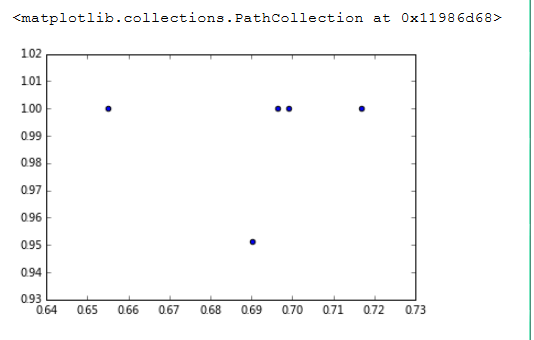
plt.scatter(recalls, precisions)
输出结果:
精确率: 0.990243902439 [ 1. 0.95121951 1. 1. 1. ]
召回率: 0.691498103666 [ 0.65486726 0.69026549 0.69911504 0.71681416 0.69642857]
## 计算综合评价指标
fls=cross_val_score(classifier,X_train,y_train,cv=5,scoring='f1')print '综合指标评价',np.mean(fls),fls
输出结果:
综合指标评价 0.791683999687 [ 0.76243094 0.79781421 0.8 0.77094972 0.82722513]
## ROC AUC
importnumpy as npimportpandas as pdimportmatplotlib.pyplot as pltfrom sklearn.feature_extraction.text importTfidfVectorizerfrom sklearn.linear_model.logistic importLogisticRegressionfrom sklearn.cross_validation importtrain_test_split,cross_val_scorefrom sklearn.metrics importroc_curve,auc
df['label']=pd.factorize(df['label'])[0]
X_train_raw, X_test_raw, y_train, y_test= train_test_split(df['message'],df['label'])
vectorizer=TfidfVectorizer()
X_train=vectorizer.fit_transform(X_train_raw)
X_test=vectorizer.transform(X_test_raw)
classifier=LogisticRegression()
classifier.fit(X_train, y_train)
predictions=classifier.predict_proba(X_test)#每一类的概率
false_positive_rate, recall, thresholds =roc_curve(y_test, predictions[:
,1])
roc_auc=auc(false_positive_rate,recall)
plt.title('Receiver Operating Characteristic')
plt.plot(false_positive_rate, recall,'b', label='AUC = %0.2f' %roc_auc)
plt.legend(loc='lower right')
plt.plot([0,1],[0,1],'r--')
plt.xlim([0.0,1.0])
plt.ylim([0.0,1.0])
plt.ylabel('Recall')
plt.xlabel('Fall-out')
plt.show()

## 网格搜索
importpandas as pdfrom sklearn.feature_extraction.text importTfidfVectorizerfrom sklearn.linear_model.logistic importLogisticRegressionfrom sklearn.grid_search importGridSearchCVfrom sklearn.pipeline importPipelinefrom sklearn.cross_validation importtrain_test_splitfrom sklearn.metrics importprecision_score, recall_score, accuracy_score
pipeline=Pipeline([
('vect', TfidfVectorizer(stop_words='english')),
('clf', LogisticRegression())
])
parameters={'vect__max_df': (0.25, 0.5, 0.75),'vect__stop_words': ('english', None),'vect__max_features': (2500, 5000, 10000, None),'vect__ngram_range': ((1, 1), (1, 2)),'vect__use_idf': (True, False),'vect__norm': ('l1', 'l2'),'clf__penalty': ('l1', 'l2'),'clf__C': (0.01, 0.1, 1, 10),
}
grid_search= GridSearchCV(pipeline, parameters, n_jobs=-1, verbose=1, scoring='accuracy', cv=3)
df=pd.read_csv('SMSSpamCollection',delimiter='\t',names=["label","message"])
df['label']=pd.factorize(df['label'])[0]
X_train, X_test, y_train, y_test= train_test_split(df['message'],df['label'])
grid_search.fit(X_train, y_train)print('最佳效果:%0.3f' % grid_search.best_score_)
输出结果;
最佳效果:0.986
print '最优参数组合'best_parameters=grid_search.best_estimator_.get_params()
for param_name insorted(parameters.keys()):print '\t%s:%r' %(param_name,best_parameters[param_name])
predictions=grid_search.predict(X_test)print '准确率:',accuracy_score(y_test,predictions)print '精确率:',precision_score(y_test,predictions)print '召回率:',recall_score(y_test,predictions)
输出结果:
clf__C:10
clf__penalty:'l2'
vect__max_df:0.25
vect__max_features:2500
vect__ngram_range:(1, 2)
vect__norm:'l2'
vect__stop_words:None
vect__use_idf:True
准确率: 0.979899497487
精确率: 0.974683544304
召回率: 0.865168539326
# logistics 多分类
importpandas as pd
df=pd.read_csv("logistic_data/train.tsv",header=0,delimiter='\t')printdf.count()printdf.head()
df.Phrase.head(10)
df.Sentiment.describe()
df.Sentiment.value_counts()
df.Sentiment.value_counts()/df.Sentiment.count()
importpandas as pdfrom sklearn.feature_extraction.text importTfidfVectorizerfrom sklearn.linear_model.logistic importLogisticRegressionfrom sklearn.cross_validation importtrain_test_splitfrom sklearn.metrics importclassification_report,accuracy_score,confusion_matrixfrom sklearn.pipeline importPipelinefrom sklearn.grid_search importGridSearchCV
pipeline=Pipeline([
('vect',TfidfVectorizer(stop_words='english')),
('clf',LogisticRegression())])
parameters={'vect__max_df':(0.25,0.5),'vect__ngram_range':((1,1),(1,2)),'vect__use_idf':(True,False),'clf__C':(0.1,1,10),
}
df=pd.read_csv("logistic_data/train.tsv",header=0,delimiter='\t')
X,y=df.Phrase,df.Sentiment.as_matrix()
X_train,X_test,y_train,y_test=train_test_split(X,y,train_size=0.5)
grid_search=GridSearchCV(pipeline,parameters,n_jobs=-1,verbose=1,scoring="accuracy")
grid_search.fit(X_train,y_train)print u'最佳效果:%0.3f'%grid_search.best_score_print u'最优参数组合:'best_parameters=grid_search.best_estimator_.get_params()for param_name insorted(parameters.keys()):print '\t%s:%r'%(param_name,best_parameters[param_name])
数据结果:
Fitting 3 folds for each of 24 candidates, totalling 72 fits
[Parallel(n_jobs=-1)]: Done 46 tasks | elapsed: 2.0min [Parallel(n_jobs=-1)]: Done 72 out of 72 | elapsed: 4.5min finished
最佳效果:0.619 最优参数组合: clf__C:10 vect__max_df:0.25 vect__ngram_range:(1, 2) vect__use_idf:False
## 多类分类效果评估
predictions=grid_search.predict(X_test)print u'准确率',accuracy_score(y_test,predictions)print u'混淆矩阵',confusion_matrix(y_test,predictions)print u'分类报告',classification_report(y_test,predictions)
数据结果:
准确率 0.636614122773
混淆矩阵 [[ 1133 1712 595 67 1]
[ 919 6136 6006 553 35]
[ 213 3212 32637 3634 138]
[ 22 420 6548 8155 1274]
[ 4 45 546 2411 1614]]
分类报告 precision recall f1-score support
0 0.49 0.32 0.39 3508
1 0.53 0.45 0.49 13649
2 0.70 0.82 0.76 39834
3 0.55 0.50 0.52 16419
4 0.53 0.35 0.42 4620
avg / total 0.62 0.64 0.62 78030