视频链接:《PyTorch深度学习实践》完结合集_哔哩哔哩_bilibili
RNN循环神经网络是用来处理有时间前后顺序的输入数据,典型的就是自然语言处理了。
目录
3.使用RNNCell建立模型:'hello'->'ohlol'
1.RNNcell
RNN cell的本质就是全连接层,只不过它的输入来自两个部分,一个部分是上次运行结果的输出,另一个部分是本次的输入数据,具体如下图:
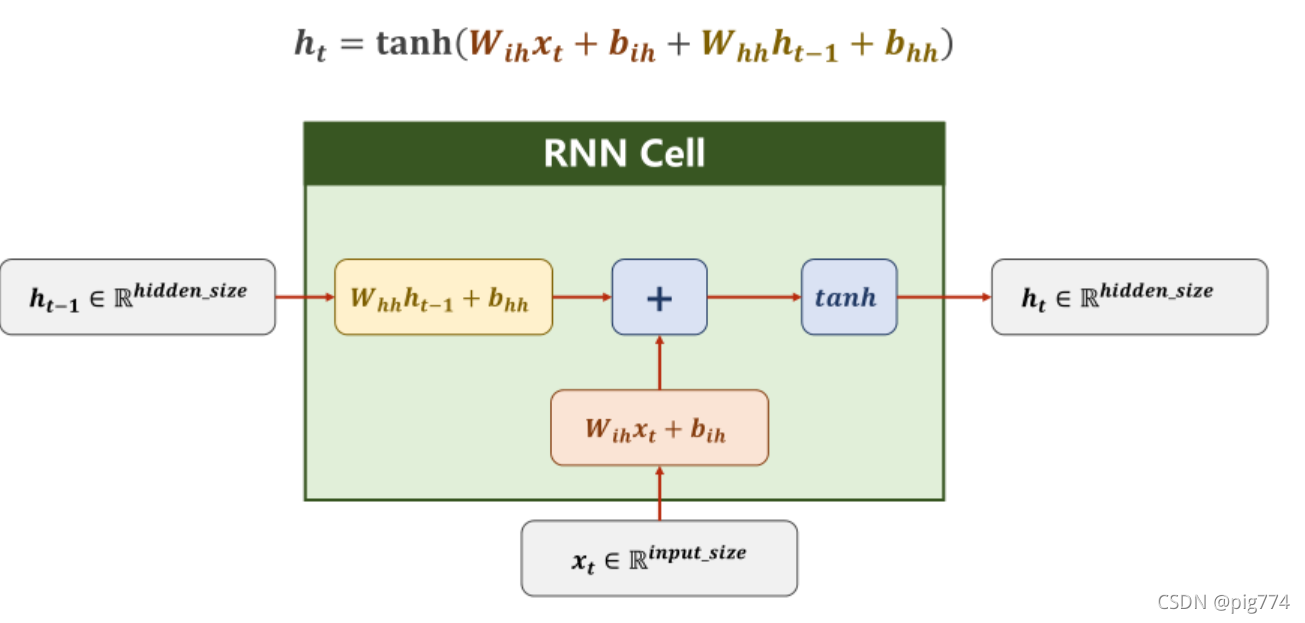
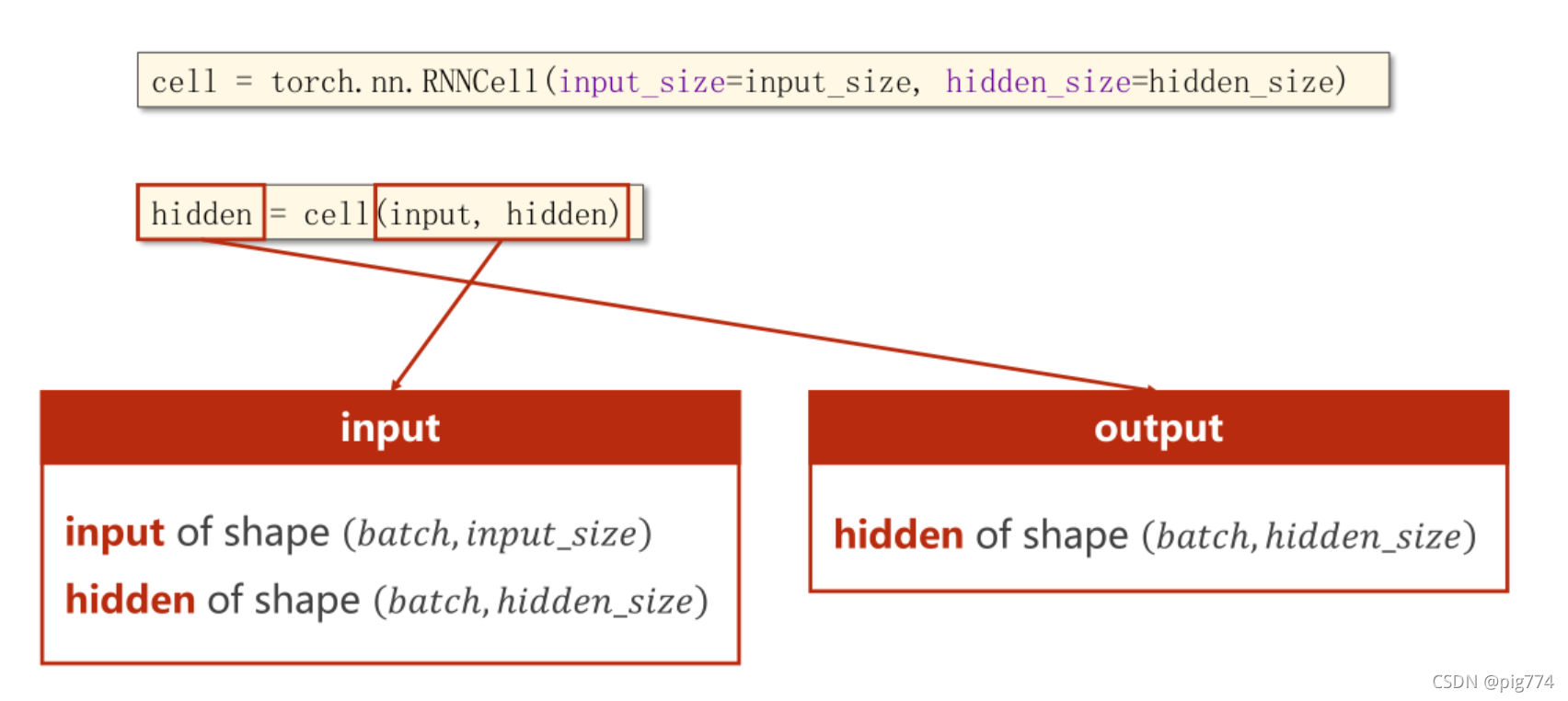
通过下面的代码可以清楚地理解参数之间维度的关系
import torch

batch_size = 1
seq_len = 3
input_size = 4
hidden_size = 2
datasets = torch.randn(seq_len,batch_size, input_size)
hidden = torch.zeros(batch_size, hidden_size)
cell = torch.nn.RNNCell(input_size=input_size, hidden_size=hidden_size)

# 进行一个RNN,而不是一个RNNcell
for idx, input in enumerate(datasets):
    print('*' * 20, idx)
    print('input_size:', input.shape)
    hidden = cell(input, hidden)
    print('input的权重形状')
    print(cell.weight_ih.shape)
    print('input的偏置形状')
    print(cell.bias_ih.shape)
    print('outputs size:', hidden.shape)
    print('hidden的权重形状')
    print(cell.weight_hh.shape)
    print('hidden的偏置形状')
    print(cell.bias_hh.shape)
    print(hidden)
我这里只给出一个RNNcell的结果:
******************** 0
input_size: torch.Size([1, 4])
input的权重形状
torch.Size([2, 4])
input的偏置形状
torch.Size([2])
outputs size: torch.Size([1, 2])
hidden的权重形状
torch.Size([2, 2])
hidden的偏置形状
torch.Size([2])
tensor([[-0.6161, -0.1936]], grad_fn=<TanhBackward0>)
从结果可以看出,内部的真正的运算为:

2.RNN
下面我们来看一下整个RNN层的运算流程图:
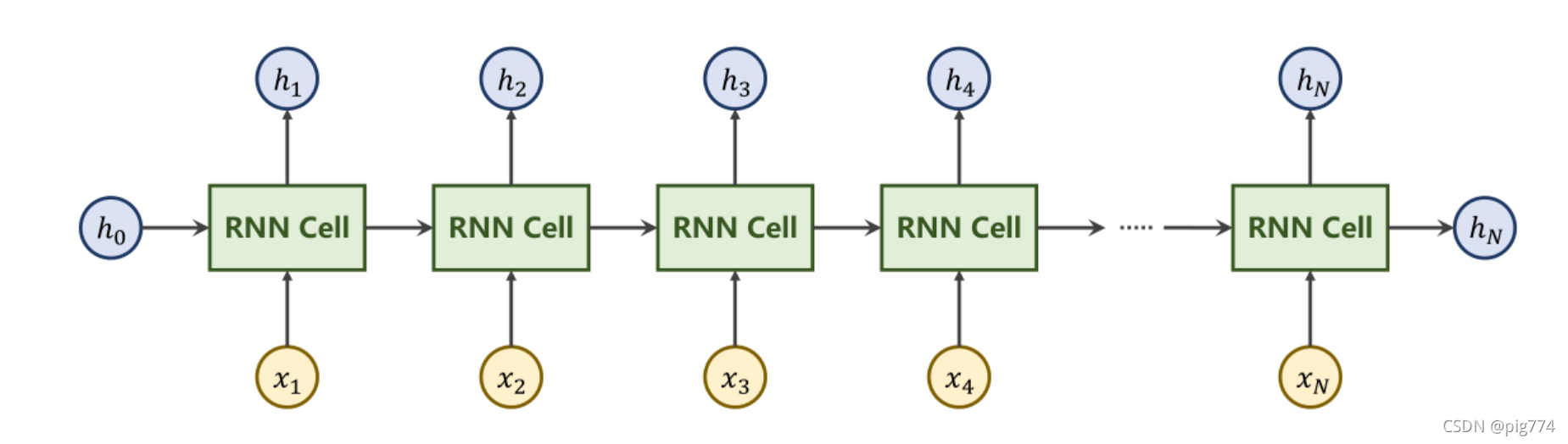
这里我们使用torch.nn.RNN就可以一次性执行多个RNNcell操作,但参数会比之前多一个num_layers,

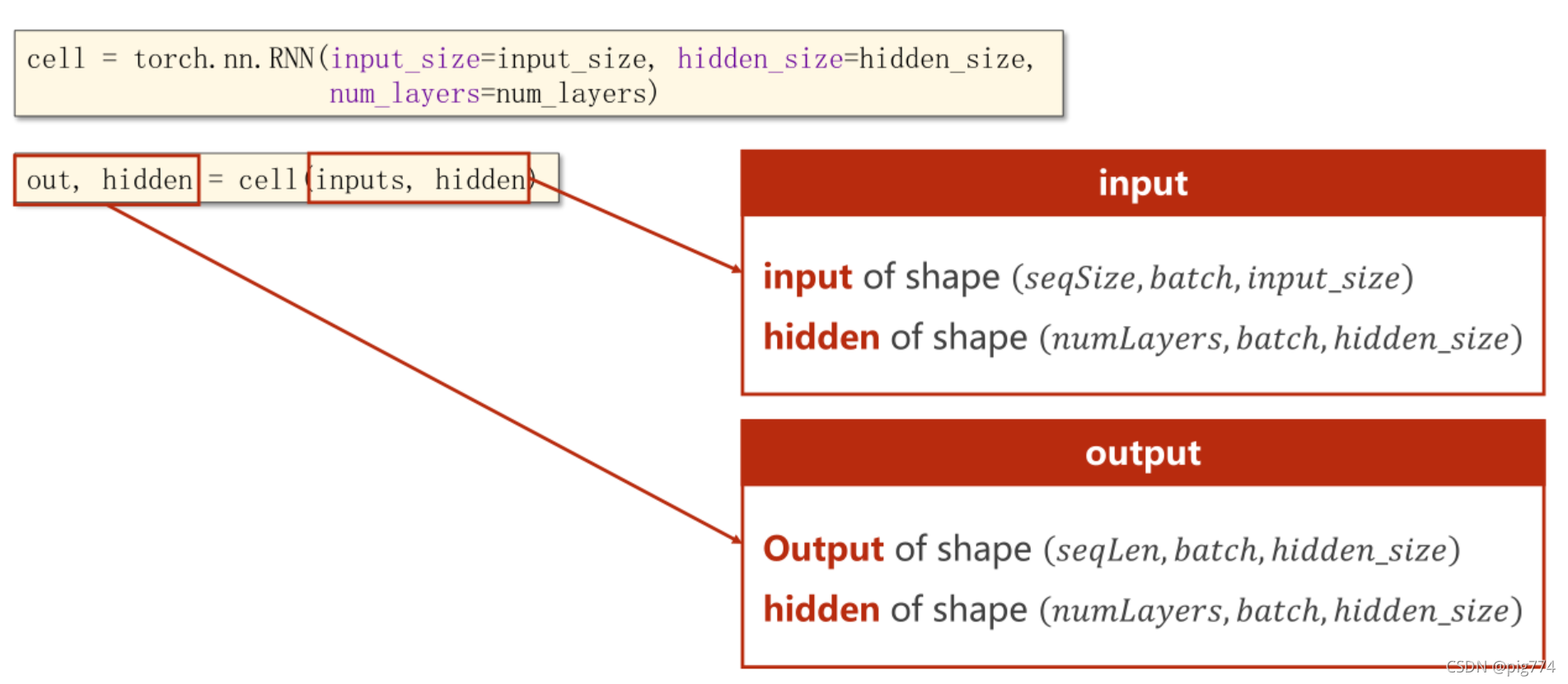
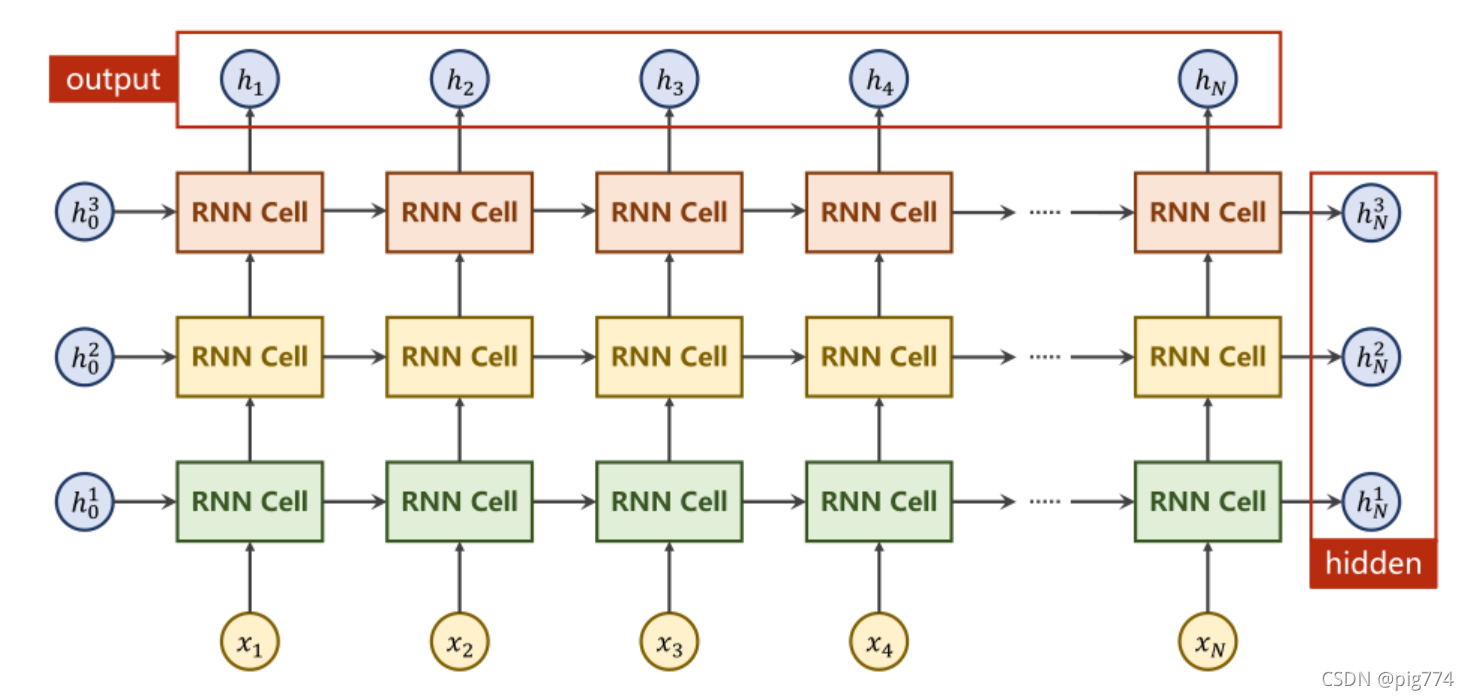
hidden是再作为下一次的输入数据的,output就是该次序列的预测的输出结果。
import torch

batch_size = 1
seq_len = 3
input_size = 4
hidden_size = 2
num_layers = 1

datasets = torch.randn(seq_len, batch_size, input_size)
hidden = torch.zeros(num_layers, batch_size, hidden_size)
# 生成RNN层
cell = torch.nn.RNN(input_size=input_size, hidden_size=hidden_size, num_layers=num_layers)

# 执行
out, hidden = cell(datasets, hidden)
print('out size:', out.shape)  # [3,1,2]
print('out:', out)
print('hidden size:', hidden.shape)  # [1,1,2]
print('hidden', hidden)
输出结果:
out size: torch.Size([3, 1, 2])
out: tensor([[[ 0.6453, -0.7334]],
[[-0.0879, -0.9478]],
[[-0.2888, -0.9519]]], grad_fn=<StackBackward0>)
hidden size: torch.Size([1, 1, 2])
hidden tensor([[[-0.2888, -0.9519]]], grad_fn=<StackBackward0>)
3.使用RNNCell建立模型:'hello'->'ohlol'
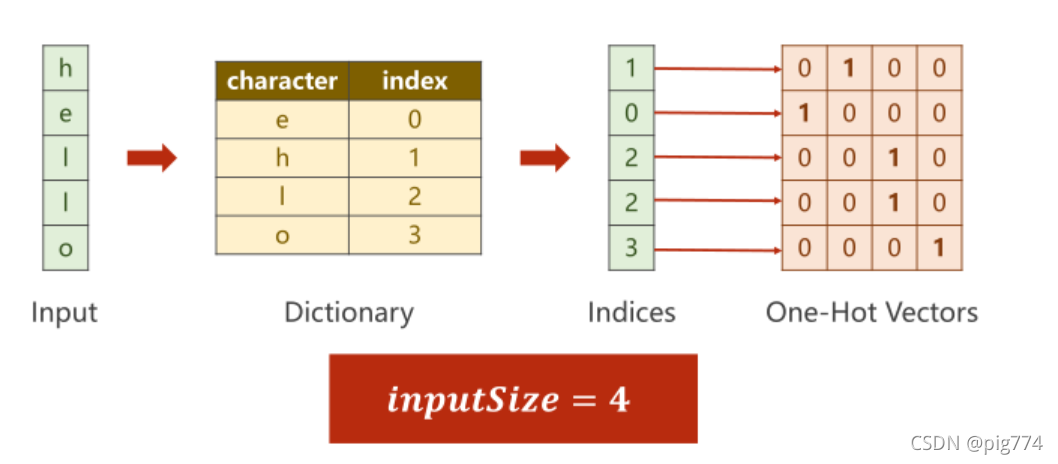
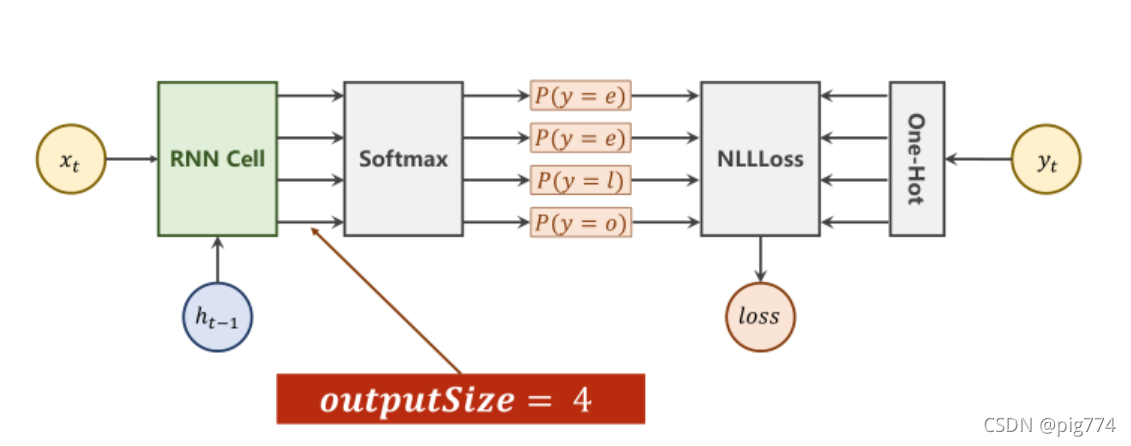
- 准备数据集,处理数据,将单词转变为向量
- 实现模型类
- 构造损失函数和优化器
- 训练
import torch

input_size = 4
hidden_size = 4
batch_size = 1

# 构造数据集
idx2char = ['e', 'h', 'l', 'o']
x_data = [1, 0, 2, 2, 3]  # hello
y_data = [3, 1, 2, 3, 2]  # ohlol

# 将x_data转变为向量
one_hot_lookup = [[1, 0, 0, 0],
                  [0, 1, 0, 0],
                  [0, 0, 1, 0],
                  [0, 0, 0, 1]]
x_one_hot = [one_hot_lookup[x] for x in x_data]

inputs = torch.Tensor(x_one_hot).view(-1, batch_size, input_size)
# 这里要是LongTensor
labels = torch.LongTensor(y_data).view(-1, 1)  # reshape the labels (seqlen,1)


# 实现模型类
class Model(torch.nn.Module):
    def __init__(self, input_size, hidden_size, batch_size):
        super(Model, self).__init__()
        self.batch_size = batch_size
        self.input_size = input_size
        self.hidden_size = hidden_size

        self.rnncell = torch.nn.RNNCell(input_size=self.input_size,
                                        hidden_size=self.hidden_size)

    def forward(self, input, hidden):
        hidden = self.rnncell(input, hidden)
        return hidden

    def init_hidden(self):
        return torch.zeros(self.batch_size, self.hidden_size)


net = Model(input_size, hidden_size, batch_size)

# 构造损失函数和优化器
criterion = torch.nn.CrossEntropyLoss()
optimizer = torch.optim.Adam(net.parameters(), lr=0.1)

# 训练
loss_list = []
for epoch in range(20):
    loss = 0
    optimizer.zero_grad()
    # 每次开始训练前,都要将h0初始化
    hidden = net.init_hidden()
    for input, label in zip(inputs, labels):
        hidden = net(input, hidden)
        loss += criterion(hidden, label)
        # 取出最大值
        _, idx = hidden.max(dim=1)
        print(idx2char[idx.item()], end='')
    print(' ', end='')
    loss.backward()
    optimizer.step()
    loss_list.append(loss.item())
    print(f'epoch={epoch+1},loss={loss.item()}')
结果如下:
lhehl epoch=1,loss=7.421962261199951
lolol epoch=2,loss=5.977343559265137
lolol epoch=3,loss=5.3166327476501465
lolol epoch=4,loss=4.806377410888672
lolol epoch=5,loss=4.240643501281738
lhlol epoch=6,loss=3.759169578552246
lhlol epoch=7,loss=3.4401092529296875
lhlol epoch=8,loss=3.1920981407165527
ohlol epoch=9,loss=2.9561209678649902
ohlol epoch=10,loss=2.7316439151763916
ohlol epoch=11,loss=2.5386734008789062
ohlol epoch=12,loss=2.391939640045166
ohlol epoch=13,loss=2.289687156677246
ohlol epoch=14,loss=2.213822603225708
ohlol epoch=15,loss=2.1478323936462402
ohlol epoch=16,loss=2.0885415077209473
ohlol epoch=17,loss=2.0389533042907715
ohlol epoch=18,loss=2.0001094341278076
ohlol epoch=19,loss=1.970154881477356
ohlol epoch=20,loss=1.9463403224945068
Process finished with exit code 0
4.使用RNN建立模型:'hello'->'ohlol'
import torch

input_size = 4
hidden_size = 4
batch_size = 1

# 构造数据集
idx2char = ['e', 'h', 'l', 'o']
x_data = [1, 0, 2, 2, 3]  # hello
y_data = [3, 1, 2, 3, 2]  # ohlol

# 将x_data转变为向量
one_hot_lookup = [[1, 0, 0, 0],
                  [0, 1, 0, 0],
                  [0, 0, 1, 0],
                  [0, 0, 0, 1]]
x_one_hot = [one_hot_lookup[x] for x in x_data]

inputs = torch.Tensor(x_one_hot).view(-1, batch_size, input_size)
# 这里要是LongTensor
labels = torch.LongTensor(y_data)


# 实现模型类
class Model(torch.nn.Module):
    def __init__(self, input_size, hidden_size, batch_size, num_layers=1):
        super(Model, self).__init__()
        self.num_layers = num_layers
        self.batch_size = batch_size
        self.input_size = input_size
        self.hidden_size = hidden_size

        self.rnn = torch.nn.RNN(input_size=self.input_size,
                                hidden_size=self.hidden_size,
                                num_layers=num_layers)

    def forward(self, input):
        hidden = torch.zeros(self.num_layers, self.batch_size, self.hidden_size)
        out, _ = self.rnn(input, hidden)
        return out.view(-1, hidden_size)


net = Model(input_size, hidden_size, batch_size, num_layers=1)

# 构造损失函数和优化器
criterion = torch.nn.CrossEntropyLoss()
optimizer = torch.optim.Adam(net.parameters(), lr=0.1)

# 训练
loss_list = []
for epoch in range(20):
    optimizer.zero_grad()
    output = net(inputs)
    loss = criterion(output, labels)
    loss.backward()
    optimizer.step()
    loss_list.append(loss.item())
    _, idx = output.max(dim=1)
    idx = idx.data.numpy()
    print('predicted:', ''.join([idx2char[x] for x in idx]), end='  ')
    print(f'epoch={epoch + 1},loss={loss.item()}')
predicted: lllll epoch=1,loss=1.4251950979232788
predicted: ellol epoch=2,loss=1.2052630186080933
predicted: lhlol epoch=3,loss=1.066596269607544
predicted: ohlol epoch=4,loss=0.961388885974884
predicted: ohlol epoch=5,loss=0.8782007098197937
predicted: ohlol epoch=6,loss=0.8153387308120728
predicted: ohlol epoch=7,loss=0.7574172616004944
predicted: ohlol epoch=8,loss=0.7028937935829163
predicted: ohlol epoch=9,loss=0.6582227349281311
predicted: ohlol epoch=10,loss=0.6231571435928345
predicted: ohlol epoch=11,loss=0.5856501460075378
predicted: ohlol epoch=12,loss=0.548419177532196
predicted: ohlol epoch=13,loss=0.5150136351585388
predicted: ohlol epoch=14,loss=0.4859493374824524
predicted: ohlol epoch=15,loss=0.4624292254447937
predicted: ohlol epoch=16,loss=0.4448699951171875
predicted: ohlol epoch=17,loss=0.4302904009819031
predicted: ohlol epoch=18,loss=0.4172581732273102
predicted: ohlol epoch=19,loss=0.40639621019363403
predicted: ohlol epoch=20,loss=0.39772507548332214
Process finished with exit code 0