说明
本示例只需在同一文件夹创建三个文件,三个文件建好之后,运行main.py文件即可。
本示例主要演示PyQt、PySide与QWebEngine前端JS交互功能。
示例使用Pyside6,如果使用PyQt,Slot需要换成pyqtSlot.
效果
先看运行效果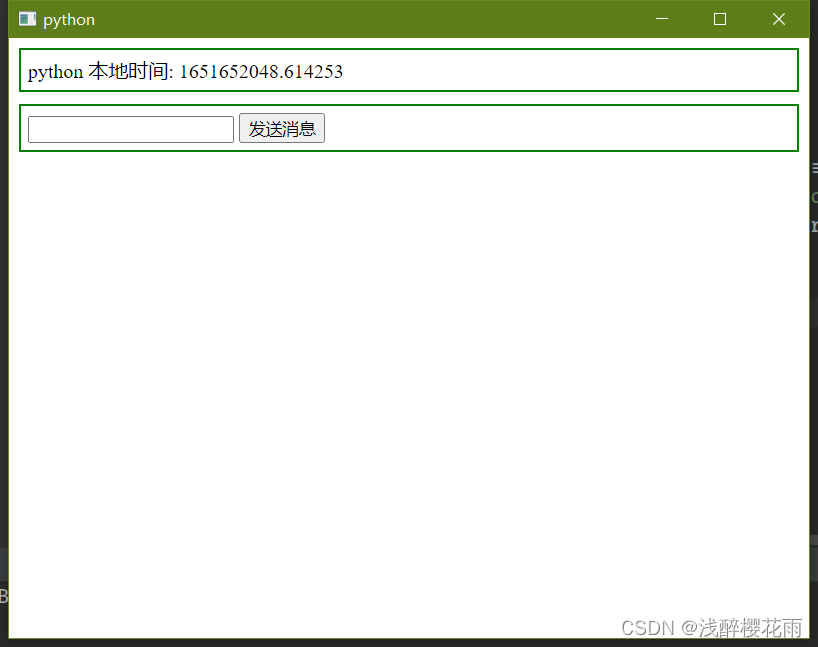
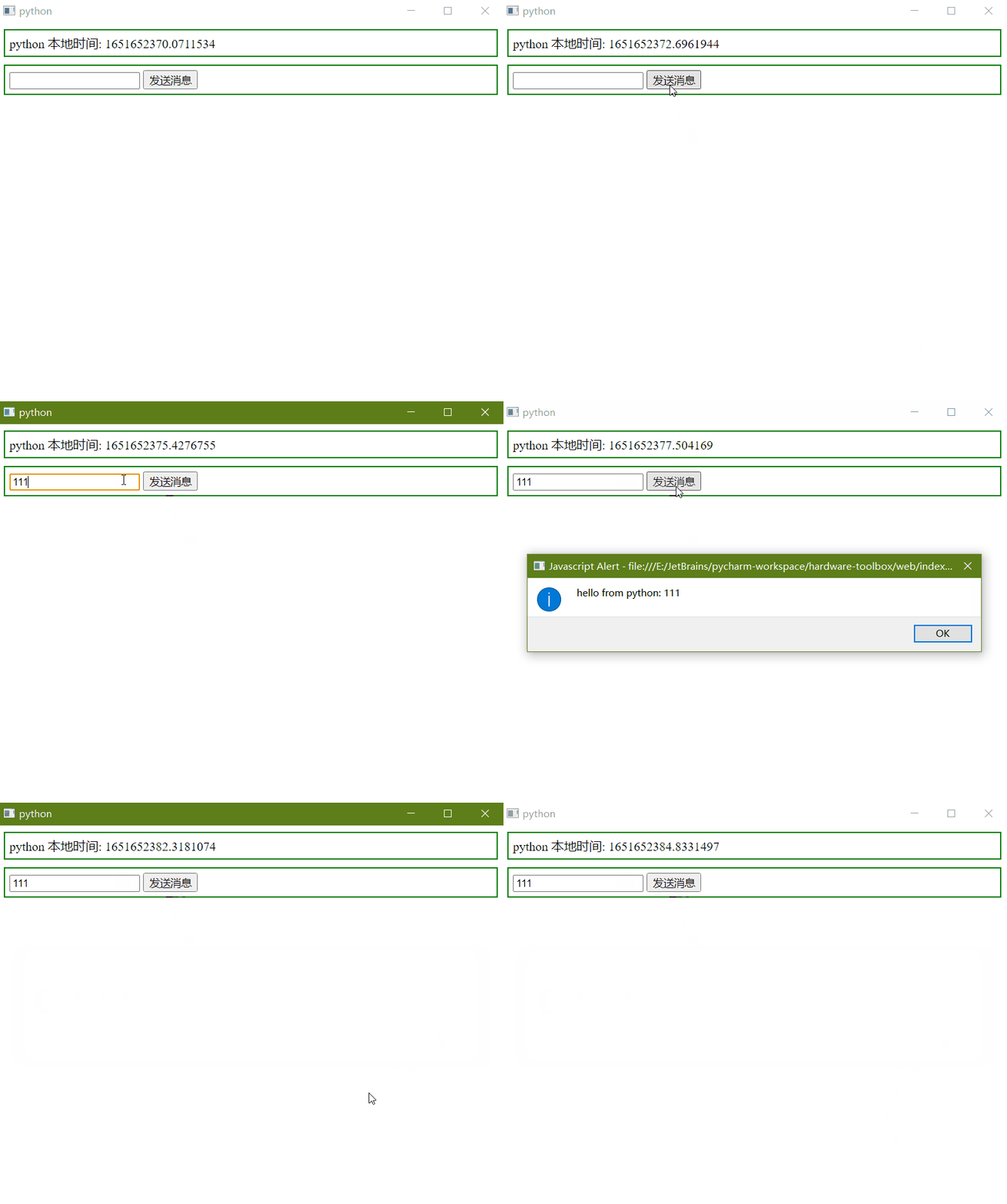
代码
本示例需要在同一个文件夹下创建三个文件
一、前端HTML文件
index.html
<!DOCTYPE html>
<html lang="en">
<head>
    <meta charset="utf-8" />
    <script type="text/javascript" src="qwebchannel.js"></script>
    <title>QWebChannel测试</title>
    <script>
    	//初始化代码,固定格式
        window.onload = function () {
            new QWebChannel(qt.webChannelTransport, function (channel) {
                window.py = channel.objects.py;
            });
        }
    </script>
</head>
<body>
<div id="sysTime" style="padding:5px;border: 2px solid green"></div>
<div style="margin-top: 10px;padding:5px;border: 2px solid green">
    <input id="message" name="message"/>
    <button onclick="sendMessage();">发送消息</button>
</div>
<script>
    function sendMessage() {
        message = document.getElementById('message').value;
        //调用python的hello方法
        py.hello(message, function(res){
            alert(res);
        });
    }
	//给python调用的显示时间的测试方法
    function sysTime(msg) {
        document.getElementById('sysTime').innerHTML=msg;
    }


</script>
</body>
</html>
二、后端python主文件
main.py
import sys
import time
import os

from PySide6.QtWidgets import QApplication
from PySide6.QtCore import QObject, Slot
from PySide6.QtWebChannel import QWebChannel
from PySide6.QtWebEngineWidgets import QWebEngineView
from PySide6.QtCore import QTimer


class Handlers(QObject):

    def __init__(self):
        super().__init__(None)
        self.view = QWebEngineView()
        self.page = self.view.page()
		# 定时发送测试消息的定时器
        self.timer = QTimer()
        self.timer.timeout.connect(self.send_time)
        self.timer.start(100)

    @Slot(str, result=str)
    def hello(self, message):
        """js调用python测试"""
        print('call received')
        return f'hello from python: {message}'

    def send_time(self):
        """python调用js测试"""
        self.page.runJavaScript(f'sysTime("python 本地时间: {time.time()}")')


if __name__ == '__main__':
    app = QApplication(sys.argv)

    channel = QWebChannel()
    handlers = Handlers()
    channel.registerObject('py', handlers)
    handlers.page.setWebChannel(channel)
    url = os.getcwd().replace('\\', '/') + '/index.html'
    handlers.view.load(url)
    handlers.view.show()
    sys.exit(app.exec())
三、通用qwebchannel.js通信文件
本文件来自Qt官方,代码固定,无需修改。
qwebchannel.js
/****************************************************************************
**
** Copyright (C) 2016 The Qt Company Ltd.
** Contact: http://www.qt.io/licensing/
**
** This file is part of the examples of the Qt Toolkit.
**
** $QT_BEGIN_LICENSE:BSD$
** You may use this file under the terms of the BSD license as follows:
**
** "Redistribution and use in source and binary forms, with or without
** modification, are permitted provided that the following conditions are
** met:
**   * Redistributions of source code must retain the above copyright
**     notice, this list of conditions and the following disclaimer.
**   * Redistributions in binary form must reproduce the above copyright
**     notice, this list of conditions and the following disclaimer in
**     the documentation and/or other materials provided with the
**     distribution.
**   * Neither the name of The Qt Company Ltd nor the names of its
**     contributors may be used to endorse or promote products derived
**     from this software without specific prior written permission.
**
**
** THIS SOFTWARE IS PROVIDED BY THE COPYRIGHT HOLDERS AND CONTRIBUTORS
** "AS IS" AND ANY EXPRESS OR IMPLIED WARRANTIES, INCLUDING, BUT NOT
** LIMITED TO, THE IMPLIED WARRANTIES OF MERCHANTABILITY AND FITNESS FOR
** A PARTICULAR PURPOSE ARE DISCLAIMED. IN NO EVENT SHALL THE COPYRIGHT
** OWNER OR CONTRIBUTORS BE LIABLE FOR ANY DIRECT, INDIRECT, INCIDENTAL,
** SPECIAL, EXEMPLARY, OR CONSEQUENTIAL DAMAGES (INCLUDING, BUT NOT
** LIMITED TO, PROCUREMENT OF SUBSTITUTE GOODS OR SERVICES; LOSS OF USE,
** DATA, OR PROFITS; OR BUSINESS INTERRUPTION) HOWEVER CAUSED AND ON ANY
** THEORY OF LIABILITY, WHETHER IN CONTRACT, STRICT LIABILITY, OR TORT
** (INCLUDING NEGLIGENCE OR OTHERWISE) ARISING IN ANY WAY OUT OF THE USE
** OF THIS SOFTWARE, EVEN IF ADVISED OF THE POSSIBILITY OF SUCH DAMAGE."
**
** $QT_END_LICENSE$
**
****************************************************************************/
"use strict";

var QWebChannelMessageTypes = {
    signal: 1,
    propertyUpdate: 2,
    init: 3,
    idle: 4,
    debug: 5,
    invokeMethod: 6,
    connectToSignal: 7,
    disconnectFromSignal: 8,
    setProperty: 9,
    response: 10,
};

var QWebChannel = function(transport, initCallback)
{
    if (typeof transport !== "object" || typeof transport.send !== "function") {
        console.error("The QWebChannel expects a transport object with a send function and onmessage callback property." +
                      " Given is: transport: " + typeof(transport) + ", transport.send: " + typeof(transport.send));
        return;
    }

    var channel = this;
    this.transport = transport;

    this.send = function(data)
    {
        if (typeof(data) !== "string") {
            data = JSON.stringify(data);
        }
        channel.transport.send(data);
    }

    this.transport.onmessage = function(message)
    {
        var data = message.data;
        if (typeof data === "string") {
            data = JSON.parse(data);
        }
        switch (data.type) {
            case QWebChannelMessageTypes.signal:
                channel.handleSignal(data);
                break;
            case QWebChannelMessageTypes.response:
                channel.handleResponse(data);
                break;
            case QWebChannelMessageTypes.propertyUpdate:
                channel.handlePropertyUpdate(data);
                break;
            default:
                console.error("invalid message received:", message.data);
                break;
        }
    }

    this.execCallbacks = {};
    this.execId = 0;
    this.exec = function(data, callback)
    {
        if (!callback) {
            // if no callback is given, send directly
            channel.send(data);
            return;
        }
        if (channel.execId === Number.MAX_VALUE) {
            // wrap
            channel.execId = Number.MIN_VALUE;
        }
        if (data.hasOwnProperty("id")) {
            console.error("Cannot exec message with property id: " + JSON.stringify(data));
            return;
        }
        data.id = channel.execId++;
        channel.execCallbacks[data.id] = callback;
        channel.send(data);
    };

    this.objects = {};

    this.handleSignal = function(message)
    {
        var object = channel.objects[message.object];
        if (object) {
            object.signalEmitted(message.signal, message.args);
        } else {
            console.warn("Unhandled signal: " + message.object + "::" + message.signal);
        }
    }

    this.handleResponse = function(message)
    {
        if (!message.hasOwnProperty("id")) {
            console.error("Invalid response message received: ", JSON.stringify(message));
            return;
        }
        channel.execCallbacks[message.id](message.data);
        delete channel.execCallbacks[message.id];
    }

    this.handlePropertyUpdate = function(message)
    {
        for (var i in message.data) {
            var data = message.data[i];
            var object = channel.objects[data.object];
            if (object) {
                object.propertyUpdate(data.signals, data.properties);
            } else {
                console.warn("Unhandled property update: " + data.object + "::" + data.signal);
            }
        }
        channel.exec({type: QWebChannelMessageTypes.idle});
    }

    this.debug = function(message)
    {
        channel.send({type: QWebChannelMessageTypes.debug, data: message});
    };

    channel.exec({type: QWebChannelMessageTypes.init}, function(data) {
        for (var objectName in data) {
            var object = new QObject(objectName, data[objectName], channel);
        }
        // now unwrap properties, which might reference other registered objects
        for (var objectName in channel.objects) {
            channel.objects[objectName].unwrapProperties();
        }
        if (initCallback) {
            initCallback(channel);
        }
        channel.exec({type: QWebChannelMessageTypes.idle});
    });
};

function QObject(name, data, webChannel)
{
    this.__id__ = name;
    webChannel.objects[name] = this;

    // List of callbacks that get invoked upon signal emission
    this.__objectSignals__ = {};

    // Cache of all properties, updated when a notify signal is emitted
    this.__propertyCache__ = {};

    var object = this;

    // ----------------------------------------------------------------------

    this.unwrapQObject = function(response)
    {
        if (response instanceof Array) {
            // support list of objects
            var ret = new Array(response.length);
            for (var i = 0; i < response.length; ++i) {
                ret[i] = object.unwrapQObject(response[i]);
            }
            return ret;
        }
        if (!response
            || !response["__QObject*__"]
            || response.id === undefined) {
            return response;
        }

        var objectId = response.id;
        if (webChannel.objects[objectId])
            return webChannel.objects[objectId];

        if (!response.data) {
            console.error("Cannot unwrap unknown QObject " + objectId + " without data.");
            return;
        }

        var qObject = new QObject( objectId, response.data, webChannel );
        qObject.destroyed.connect(function() {
            if (webChannel.objects[objectId] === qObject) {
                delete webChannel.objects[objectId];
                // reset the now deleted QObject to an empty {} object
                // just assigning {} though would not have the desired effect, but the
                // below also ensures all external references will see the empty map
                // NOTE: this detour is necessary to workaround QTBUG-40021
                var propertyNames = [];
                for (var propertyName in qObject) {
                    propertyNames.push(propertyName);
                }
                for (var idx in propertyNames) {
                    delete qObject[propertyNames[idx]];
                }
            }
        });
        // here we are already initialized, and thus must directly unwrap the properties
        qObject.unwrapProperties();
        return qObject;
    }

    this.unwrapProperties = function()
    {
        for (var propertyIdx in object.__propertyCache__) {
            object.__propertyCache__[propertyIdx] = object.unwrapQObject(object.__propertyCache__[propertyIdx]);
        }
    }

    function addSignal(signalData, isPropertyNotifySignal)
    {
        var signalName = signalData[0];
        var signalIndex = signalData[1];
        object[signalName] = {
            connect: function(callback) {
                if (typeof(callback) !== "function") {
                    console.error("Bad callback given to connect to signal " + signalName);
                    return;
                }

                object.__objectSignals__[signalIndex] = object.__objectSignals__[signalIndex] || [];
                object.__objectSignals__[signalIndex].push(callback);

                if (!isPropertyNotifySignal && signalName !== "destroyed") {
                    // only required for "pure" signals, handled separately for properties in propertyUpdate
                    // also note that we always get notified about the destroyed signal
                    webChannel.exec({
                        type: QWebChannelMessageTypes.connectToSignal,
                        object: object.__id__,
                        signal: signalIndex
                    });
                }
            },
            disconnect: function(callback) {
                if (typeof(callback) !== "function") {
                    console.error("Bad callback given to disconnect from signal " + signalName);
                    return;
                }
                object.__objectSignals__[signalIndex] = object.__objectSignals__[signalIndex] || [];
                var idx = object.__objectSignals__[signalIndex].indexOf(callback);
                if (idx === -1) {
                    console.error("Cannot find connection of signal " + signalName + " to " + callback.name);
                    return;
                }
                object.__objectSignals__[signalIndex].splice(idx, 1);
                if (!isPropertyNotifySignal && object.__objectSignals__[signalIndex].length === 0) {
                    // only required for "pure" signals, handled separately for properties in propertyUpdate
                    webChannel.exec({
                        type: QWebChannelMessageTypes.disconnectFromSignal,
                        object: object.__id__,
                        signal: signalIndex
                    });
                }
            }
        };
    }

    /**
     * Invokes all callbacks for the given signalname. Also works for property notify callbacks.
     */
    function invokeSignalCallbacks(signalName, signalArgs)
    {
        var connections = object.__objectSignals__[signalName];
        if (connections) {
            connections.forEach(function(callback) {
                callback.apply(callback, signalArgs);
            });
        }
    }

    this.propertyUpdate = function(signals, propertyMap)
    {
        // update property cache
        for (var propertyIndex in propertyMap) {
            var propertyValue = propertyMap[propertyIndex];
            object.__propertyCache__[propertyIndex] = propertyValue;
        }

        for (var signalName in signals) {
            // Invoke all callbacks, as signalEmitted() does not. This ensures the
            // property cache is updated before the callbacks are invoked.
            invokeSignalCallbacks(signalName, signals[signalName]);
        }
    }

    this.signalEmitted = function(signalName, signalArgs)
    {
        invokeSignalCallbacks(signalName, signalArgs);
    }

    function addMethod(methodData)
    {
        var methodName = methodData[0];
        var methodIdx = methodData[1];
        object[methodName] = function() {
            var args = [];
            var callback;
            for (var i = 0; i < arguments.length; ++i) {
                if (typeof arguments[i] === "function")
                    callback = arguments[i];
                else
                    args.push(arguments[i]);
            }

            webChannel.exec({
                "type": QWebChannelMessageTypes.invokeMethod,
                "object": object.__id__,
                "method": methodIdx,
                "args": args
            }, function(response) {
                if (response !== undefined) {
                    var result = object.unwrapQObject(response);
                    if (callback) {
                        (callback)(result);
                    }
                }
            });
        };
    }

    function bindGetterSetter(propertyInfo)
    {
        var propertyIndex = propertyInfo[0];
        var propertyName = propertyInfo[1];
        var notifySignalData = propertyInfo[2];
        // initialize property cache with current value
        // NOTE: if this is an object, it is not directly unwrapped as it might
        // reference other QObject that we do not know yet
        object.__propertyCache__[propertyIndex] = propertyInfo[3];

        if (notifySignalData) {
            if (notifySignalData[0] === 1) {
                // signal name is optimized away, reconstruct the actual name
                notifySignalData[0] = propertyName + "Changed";
            }
            addSignal(notifySignalData, true);
        }

        Object.defineProperty(object, propertyName, {
            configurable: true,
            get: function () {
                var propertyValue = object.__propertyCache__[propertyIndex];
                if (propertyValue === undefined) {
                    // This shouldn't happen
                    console.warn("Undefined value in property cache for property \"" + propertyName + "\" in object " + object.__id__);
                }

                return propertyValue;
            },
            set: function(value) {
                if (value === undefined) {
                    console.warn("Property setter for " + propertyName + " called with undefined value!");
                    return;
                }
                object.__propertyCache__[propertyIndex] = value;
                webChannel.exec({
                    "type": QWebChannelMessageTypes.setProperty,
                    "object": object.__id__,
                    "property": propertyIndex,
                    "value": value
                });
            }
        });

    }

    // ----------------------------------------------------------------------

    data.methods.forEach(addMethod);

    data.properties.forEach(bindGetterSetter);

    data.signals.forEach(function(signal) { addSignal(signal, false); });

    for (var name in data.enums) {
        object[name] = data.enums[name];
    }
}

//required for use with nodejs
if (typeof module === 'object') {
    module.exports = {
        QWebChannel: QWebChannel
    };
}
版权声明:本文为u013314786原创文章,遵循CC 4.0 BY-SA版权协议,转载请附上原文出处链接和本声明。