以下主要是记录个人对官方代码的理解。注意这篇官方教程只写了entity classification的代码。
参考文章:这篇博客
R-GCN:多层网络
由多层R-GCNLayer组成,代码比较简单在此略过,重点看每一层是怎么实现的。
RGCNLayer:单层卷积网络
先全部摆出来,然后再着重看几个部分。
class RGCNLayer(nn.Module):
    def __init__(self, in_feat, out_feat, num_rels, num_bases=-1, bias=None,
                 activation=None, is_input_layer=False):
        super(RGCNLayer, self).__init__()
        self.in_feat = in_feat  # 输入维度
        self.out_feat = out_feat  # 输出维度
        self.num_rels = num_rels  # 边类型数量(关系数量)  # |E|=num_rels(关系个数、边的种类)
        self.num_bases = num_bases  # W_r分解的数量,对应原文公式3的B
        self.bias = bias  # 偏置,应该和模型输出的维度一样
        self.activation = activation  # 激活函数
        self.is_input_layer = is_input_layer  # 是否是输入层(第一层)

        # sanity check
        # 矩阵分解的参数校验条件:不能小于0,不能比现有维度大(复杂度会变高,参数反而增加)
        if self.num_bases <= 0 or self.num_bases > self.num_rels:
            self.num_bases = self.num_rels

        # weight bases in equation (3)
        # 这里是根据公式3把W_r算出来,用V_b(weight)表示,共有num_bases个V_b累加得到
        # 得到的结果是Tensor,因此用 nn.Parameter将一个不可训练的类型Tensor
        # 转换成可以训练的类型Parameter
        # 并将这个parameter绑定到这个module里面
        self.weight = nn.Parameter(torch.Tensor(self.num_bases, self.in_feat,
                                                self.out_feat))
        if self.num_bases < self.num_rels:  # B < 边种类|E|,那么矩阵分解就可以减少参数个数
            # linear combination coefficients in equation (3)
            # 这里的w_comp是公式3里面的a_{rb}
            # 一个边类型对应一个W_r(那么就一共有num_rels种W_r),每个W_r分解为num_bases个组合
            # 因此w_comp这里的维度就是num_rels×num_bases
            self.w_comp = nn.Parameter(torch.Tensor(self.num_rels, self.num_bases))

        # add bias
        if self.bias:
            self.bias = nn.Parameter(torch.Tensor(out_feat))

        # init trainable parameters
        # 这里用的是xavier初始化
        nn.init.xavier_uniform_(self.weight,
                                gain=nn.init.calculate_gain('relu'))
        if self.num_bases < self.num_rels:
            nn.init.xavier_uniform_(self.w_comp,
                                    gain=nn.init.calculate_gain('relu'))
        if self.bias:
            nn.init.xavier_uniform_(self.bias,
                                    gain=nn.init.calculate_gain('relu'))

    def forward(self, g):
        if self.num_bases < self.num_rels:  # 分解就走公式3:  B<|E|
            # generate all weights from bases (equation (3))
            weight = self.weight.view(self.in_feat, self.num_bases, self.out_feat)
            weight = torch.matmul(self.w_comp, weight).view(self.num_rels,
                                                            self.in_feat, self.out_feat)
            # |E|=num_rels(关系个数、边的种类)
            # w_comp:|E|*B, weight:in*B*out -> in*|E|*out -> |E|*in*out
        else:  # 不分解就直接用weight算
            weight = self.weight  # |E|*in*out, 此时|E|=B=min{|E|, B}

        if self.is_input_layer:
            def message_func(edges):
                # for input layer, matrix multiply can be converted to be
                # an embedding lookup using source node id
                # 对于第一层,输入可以直接用独热编码进行aggregate
                # 信息的汇聚就可以直接写成矩阵相乘的形式
                embed = weight.view(-1, self.out_feat)  # embed维度整成out_feat维度一样
                index = edges.data['rel_type'] * self.in_feat + edges.src['id']
                return {'msg': embed[index] * edges.data['norm']}
        else:
            def message_func(edges):
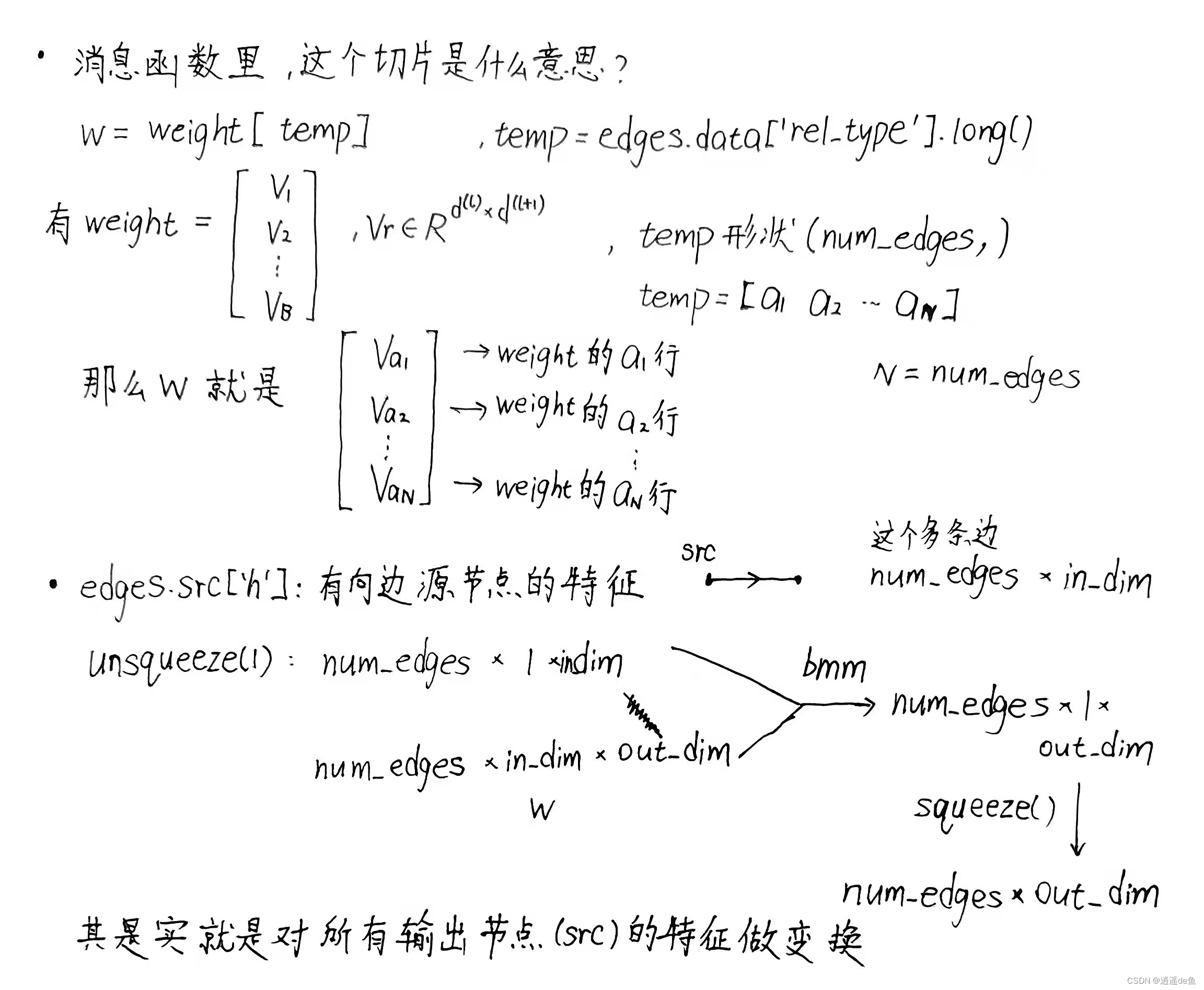
                w = weight[edges.data['rel_type'].long()]  # 根据边类型'rel_type'获取对应的
                # 这个切片就有点神奇了,weight是B*in*out,edges.data['rel_type']是(65439,),切出来是w:65439*in*out
                # 我悟了
                msg = torch.bmm(edges.src['h'].unsqueeze(1), w).squeeze()  # 消息汇聚,就是w乘以src['h'](输入节点特征)
                # edges.src['h'].unsqueeze(1): 65439*in -> 65439*1*in
                # (65439*1*in) * (65439*in*out) -> 65439*1*out 广播,
                # 前一项提出65439,然后1*in与in*out作矩阵乘法,得1*out,然后与65439组合成65439*1*out
                # .squeeze() msg: 65439*1*out -> 65439*out
                msg = msg * edges.data['norm']
                return {'msg': msg}

        def apply_func(nodes):
            h = nodes.data['h']
            if self.bias:
                h = h + self.bias
            if self.activation:
                h = self.activation(h)
            return {'h': h}

        g.update_all(message_func, fn.sum(msg='msg', out='h'), apply_func)
重点讲一下几个变量和函数。
基函数分解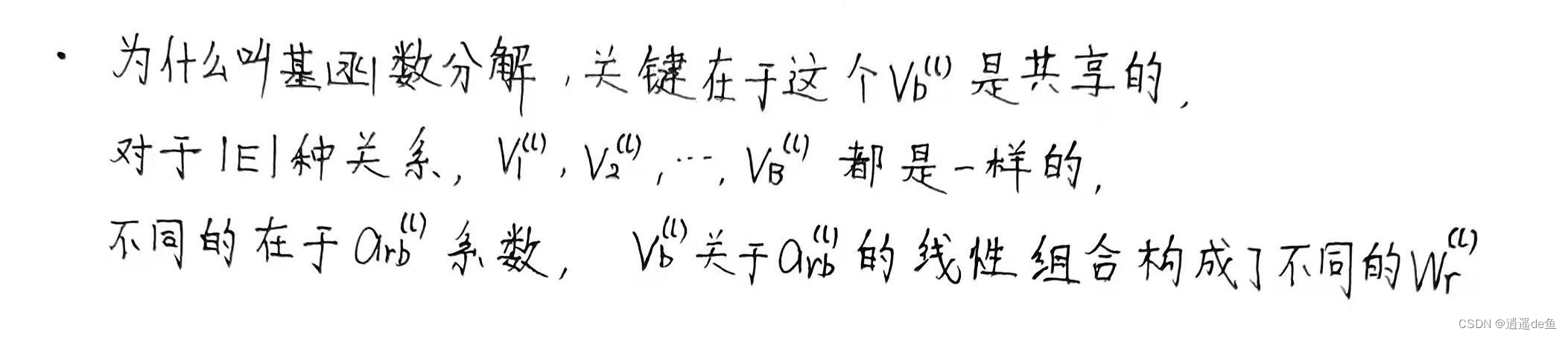
self.w_comp变量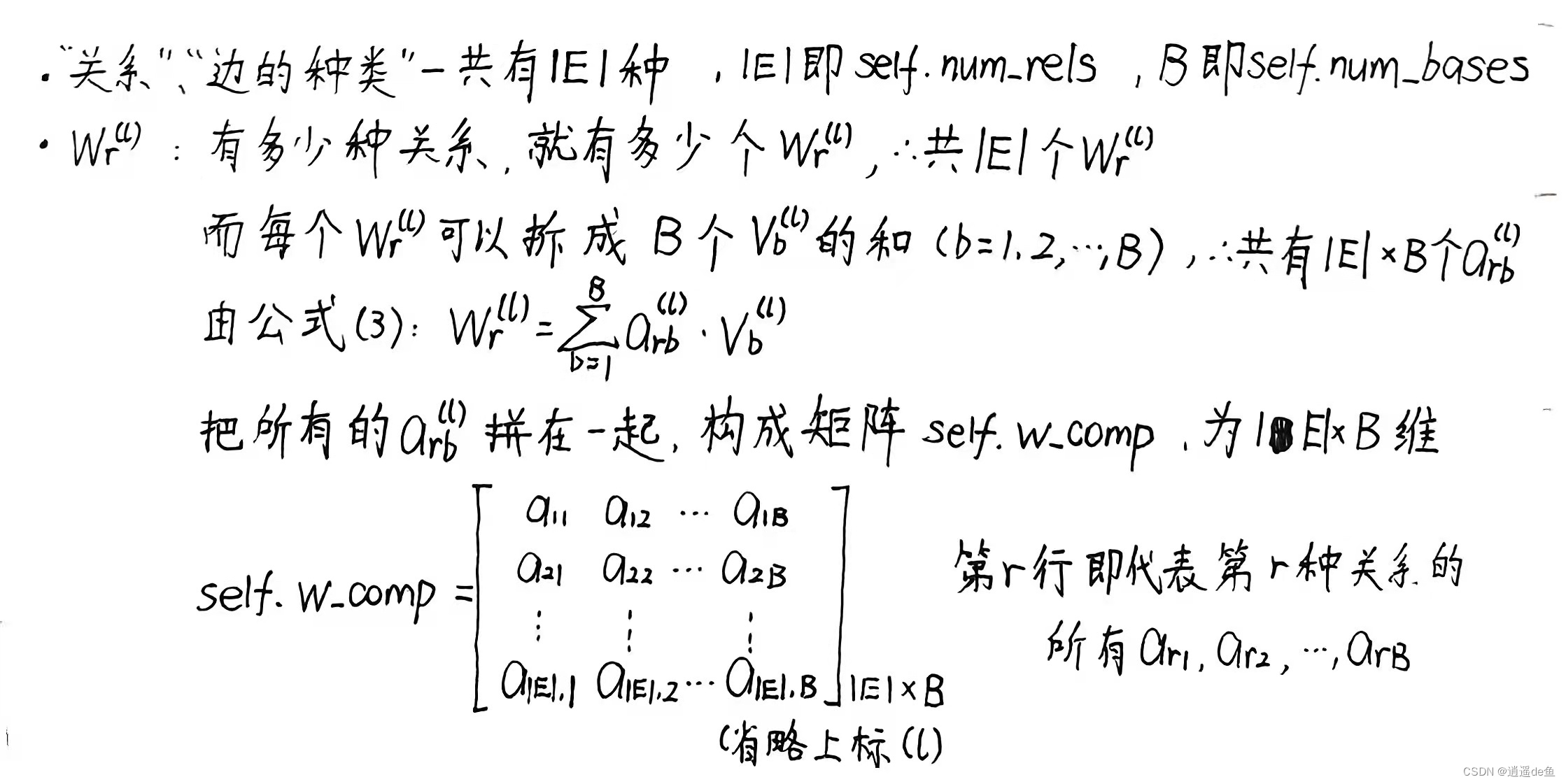
        if self.num_bases < self.num_rels:  # B < 边种类|E|,那么矩阵分解就可以减少参数个数
            # linear combination coefficients in equation (3)
            # 这里的w_comp是公式3里面的a_{rb}
            # 一个边类型对应一个W_r(那么就一共有num_rels种W_r),每个W_r分解为num_bases个组合
            # 因此w_comp这里的维度就是num_rels×num_bases
            self.w_comp = nn.Parameter(torch.Tensor(self.num_rels, self.num_bases))
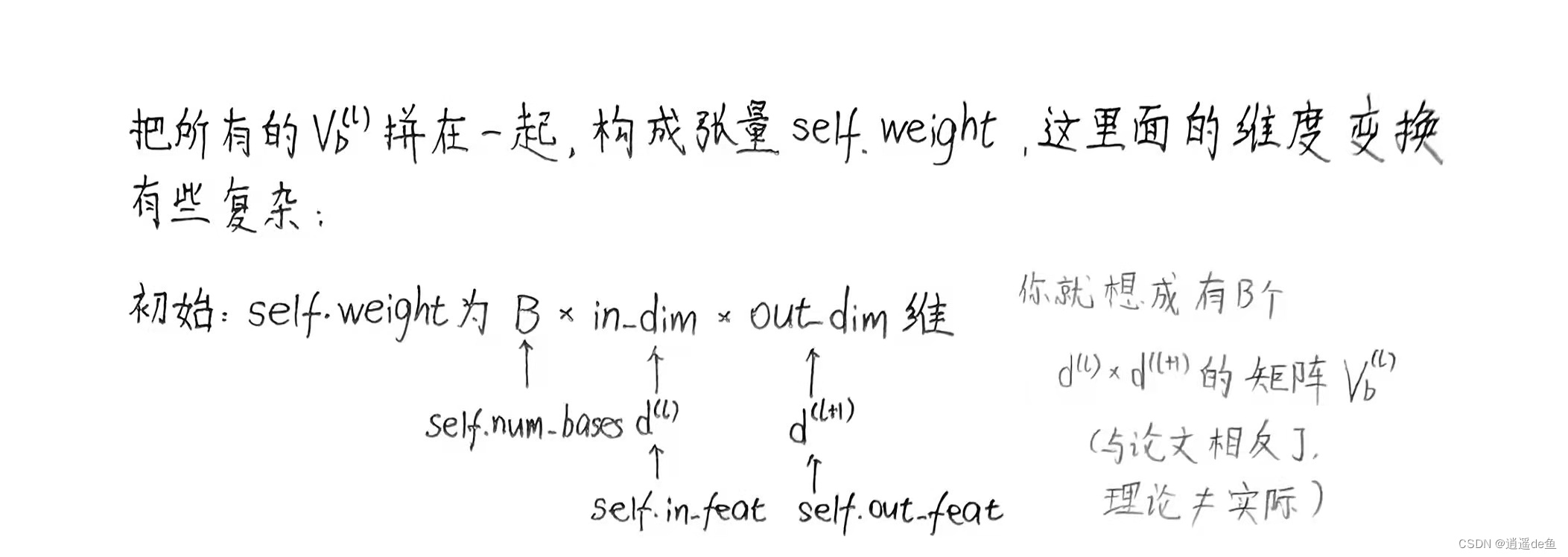
self.weight变量
        # weight bases in equation (3)
        # 这里是根据公式3把W_r算出来,用V_b(weight)表示,共有num_bases个V_b累加得到
        # 得到的结果是Tensor,因此用 nn.Parameter将一个不可训练的类型Tensor
        # 转换成可以训练的类型Parameter
        # 并将这个parameter绑定到这个module里面
        self.weight = nn.Parameter(torch.Tensor(self.num_bases, self.in_feat,
                                                self.out_feat))
forward函数
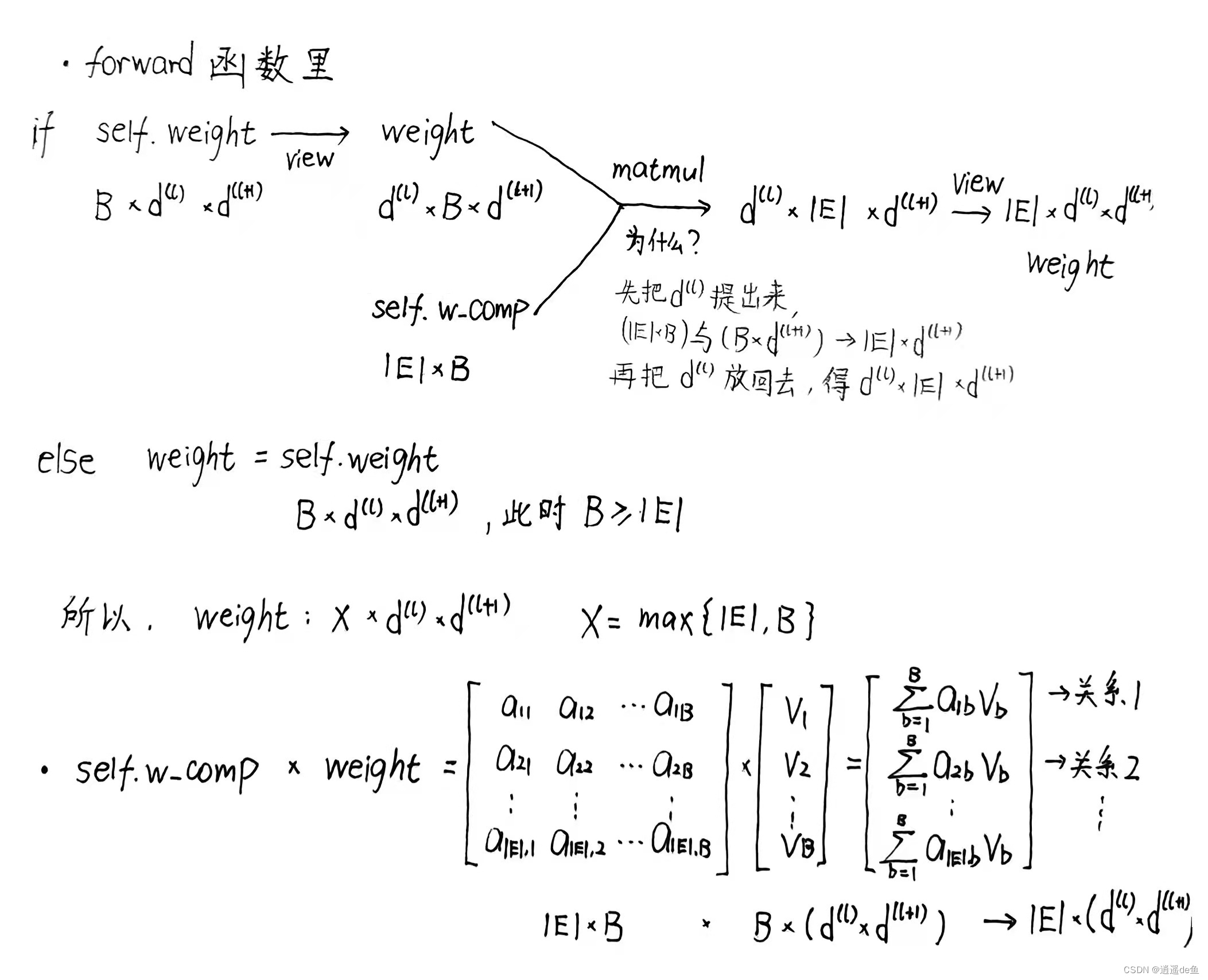
B是人为设定的超参数,如果B小于关系数目(边的种类数目),那么说明我们要用基函数分解,来增加模型约束,减少过拟合;如果B大于等于关系数目,那么基函数分解就没有必要的,反而会增大模型的参数个数。
    def forward(self, g):
        if self.num_bases < self.num_rels:  # 分解就走公式3:  B<|E|
            # generate all weights from bases (equation (3))
            weight = self.weight.view(self.in_feat, self.num_bases, self.out_feat)
            weight = torch.matmul(self.w_comp, weight).view(self.num_rels,
                                                            self.in_feat, self.out_feat)
            # |E|=num_rels(关系个数、边的种类)
            # w_comp:|E|*B, weight:in*B*out -> in*|E|*out -> |E|*in*out
        else:  # 不分解就直接用weight算, B>=|E|
            weight = self.weight  # |E|*in*out, 此时|E|=B=max{|E|, B}
消息函数
            def message_func(edges):
                w = weight[edges.data['rel_type'].long()]  # 根据边类型'rel_type'获取对应的
                # 这个切片就有点神奇了,weight是B*in*out,edges.data['rel_type']是(65439,),切出来是w:65439*in*out
                # 我悟了
                msg = torch.bmm(edges.src['h'].unsqueeze(1), w).squeeze()  # 消息汇聚,就是w乘以src['h'](输入节点特征)
                # edges.src['h'].unsqueeze(1): 65439*in -> 65439*1*in
                # (65439*1*in) * (65439*in*out) -> 65439*1*out 广播,
                # 前一项提出65439,然后1*in与in*out作矩阵乘法,得1*out,然后与65439组合成65439*1*out
                # .squeeze() msg: 65439*1*out -> 65439*out
                msg = msg * edges.data['norm']
                return {'msg': msg}
https://blog.csdn.net/Wolf_AgOH/article/details/124528026
版权声明:本文为Wolf_AgOH原创文章,遵循CC 4.0 BY-SA版权协议,转载请附上原文出处链接和本声明。