目录
接口隔离原则(Interface Segregation Principle)
设计模式七大原则
设计模式的目的
编写软件过程中,程序员面临着来自 耦合性,内聚性以及可维护性,可扩展性,重用性,灵活性 等多方面的挑战,设计模式是为了让程序(软件),具有更好
1) 代码重用性 (即:相同功能的代码,不用多次编写)
2) 可读性 (即:编程规范性, 便于其他程序员的阅读和理解)
3) 可扩展性 (即:当需要增加新的功能时,非常的方便,称为可维护)
4) 可靠性 (即:当我们增加新的功能后,对原来的功能没有影响)
5) 使程序呈现高内聚,低耦合的特性
分享金句:
6) 设计模式包含了面向对象的精髓,“懂了设计模式,你就懂了面向对象分析和设计(OOA/D)的精要”
7) Scott Mayers 在其巨著《Effective C++》就曾经说过:C++老手和 C++新手的区别就是前者手背上有很多伤疤
设计模式七大原则
设计模式原则,其实就是程序员在编程时,应当遵守的原则,也是各种设计模式的基础(即:设计模式为什么这样设计的依据)
设计模式常用的七大原则有:
单一职责原则
接口隔离原则
依赖倒转(倒置)原则
里氏替换原则
开闭原则
迪米特法则
合成复用原则
单一职责原则
基本介绍
对类来说的,即一个类应该只负责一项职责。如类 A负责两个不同职责:职责 1,职责 2。当职责 1需求变更而改变 A时,可能造成职责 2执行错误,所以需要将类 A的粒度分解为 A1,A2
应用实例
public class SingleResponsibility1 {
public static void main(String[] args) {
// TODOAuto-generated method stub
Vehicle vehicle = new Vehicle();
vehicle.run("摩托车");
vehicle.run("汽车");
vehicle.run("飞机");
}
}
// 交通工具类
// 方式 1
// 1. 在方式 1 的 run方法中,违反了单一职责原则
// 2. 解决的方案非常的简单,根据交通工具运行方法不同,分解成不同类即可
class Vehicle {
public void run(String vehicle) {
System.out.println(vehicle + " 在公路上运行....");
}
}2) 方案 2 [分析说明]
package com.atguigu.principle.singleresponsibility;
public class SingleResponsibility2 {
public static void main(String[] args) {
// TODOAuto-generated method stubRoadVehicle roadVehicle = new RoadVehicle();
roadVehicle.run("摩托车");
roadVehicle.run("汽车");
AirVehicle airVehicle = new AirVehicle();
airVehicle.run("飞机");
}
}
//方案 2的分析
//1. 遵守单一职责原则
//2. 但是这样做的改动很大,即将类分解,同时修改客户端
//3. 改进:直接修改 Vehicle 类,改动的代码会比较少=>方案 3
class RoadVehicle {
public void run(String vehicle) {
System.out.println(vehicle + "公路运行");
}
}
class AirVehicle {
public void run(String vehicle) {
System.out.println(vehicle + "天空运行");
}}
class WaterVehicle {
public void run(String vehicle) {
System.out.println(vehicle + "水中运行");
}
}
3) 方案 3 [分析说明]package com.atguigu.principle.singleresponsibility;
public class SingleResponsibility3 {
public static void main(String[] args) {
// TODOAuto-generated method stub
Vehicle2 vehicle2 = new Vehicle2();
vehicle2.run("汽车");
vehicle2.runWater("轮船");
vehicle2.runAir("飞机");
}
}
//方式 3的分析//1. 这种修改方法没有对原来的类做大的修改,只是增加方法
//2. 这里虽然没有在类这个级别上遵守单一职责原则,但是在方法级别上,仍然是遵守单一职责
class Vehicle2 {
public void run(String vehicle) {
//处理
System.out.println(vehicle + " 在公路上运行....");
}
public void runAir(String vehicle) {
System.out.println(vehicle + " 在天空上运行....");
}
public void runWater(String vehicle) {
System.out.println(vehicle + " 在水中行....");
}
//方法 2.
//..
//..
//...
}
单一职责原则注意事项和细节
1) 降低类的复杂度,一个类只负责一项职责。
2) 提高类的可读性,可维护性
3) 降低变更引起的风险
4) 通常情况下,我们应当遵守单一职责原则,只有逻辑足够简单,才可以在代码级违反单一职责原则;只有类中
方法数量足够少,可以在方法级别保持单一职责原则
接口隔离原则(Interface Segregation Principle)
基本介绍
1) 客户端不应该依赖它不需要的接口,即一个类对另一个类的依赖应该建立在最小的接口上
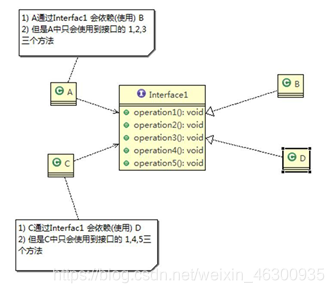
2) 先看一张图:
3) 类 A 通过接口 Interface1 依赖类 B,类 C 通过接口 Interface1 依赖类 D,如果接口 Interface1 对于类 A 和类 C
来说不是最小接口,那么类 B和类 D必须去实现他们不需要的方法。
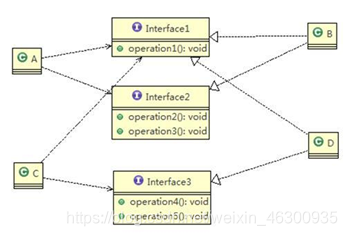
4) 按隔离原则应当这样处理:
将接口 Interface1拆分为独立的几个接口(这里我们拆分成 3个接口),类 A和类 C分别与他们需要的接口建立依赖关系。也就是采用接口隔离原则
应用实例
1) 类 A通过接口 Interface1依赖类 B,类 C通过接口 Interface1依赖类 D,请编写代码完成此应用实例。
2) 看老师代码-没有使用接口隔离原则代码
public class Segregation1 {
public static void main(String[] args) {
// TODOAuto-generated method stub
}
}
//接口
interface Interface1 {
void operation1();
void operation2();
void operation3();
void operation4();
void operation5();
}
class B implements Interface1 {
public void operation1() {
System.out.println("B 实现了 operation1");
}
public void operation2() {
System.out.println("B 实现了 operation2");
}
public void operation3() {
System.out.println("B 实现了 operation3");
}
public void operation4() {
System.out.println("B 实现了 operation4");
}
public void operation5() {
System.out.println("B 实现了 operation5");
}
}
class D implements Interface1 {
public void operation1() {
System.out.println("D 实现了 operation1");
}
public void operation2() {
System.out.println("D 实现了 operation2");
}
public void operation3() {
System.out.println("D 实现了 operation3");
}
public void operation4() {
System.out.println("D 实现了 operation4");
}
public void operation5() {
System.out.println("D 实现了 operation5");
}
}
class A { //A 类通过接口 Interface1 依赖(使用) B类,但是只会用到 1,2,3方法
public void depend1(Interface1 i) {
i.operation1();
}
public void depend2(Interface1 i) {
i.operation2();
}
public void depend3(Interface1 i) {
i.operation3();

}
}
class C { //C 类通过接口 Interface1 依赖(使用) D类,但是只会用到 1,4,5方法
public void depend1(Interface1 i) {
i.operation1();
}
public void depend4(Interface1 i) {
i.operation4();
}
public void depend5(Interface1 i) {
i.operation5();
}
}
应传统方法的问题和使用接口隔离原则改进
1) 类 A 通过接口 Interface1 依赖类 B,类 C 通过接口 Interface1 依赖类 D,如果接口 Interface1 对于类 A 和类 C
来说不是最小接口,那么类 B和类 D必须去实现他们不需要的方法
2) 将接口 Interface1拆分为独立的几个接口,类 A和类 C分别与他们需要的接口建立依赖关系。也就是采用接口
隔离原则
3) 接口 Interface1中出现的方法,根据实际情况拆分为三个接口
4) 代码实现
public class Segregation1 {
public static void main(String[] args) {
// TODOAuto-generated method stub
// 使用一把
A a = newA();
a.depend1(new B()); // A类通过接口去依赖 B类
a.depend2(new B());
a.depend3(new B());
C c = new C();
c.depend1(new D()); // C类通过接口去依赖(使用)D类
c.depend4(new D());
c.depend5(new D());

}
}
// 接口 1
interface Interface1 {
void operation1();
}
// 接口 2
interface Interface2 {
void operation2();
void operation3();
}
// 接口 3
interface Interface3 {
void operation4();
void operation5();
}
class B implements Interface1, Interface2 {

public void operation1() {
System.out.println("B 实现了 operation1");
}
public void operation2() {
System.out.println("B 实现了 operation2");
}
public void operation3() {
System.out.println("B 实现了 operation3");
}
}
class D implements Interface1, Interface3 {
public void operation1() {
System.out.println("D 实现了 operation1");
}
public void operation4() {
System.out.println("D 实现了 operation4");
}
public void operation5() {
System.out.println("D 实现了 operation5");
}

}
class A { // A 类通过接口 Interface1,Interface2 依赖(使用) B类,但是只会用到 1,2,3方法
public void depend1(Interface1 i) {
i.operation1();
}
public void depend2(Interface2 i) {
i.operation2();
}
public void depend3(Interface2 i) {
i.operation3();
}
}
class C { // C 类通过接口 Interface1,Interface3 依赖(使用) D类,但是只会用到 1,4,5方法
public void depend1(Interface1 i) {
i.operation1();
}
public void depend4(Interface3 i) {
i.operation4();
}
public void depend5(Interface3 i) {
i.operation5();
}
}