2.1线性表的定义和特点
线性结构:
- 若结构是非空有限集,则有且仅有一个开始结点和一个终端结点,并且所有结点都最多只有一个直接前趋和一个直接后继。
- 可表示为: (a1 , a2 , …, ai-1, ai, ai+1,…, an)
- 包括线性表、栈、队列、字符串和数组,其中,最典型、最常用的是线性表。
线性结构的特点:
在数据元素的非空有限集中
- 存在唯一的一个被称作“第一个”的数据元素;
- 存在唯一的一个被称作“最后一个”的数据元素;
- 除第一个外,集合中的每个数据元素均只有一个直接前驱;
- 除最后一个之外,集合中每个数据元素均只有一个直接后继。
线性表:
- n个具有相同特性的数据元素的有限序列
- eg:26 个英文字母组成的英文表,( A, B, C, D, … , Z),数据元素都是字母,元素间关系是线性
2.2 线性表的顺序表示和实现
用一组地址连续的存储单元依次存储线性表中的数据元素。
代码用到文件: 刚发现上传的文件被人下载需要vip,百度网盘也挺麻烦,直接把内容放上去了,用的话可以cv到一个txt里!
ISBN 书名 定价
9787302257646 程序设计基础 25
9787302219972 单片机技术及应用 32
9787302203513 编译原理 46
9787811234923 汇编语言程序设计教程 21
9787512100831 计算机操作系统 17
9787302265436 计算机导论实验指导 18
9787302180630 实用数据结构 29
9787302225065 数据结构(C语言版) 38
9787302171676 C#面向对象程序设计 39
9787302250692 C语言程序设计 42
9787302150664 数据库原理 35
9787302260806 Java编程与实践 56
9787302252887 Java程序设计与应用教程 39
9787302198505 嵌入式操作系统及编程 25
9787302169666 软件测试 24
9787811231557 Eclipse基础与应用 35
代码如下:
/*
* 线性表的顺序表示和实现
* 以图书管理项目为例
*
* @Author: longbow_nice
* @CreatedTime: 2022/7/8
*/

#include<iostream>
#include<string>
#include<iomanip>
#include<fstream>
using namespace std;
#define OK 1
#define ERROR 0
#define OVERFLOW -2		//含义为运算过程中出现了上溢,即运算结果超出了运算变量所能存储的范围。
#define MAXSIZE 100		//顺序表最大长度
typedef int Status;		//函数名返回值类型
typedef int ElemType;	//数据类型
struct Book {
	string id;	//IBSN
	string name;	//书名
	double price;	//价格
};
typedef struct {
	Book* elem;	//存储空间机制
	int length;	//表长
}SqList;

//初始化顺序表L
Status InitList(SqList& L) {
	L.elem = new Book[MAXSIZE];
	if (!L.elem) {
		exit(OVERFLOW);
	}
	L.length = 0;
	return OK;
}

//销毁顺序表L
void DestroyList(SqList& L) {
	if (L.elem) {
		delete []L.elem;
	}
	L.length = 0;
	L.elem = NULL;
	cout << "销毁成功!" << endl;
}

//清空顺序表L
void ClearList(SqList &L) {
	L.length = 0;
	cout << "清空成功" << endl;
}

//求顺序表L的长度
int GetLength(SqList L) {
	return L.length;
}

//判断顺序表L是否为空
bool ListEmpty(SqList L) {
	return L.length == 0;
}

//取值
//获取顺序表L中的第i个元素内容
Status GetElem(SqList L, int i, Book &e) {
	if (i<1 || i>L.length) {
		return ERROR;
	}
	e = L.elem[i - 1];
	return OK;
}

//检索(查找)
//查找价格为price的图书位置
Status LocateElem(SqList L, double price) {
	for (int i = 0; i < L.length; i++) {
		if (L.elem[i].price == price) {
			return i + 1;
		}
	}
	return 0;
}

//插入
//在第j个位置之前插入新的元素e
Status ListInsert(SqList& L, int j, Book e) {
	if (j<1 || j>L.length+1) {
		return ERROR;
	}
	if (L.length == MAXSIZE) {
		return OVERFLOW;
	}
	for (int i = L.length-1; i >= j-1; i--) {
		L.elem[i+1] = L.elem[i];
	}
	L.elem[j-1] = e;
	L.length++;
	return OK;
}

//删除
//删除顺序表L中第i个数据元素
Status ListDelete(SqList& L, int j) {
	if (j<1 || j>L.length) {
		return ERROR;
	}
	for (int i = j-1; i < L.length; i++) {
		L.elem[i] = L.elem[i + 1];
	}
	L.length--;
	return OK;
}

//读取文件建立顺序表
Status ListCreate(SqList &L) {
	int i = 0;
	string head1, head2, head3;
	fstream file;
	file.open("book.txt");
	if (!file) {
		cout << "打开文件失败!" << endl;
		exit(ERROR);
	}
	file >> head1 >> head2 >> head3;
	while (!file.eof()) {
		file >> L.elem[i].id >> L.elem[i].name >> L.elem[i].price;
		i++;
	}
	cout << "输入 book.txt 信息完毕" << endl;
	L.length = i;
	file.close();
	return OK;
}

//输出顺序表
void ListPrint(SqList L) {
	for (int i = 0; i < L.length; i++) {
		cout << left << setw(15) << L.elem[i].id << "\t";
		cout << left << setw(20) << L.elem[i].name << "\t";
		cout << left << setw(10) << L.elem[i].price << endl;
	}
}


int main() {
	cout << "1. 初始化顺序表" << endl;
	cout << "2. 读取文件建立顺序表" << endl;
	cout << "3. 销毁顺序表" << endl;
	cout << "4. 清空顺序表" << endl;
	cout << "5. 顺序表长度" << endl;
	cout << "6. 判断顺序表是否为空" << endl;
	cout << "7. 获取元素" << endl;
	cout << "8. 查找元素" << endl;
	cout << "9. 插入一个元素" << endl;
	cout << "10. 删除某一个元素 " << endl;
	cout << "11. 输出顺序表" << endl;
	cout << "0. 退出" << endl;


	SqList L;
	int temp,location =0,choice=-1;
	Book e;

	while (choice != 0) {
		cout <<endl<< "请选择: ";
		cin >> choice;
		switch (choice) {
		case 1:			;
			if(InitList(L)){
				cout << "顺序表初始化成功!" << endl;
			}
			else {
				cout << "顺序表初始化!" << endl;
			}
			break;

		case 2:
			ListCreate(L);
			break;

		case 3:
			DestroyList(L);
			break;

		case 4:
			ClearList(L);
			break;

		case 5:
		//在case里面定义变量,需要用括号括起来{}。
		//否则length初始化操作由 case 标签跳过
		{
			int length = GetLength(L);
			cout <<"顺序表长度:"<< length << endl;
		}
		break;


		case 6:
			if (ListEmpty(L)) {
				cout << "顺序表为空!" << endl;
			}else {
				cout << "顺序表不为空!" << endl;
			}
			break;

		case 7:
			cout << "请输入一个位置用来取值:";
			cin >> location;
			temp=GetElem(L, location, e);
			if (temp != 0) {
				cout << "获取成功,此图书信息:" << endl;
				cout << left << setw(15) << L.elem[location-1].id << "\t";
				cout << left << setw(20) << L.elem[location-1].name << "\t";
				cout << left << setw(10) << L.elem[location-1].price << endl;
			}
			else {
				cout << "查找失败!位置超出范围" << endl;
			}
			break;

		case 8:
			cout << "请输入所要查找价格:";
			double price;
			cin >> price;
			location =LocateElem(L, price);
			if (location != 0) {
				cout << "查找成功,此图书信息:" << endl;
				cout << left << setw(15) << L.elem[location-1].id << "\t";
				cout << left << setw(20) << L.elem[location-1].name << "\t";
				cout << left << setw(10) << L.elem[location-1].price << endl;
			}else {
				cout << "查找失败!没有这个价格对应的书籍" << endl;
			}
			break;

		case 9:
			cout << "插入位置:";
			cin >> location;
			cout << "插入图书id、名字、价格: ";
			cin >> e.id >> e.name >> e.price;
			temp = ListInsert(L, location, e);
			if (temp == OK) {
				cout << "插入成功!" << endl;
			}
			else if (temp == ERROR) {
				cout << "插入位置超出范围!" << endl;
			}
			else {
				cout<<"顺序表存储空间已满!";
			}
			break;

		case 10:
			cout << "删除图书的位置:";
			cin >> location;
			temp=ListDelete(L, location);
			if (temp != 0) {
				cout << "删除成功!" << endl;
			}
			else {
				cout << "删除位置超出范围!";
			}
			break;

		case 11:
			ListPrint(L);
			break;
		}
	}
	return 0;
}
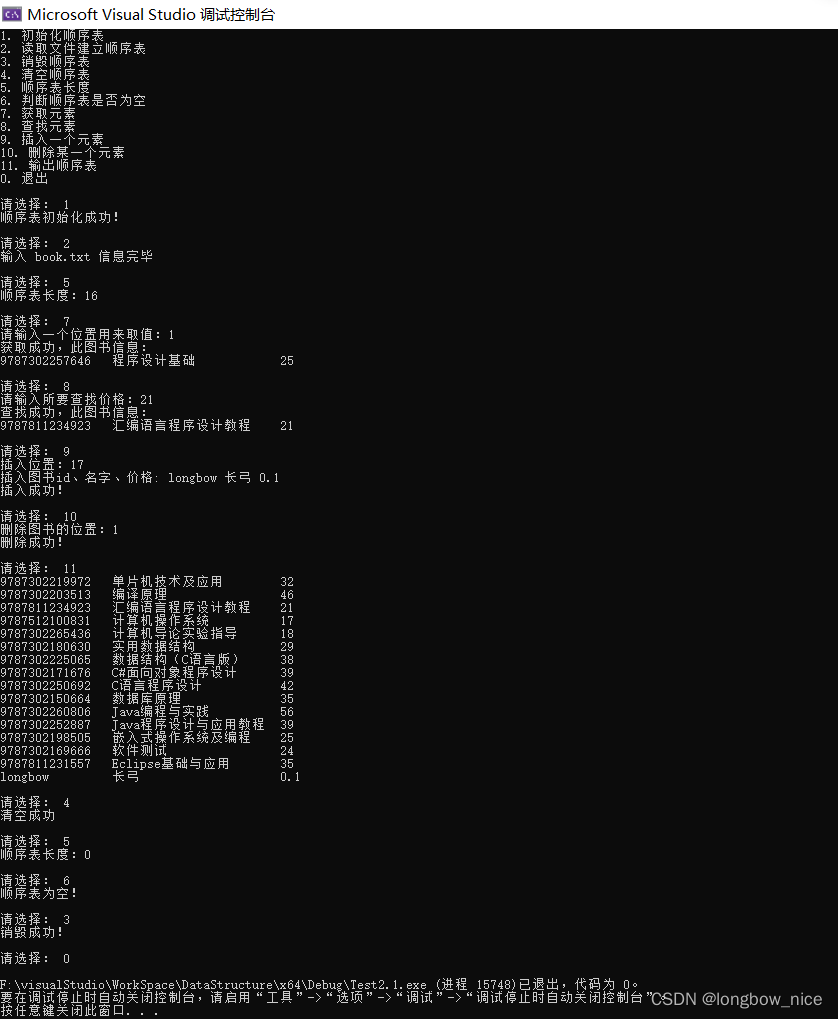
运行结果:
2.3,遇到问题
已在 Test2.1.exe 中执行断点指令(__debugbreak()语句或类似调用)。
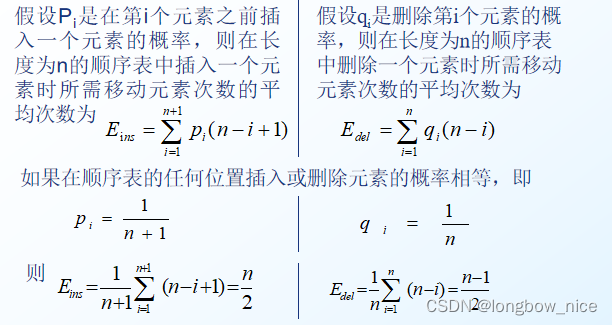
2.4,插入和删除操作的性能分析
在顺序存储表示的线性表中插入或删除一个数据元素,平均约需移动表中一半元素。
2.5. 线性表顺序表示的优缺点
优点
- 可以随机存取表中任一元素;
- 无需为表示表中元素之间的逻辑关系而增加额外存储空间;
缺点
- 在插入、删除某一元素时,需要移动大量元素;
- 表的容量难以确定,浪费存储空间