简单介绍:
在进行了(16)以后,前面的页面是html页面,我们以前开发需要把他们转成jsp页面,jsp页面的好处就是到我们查出一些数据,我们可以用foreach进行遍历,用判断等等···jsp有强大的功能,包括写java,但是我们现在的情况是,springboot首先是以jar包的方式,而不是web项目。
而且还是嵌入式的tomcat嵌入,所以现在是不支持jsp的。
解决办法: 如果我们用从静态页面开发的方式,会开发很困难。
优化解决办法:springboot推荐我们使用模版引擎
模版引擎的种类有:JSP、Velocity、Freemarker、Thymeleaf
但是所有的模版引擎的思想是一样的。
模版引擎的作用:首先写一个页面模版,有些值是动态的,那么这些值哪里来呢,我们首先组装一些数据Data,然后把这个模板Template和数据Data交给模版引擎(TemplateEngine),按照数据把表达式解析,填充到指定的位置,然后把数据生成一个我们想要的内容,写出去output。
注意:只是不同的模版引擎语法不同。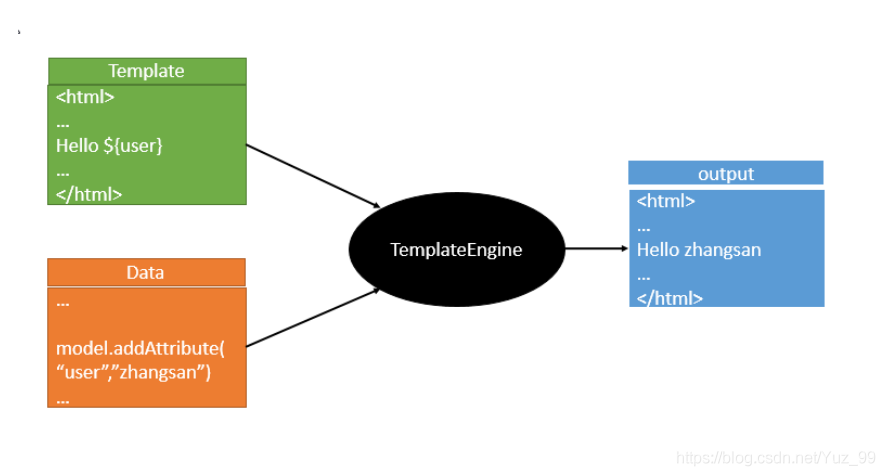
SpringBoot推荐的Thymeleaf: 语法更简单,功能更强大;
1、引入thymeleaf;
找依赖
官方文档
dependencies中:
        <!-- 引入thymeleaf-->
        <dependency>
            <groupId>org.springframework.boot</groupId>
            <artifactId>spring-boot-starter-thymeleaf</artifactId>
        </dependency>
2、Thymeleaf使用
我们查看使用的文档
@ConfigurationProperties(prefix = "spring.thymeleaf")
public class ThymeleafProperties {

	private static final Charset DEFAULT_ENCODING = Charset.forName("UTF-8");

	private static final MimeType DEFAULT_CONTENT_TYPE = MimeType.valueOf("text/html");

	public static final String DEFAULT_PREFIX = "classpath:/templates/";

	public static final String DEFAULT_SUFFIX = ".html";
  	//
在Controller下的包的helloController类中写入如下内容:
@RequestMapping("/success")
    public String success(){
        return "success";
    }
注意:前面别加ResponseBody
接下来:我们来写一个请求,进行测试
我们在resources下的templates下创建一个success.html
写入如下内容:
<!DOCTYPE html>
<html lang="en">
<head>
    <meta charset="UTF-8">
    <title>Title</title>
</head>
<body>
        <h1>测试成功!!!</h1>
</body>
</html>
然后运行一下程序,访问端口:
就可以出来结果了: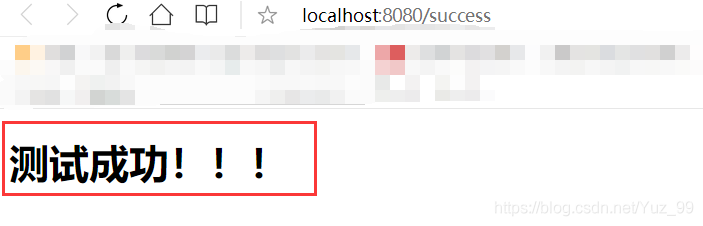
3、thymeleaf语法
只要我们把HTML页面放在classpath:/templates/,thymeleaf就能自动渲染;
使用步骤:
3.1 Controller
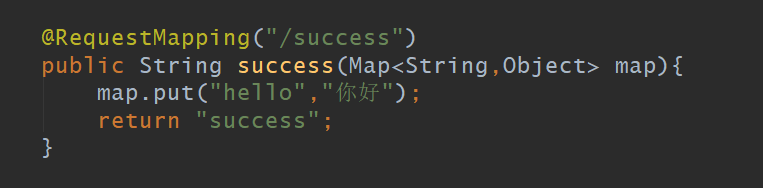
3.2 导入thymeleaf的名称空间
<html lang="en" xmlns:th="http://www.thymeleaf.org">

3.3 使用thymeleaf语法;
<!DOCTYPE html>
<html lang="en" xmlns:th="http://www.thymeleaf.org">
<head>
    <meta charset="UTF-8">
    <title>Title</title>
</head>
<body>
    <h1>成功!</h1>
    <!--th:text 将div里面的文本内容设置为指定的值 -->
    <div th:text="${hello}">这是显示欢迎信息</div>
</body>
</html>
3.4 我们访问端口,结果显示为:
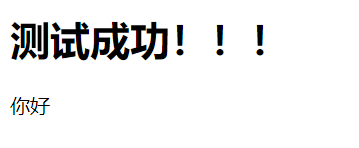
3.5 语法规则:
3.5.1
th:text;改变当前元素里面的文本内容;
th:任意html属性;来替换原生属性的值
属性的优先级: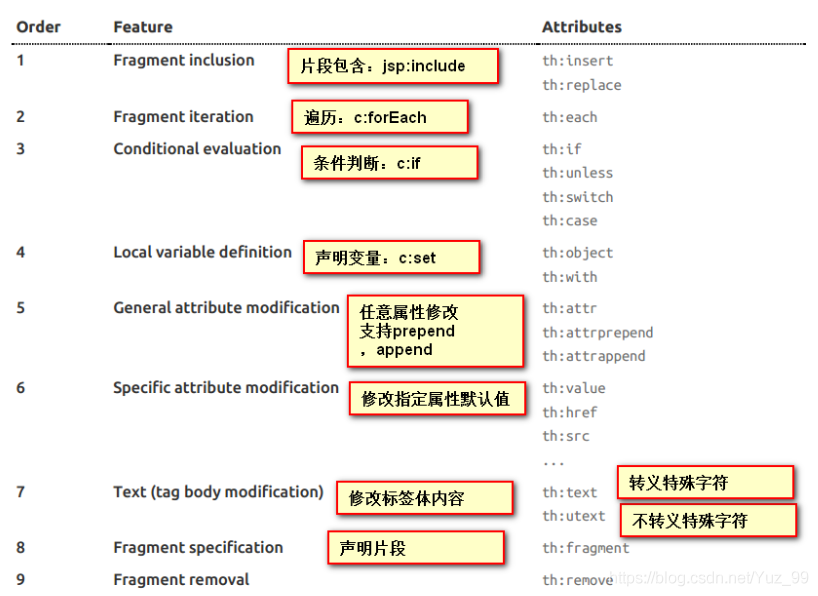
3.5.2 表达式
Simple expressions:(表达式语法)
    Variable Expressions: ${...}:获取变量值;OGNL;
    		1)、获取对象的属性、调用方法
    		2)、使用内置的基本对象:
    			#ctx : the context object.
    			#vars: the context variables.
                #locale : the context locale.
                #request : (only in Web Contexts) the HttpServletRequest object.
                #response : (only in Web Contexts) the HttpServletResponse object.
                #session : (only in Web Contexts) the HttpSession object.
                #servletContext : (only in Web Contexts) the ServletContext object.

                ${session.foo}
            3)、内置的一些工具对象:
#execInfo : information about the template being processed.
#messages : methods for obtaining externalized messages inside variables expressions, in the same way as they would be obtained using #{…} syntax.
#uris : methods for escaping parts of URLs/URIs
#conversions : methods for executing the configured conversion service (if any).
#dates : methods for java.util.Date objects: formatting, component extraction, etc.
#calendars : analogous to #dates , but for java.util.Calendar objects.
#numbers : methods for formatting numeric objects.
#strings : methods for String objects: contains, startsWith, prepending/appending, etc.
#objects : methods for objects in general.
#bools : methods for boolean evaluation.
#arrays : methods for arrays.
#lists : methods for lists.
#sets : methods for sets.
#maps : methods for maps.
#aggregates : methods for creating aggregates on arrays or collections.
#ids : methods for dealing with id attributes that might be repeated (for example, as a result of an iteration).

    Selection Variable Expressions: *{...}:选择表达式:和${}在功能上是一样;
    	补充:配合 th:object="${session.user}:
   <div th:object="${session.user}">
    <p>Name: <span th:text="*{firstName}">Sebastian</span>.</p>
    <p>Surname: <span th:text="*{lastName}">Pepper</span>.</p>
    <p>Nationality: <span th:text="*{nationality}">Saturn</span>.</p>
    </div>

    Message Expressions: #{...}:获取国际化内容
    Link URL Expressions: @{...}:定义URL;
    		@{/order/process(execId=${execId},execType='FAST')}
    Fragment Expressions: ~{...}:片段引用表达式
    		<div th:insert="~{commons :: main}">...</div>

Literals(字面量)
      Text literals: 'one text' , 'Another one!' ,…
      Number literals: 0 , 34 , 3.0 , 12.3 ,…
      Boolean literals: true , false
      Null literal: null
      Literal tokens: one , sometext , main ,…
Text operations:(文本操作)
    String concatenation: +
    Literal substitutions: |The name is ${name}|
Arithmetic operations:(数学运算)
    Binary operators: + , - , * , / , %
    Minus sign (unary operator): -
Boolean operations:(布尔运算)
    Binary operators: and , or
    Boolean negation (unary operator): ! , not
Comparisons and equality:(比较运算)
    Comparators: > , < , >= , <= ( gt , lt , ge , le )
    Equality operators: == , != ( eq , ne )
Conditional operators:条件运算(三元运算符)
    If-then: (if) ? (then)
    If-then-else: (if) ? (then) : (else)
    Default: (value) ?: (defaultvalue)
Special tokens:
    No-Operation: _
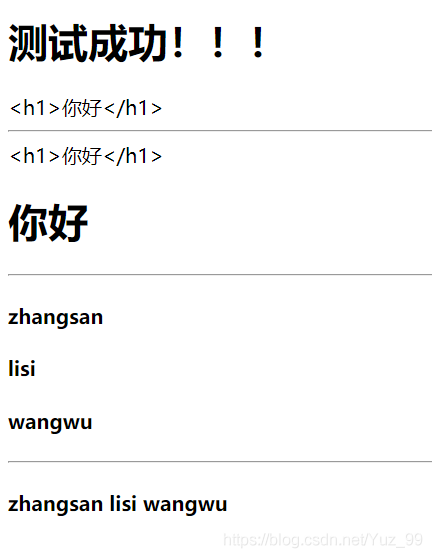
3.6 text utext 的区别 、遍历列表 进行一个测试:
3.6.1
Controller中:
    @RequestMapping("/success")
    public String success(Map<String,Object> map){
        map.put("hello","<h1>你好</h1>");
        map.put("users", Arrays.asList("zhangsan","lisi","wangwu"));
        return "success";
    }
3.6.2
success.html文件中:
<!DOCTYPE html>
<html lang="en" xmlns:th="http://www.thymeleaf.org">
<head>
    <meta charset="UTF-8">
    <title>Title</title>
</head>
<body>
    <h1>测试成功!!!</h1>
    <!--th:text 将div里面的文本内容设置为指定的值 -->
    <div th:text="${hello}">这是显示欢迎信息</div>

<hr/>
    <div th:text="${hello}"></div>
    <div th:utext="${hello}"></div>
<hr/>

<!--each每次遍历都会生成当前这个标签-->
<h4 th:text="${user}" th:each="user:${users}"></h4>
<hr/>
<h4>
    <span th:each="user:${users}"> [[${user}]] </span>
</h4>


</body>
</html>
3.6.3
显示结果: