start:
.type start,#function.rept 8mov r0,r0@ 空语句.endrb 1f/*魔数,和uboot的魔数相对应*/.word 0x016f2818 @ Magic numbers to help the loader.word start @ absolute load/run zImage address.word _edata @ zImage end address1: mov r7, r1 @ save architecture IDmov r8, r2 @ save atags pointer#ifndef __ARM_ARCH_2__......#else/*关中断*/teqp pc, #0x0c000003 @ turn off interrupts#endif/** Note that some cache flushing and other stuff may* be needed here - is there an Angel SWI call for this?*//** some architecture specific code can be inserted* by the linker here, but it should preserve r7, r8, and r9.*/.text/** LC0标签在下面定义,这里把LC0的地址装载到r0,和ldr不同,adr不需要考虑偏移* 下面ldmia命令把r0(LC0)的内容依次赋给r1,r2等寄存器,对应关系看下面LC0标签*/adr r0, LC0ARM( ldmia r0, {r1, r2, r3, r4, r5, r6, r11, ip, sp})THUMB( ldmia r0, {r1, r2, r3, r4, r5, r6, r11, ip} )THUMB( ldr sp, [r0, #32] )/*这里 r0 = r0 - r1 并更新 N、Z、C 和 V 标记*/subs r0, r0, r1 @ calculate the delta offset@ if delta is zero, we are@如果运行当前运行地址和链接地址相等,则不需进行重定位。直接清除bss段beq not_relocated @ running at the address we- ......
not_relocated:
mov r0, #0/* r2:bbs开始位置* r3: bbs结束位置*str命令: STR Rd, [Rbase], Rindex 存储 Rd 到 Rbase 所包含的有效地址。把 Rbase- * + Rindex 所合成的有效地址写回 Rbase。
- * 下面4句str命令将清空 bss 32个字节 ,r2 累加 32
* */1: str r0, [r2], #4 @ clear bss r2+=4str r0, [r2], #4@ clear bss r2+=4str r0, [r2], #4@ clear bss r2+=4str r0, [r2], #4@ clear bss r2+=4cmp r2, r3 @ 判断是否到bss的结束位置,blo 1b @若不是,继续清空/** The C runtime environment should now be setup* sufficiently. Turn the cache on, set up some* pointers, and start decompressing.*/bl cache_on- /*r1、r2作为参数传给decompress_kernel */
mov r1, sp @ malloc space above stackadd r2, sp, #0x10000 @ 64k max 分配一段解压函数需要的内存缓冲 sp 栈指针,/** Check to see if we will overwrite ourselves.* r4 = final kernel address 最终的内核开始地址,就是解压后的地址* r5 = start of this image 解压前的映像开始地址* r6 = size of decompressed image 解压前的映像大小* r2 = end of malloc space (and therefore this image)* We basically want:* r4 >= r2 -> OK* r4 + image length <= r5 -> OK*内核映像解压后不会超过解压前的4倍大小- * 调用decompress_kernel前,要准备4个参数:r0 (解压后的内核开始位置),r1(动态内存开始位置)
- * r2(动态内存结束位置),r3(结构ID))
*/cmp r4, r2 @ r4为内核执行地址,此时为0X50008000,r2此时为用户栈顶,@ 即解压函数所需内存缓冲的开始处bhs wont_overwriteadd r0, r4, r6cmp r0, r5bls wont_overwritemov r5, r2 @ decompress after malloc spacemov r0, r5mov r3, r7bl decompress_kerneladd r0, r0, #127 + 128 @ alignment + stackbic r0, r0, #127 @ align the kernel length/** r0 = decompressed kernel length* r1-r3 = unused* r4 = kernel execution address* r5 = decompressed kernel start* r7 = architecture ID* r8 = atags pointer* r9-r12,r14 = corrupted*/add r1, r5, r0 @ end of decompressed kerneladr r2, reloc_startldr r3, LC1add r3, r2, r31: ldmia r2!, {r9 - r12, r14} @ copy relocation codestmia r1!, {r9 - r12, r14}ldmia r2!, {r9 - r12, r14}stmia r1!, {r9 - r12, r14}cmp r2, r3blo 1bmov sp, r1add sp, sp, #128 @ relocate the stackbl cache_clean_flushARM( add pc, r5, r0 ) @ call relocation codeTHUMB( add r12, r5, r0 )THUMB( mov pc, r12 ) @ call relocation code/** We're not in danger of overwriting ourselves. Do this the simple way.** r4 = kernel execution address* r7 = architecture ID*/
wont_overwrite:
mov r0, r4 @ 解压后的内核开始位置mov r3, r7 @ 结构IDbl decompress_kernel@ 这个是跳转到arch/arm/boot/compressed/misc.c的- @ decompress_kernel 函数
b call_kernel @ 解压完毕调用这个.align 2.type LC0, #object
LC0:
.word LC0 @ r1.word __bss_start @ r2.word _end @ r3.word zreladdr @ r4.word _start @ r5.word _image_size @ r6.word _got_start @ r11.word _got_end @ ip.word user_stack+4096 @ sp
LC1:
.word reloc_end - reloc_start.size LC0, . - LC0....../** Turn on the cache. We need to setup some page tables so that we* can have both the I and D caches on.** We place the page tables 16k down from the kernel execution address,* and we hope that nothing else is using it. If we're using it, we* will go pop!** On entry,* r4 = kernel execution address* r7 = architecture number* r8 = atags pointer* r9 = run-time address of "start" (???)* On exit,* r1, r2, r3, r9, r10, r12 corrupted* This routine must preserve:* r4, r5, r6, r7, r8*/.align 5
cache_on:
mov r3, #8 @ cache_on functionb call_cache_fn....../** Here follow the relocatable cache support functions for the* various processors. This is a generic hook for locating an* entry and jumping to an instruction at the specified offset* from the start of the block. Please note this is all position* independent code.** r1 = corrupted* r2 = corrupted* r3 = block offset value和mask各占了4byte,* 所以在cache_on标签处被赋值为8,* 用于偏移到函数跳转的位置,具体看代码* r9 = corrupted* r12 = corrupted*/
call_cache_fn:
adr r12, proc_types#ifdef CONFIG_CPU_CP15mrc p15, 0, r9, c0, c0 @ get processor ID#elseldr r9, =CONFIG_PROCESSOR_ID#endif/*上面找到processor ID放入 r9 , 下面标号1的代码循环调用,在proc_types中查找和processor ID匹配的cache函数,找到后即调用*/1: ldr r1, [r12, #0] @ get valueldr r2, [r12, #4] @ get maskeor r1, r1, r9 @ (real ^ match)tst r1, r2 @ & mask/*若eq(匹配成功),跳到cache函数*/ARM( addeq pc, r12, r3 ) @ call cache functionTHUMB( addeq r12, r3 )THUMB( moveq pc, r12 ) @ call cache functionadd r12, r12, #4*5b 1b @ proc_types 是一个列表,要一个一个匹配,跳回标号1,匹配下一个/** Table for cache operations. This is basically:* - CPU ID match* - CPU ID mask* - 'cache on' method instruction* - 'cache off' method instruction* - 'cache flush' method instruction** We match an entry using: ((real_id ^ match) & mask) == 0** Writethrough caches generally only need 'on' and 'off'* methods. Writeback caches _must_ have the flush method* defined.*/.align 2.type proc_types,#object
proc_types:
.word 0x41560600 @ ARM6/610.word 0xffffffe0W(b) __arm6_mmu_cache_off @ works, but slowW(b) __arm6_mmu_cache_offmov pc, lr......... @ ARM7/710mov pc, lr... @ ARM720T (writethrough)mov pc, lr......这里忽略一些项@ These match on the architecture ID@ 这个是匹配ARMv4T的,如ARM920T的s3c2440等等.word 0x00020000 @ ARMv4T.word 0x000f0000W(b) __armv4_mmu_cache_onW(b) __armv4_mmu_cache_offW(b) __armv4_mmu_cache_flush......这里忽略一些项/*目前我使用S5PV210是cortexA8的cpu,v7架构,匹配这个上面的语句addeq pc, r12, r3将跳转到__armv7_mmu_cache_on,因为r3事先被赋值为8。*/.word 0x000f0000 @ new CPU Id 4 字节.word 0x000f0000 @ 4 字节W(b) __armv7_mmu_cache_on @ r12 偏移 r3 后,是这里W(b) __armv7_mmu_cache_off @在内核解压完毕,r3会被赋值为12,即调用这个W(b) __armv7_mmu_cache_flush @在内核解压完毕,r3会被赋值为16,即调用这个.word 0 @ unrecognised type.word 0mov pc, lr......
__setup_mmu:
sub r3, r4, #16384 @ Page directory size16384 是16K- /*上面r4是zreladdr 内核执行地址*/
bic r3, r3, #0xff @ Align the pointer 16K对齐bic r3, r3, #0x3f00/*为了容易理解注释,这里假设对齐后 r3 = 0x50004000*//** Initialise the page tables, turning on the cacheable and bufferable* bits for the RAM area only.*/mov r0, r3 @ r0 =0x50004000mov r9, r0, lsr #18 @ r0 先 lsr(逻辑右移)18位,再mov给r9mov r9, r9, lsl #18 @ r9 先 lsl(逻辑左移)18位,再mov给r9 = 0x50000000@ start of RAMadd r10, r9, #0x10000000 @ a reasonable RAM size r10 = 0x60000000/*上面得到r9为256M对齐的地址,作为RAM的开始地址,r10作为RAM的结束地址*//* r9 = 0x50004000 r10 = 0x50008000*/mov r1, #0x12 @ r1 = 0b 0000 0000 0001 0010orr r1, r1, #3 << 10 @ r1 = 0b 0000 1100 0001 0010 = 0xC12add r2, r3, #16384 @ r2 = 0x 5000 8000/*下面一个循环,把虚拟空间的256MB映射的页表项 设置 缓存和写缓存*/1: cmp r1, r9 @ if virt > start of RAMorrhs r1, r1, #0x0c @ set cacheable, bufferablecmp r1, r10 @ if virt > end of RAMbichs r1, r1, #0x0c @ clear cacheable, bufferablestr r1, [r0], #4 @ 1:1 mappingadd r1, r1, #1048576 @ 判断下一个 1M 的节区teq r0, r2bne 1bfor(r0=0x50004000,r1=0xc12; r0!=0x50008000; r0+=4,r1+=0x100000){if(r1 > 0x50000000)r1 = r1 or 0x0c; // 0xC12 -> 0xC1E 第2、3个bit为1,即set cacheable, bufferableif(r1 > 0x60000000)r1 = r1 xor 0x0c; // 0xC1E -> 0xC12 这样,从0x50000000到0x60000000的虚拟地址为cacheable, bufferable*r0 = r1; // 把虚拟地址值直接写入到对应的页表物理空间}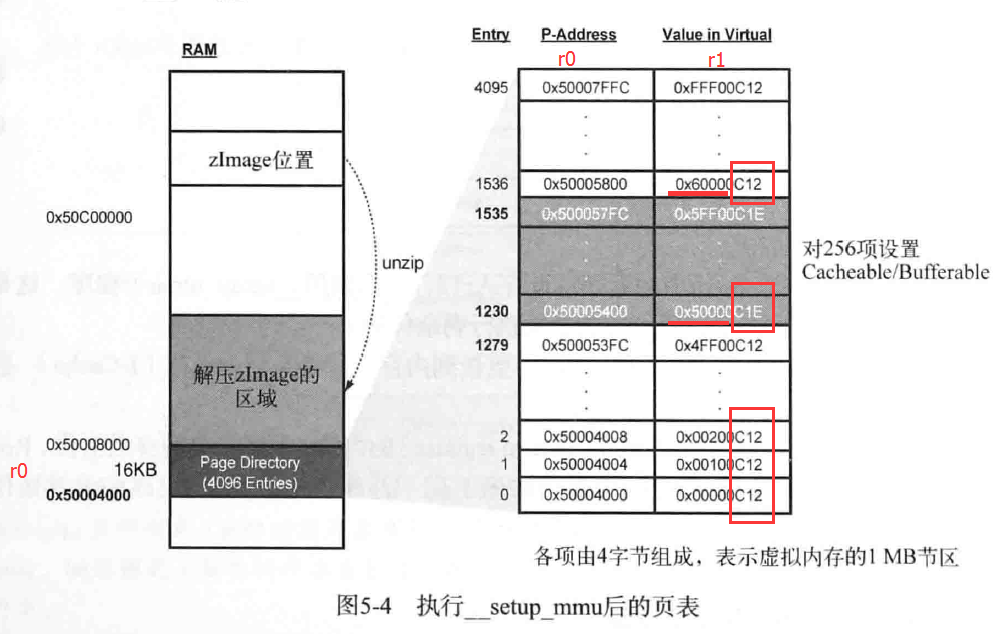

/** If ever we are running from Flash, then we surely want the cache* to be enabled also for our execution instance... We map 2MB of it* so there is no map overlap problem for up to 1 MB compressed kernel.* If the execution is in RAM then we would only be duplicating the above.*/mov r1, #0x1eorr r1, r1, #3 << 10mov r2, pc, lsr #20orr r1, r1, r2, lsl #20add r0, r3, r2, lsl #2str r1, [r0], #4add r1, r1, #1048576str r1, [r0]mov pc, lrENDPROC(__setup_mmu)
__armv4_mmu_cache_on:
mov r12, lr @ 保存返回地址到r12,因为下面调用bl __setup_mm@ 时会将返回地址lr更新掉#ifdef CONFIG_MMUbl __setup_mmumov r0, #0/* 利用cp15将所有写缓冲的内容更新到内存,并清除指令缓存I-Cache和数据缓存D-Cache、TLB等读取CP15的控制寄存器内容,设置指令缓存激活位、RoundRobin缓存交替策略激活位。这部分参考ARM Linux内核源码剖析mcr p15, 0, r0, c7, c10, 4 @ drain write buffermcr p15, 0, r0, c8, c7, 0 @ flush I,D TLBsmrc p15, 0, r0, c1, c0, 0 @ read control regorr r0, r0, #0x5000 @ I-cache enable, RR cache replacementorr r0, r0, #0x0030#ifdef CONFIG_CPU_ENDIAN_BE8orr r0, r0, #1 << 25 @ big-endian page tables#endif/*__common_mmu_cache_on子程序使用了上面变更的域设置和“指令缓存”激活、缓存循环交替策略。同时将页目录的起始地址值存入CP15专用寄存器*/bl __common_mmu_cache_on@ 清除指令缓存、数据缓存、TLBmov r0, #0mcr p15, 0, r0, c8, c7, 0 @ flush I,D TLBs#endifmov pc, r12 @返回
__armv7_mmu_cache_on:
mov r12, lr#ifdef CONFIG_MMUmrc p15, 0, r11, c0, c1, 4 @ read ID_MMFR0tst r11, #0xf @ VMSAblne __setup_mmumov r0, #0mcr p15, 0, r0, c7, c10, 4 @ drain write buffertst r11, #0xf @ VMSAmcrne p15, 0, r0, c8, c7, 0 @ flush I,D TLBs#endifmrc p15, 0, r0, c1, c0, 0 @ read control regorr r0, r0, #0x5000 @ I-cache enable, RR cache replacementorr r0, r0, #0x003c @ write buffer#ifdef CONFIG_MMU#ifdef CONFIG_CPU_ENDIAN_BE8orr r0, r0, #1 << 25 @ big-endian page tables#endiforrne r0, r0, #1 @ MMU enabledmovne r1, #-1mcrne p15, 0, r3, c2, c0, 0 @ load page table pointermcrne p15, 0, r1, c3, c0, 0 @ load domain access control#endifmcr p15, 0, r0, c1, c0, 0 @ load control registermrc p15, 0, r0, c1, c0, 0 @ and read it backmov r0, #0mcr p15, 0, r0, c7, c5, 4 @ ISBmov pc, r12......
__common_mmu_cache_on:
#ifndef CONFIG_THUMB2_KERNEL#ifndef DEBUGorr r0, r0, #0x000d @ Write buffer, mmu#endifmov r1, #-1mcr p15, 0, r3, c2, c0, 0 @ load page table pointermcr p15, 0, r1, c3, c0, 0 @ load domain access controlb 1f.align 5 @ cache line aligned1: mcr p15, 0, r0, c1, c0, 0 @ load control registermrc p15, 0, r0, c1, c0, 0 @ and read it back tosub pc, lr, r0, lsr #32 @ properly flush pipeline#endif
call_kernel:
bl cache_clean_flush @清理缓存bl cache_off @关闭缓存mov r0, #0 @ must be zeromov r1, r7 @ restore architecture numbermov r2, r8 @ restore atags pointermov pc, r4 @ call kernel r4是解压后的内核开始地址
/** Clean and flush the cache to maintain consistency.** On exit,* r1, r2, r3, r9, r11, r12 corrupted* This routine must preserve:* r0, r4, r5, r6, r7*/.align 5
cache_clean_flush:
mov r3, #16 @ 在调用cache函数时,通过r3=16,偏移16字节,即调用b call_cache_fn
/** Turn off the Cache and MMU. ARMv3 does not support* reading the control register, but ARMv4 does.** On exit, r0, r1, r2, r3, r9, r12 corrupted* This routine must preserve: r4, r6, r7*/.align 5
cache_off:
mov r3, #12 @ cache_off function在调用cache函数时,通过r3=12,偏移12字节,即调用b call_cache_fn
版权声明:本文为VictaminC原创文章,遵循CC 4.0 BY-SA版权协议,转载请附上原文出处链接和本声明。