k-NN算法,构建模型只需要保存训练数据集,对新数据点做出预测,算法会在数据集中找到最近的数据点(最近邻)。
k近邻分类:KNeighborsClassifier
1邻居直接取邻居,多邻居取出出现次数较多的。
可视化:mglearn.plots.plot_knn_classification(n_neighbors=3)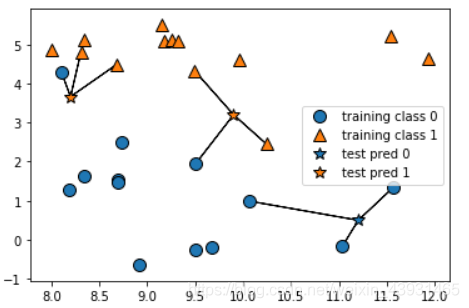
在forge数据集上的应用
from sklearn.model_selection import train_test_split

# 生成数据集
X, y = mglearn.datasets.make_forge() # 输入,目标
X_train, X_test, y_train, y_test = train_test_split(X, y, random_state=0)

# 构建模型
from sklearn.neighbors import KNeighborsClassifier
clf = KNeighborsClassifier(n_neighbors=3)
clf.fit(X_train, y_train) # 利用训练集对分类器进行拟合

# 评估模型
print(clf.predict(X_test))
print("Test accuracy:{:.2f}".format(clf.score(X_test, y_test))) # 0.86
分析算法
对于二维数据集,绘制可视化图表中,可以查看决策边界(边界这边是一目标类,另外一边是另一目标类)
# 绘制多个画布
fig, axes = plt.subplots(1, 3, figsize=(10, 3))

for n, ax in zip([1, 3, 9], axes):
    clf = KNeighborsClassifier(n_neighbors=n).fit(X, y)

    # 绘制分界线
    mglearn.plots.plot_2d_separator(clf, X, fill=True, eps=0.5, ax=ax, alpha=.4)

    mglearn.discrete_scatter(X[:, 0], X[:, 1], y, ax=ax)
    ax.set_title("{} neighbor(s)".format(n))
    ax.set_xlabel("feature 0")
    ax.set_ylabel("feature 1")
axes[0].legend(['Class 0', 'Class 1'], loc=3)
在matplotlib下,一个Figure对象可以包含多个子图(Axes)
subplot()函数快速绘制,subplot(numRows, numCols, plotNum)参数为(行号,列号,对象坐在区域)。figsize参数指定以英寸为单位的宽高。facecolor背景色,edgecolor边框色。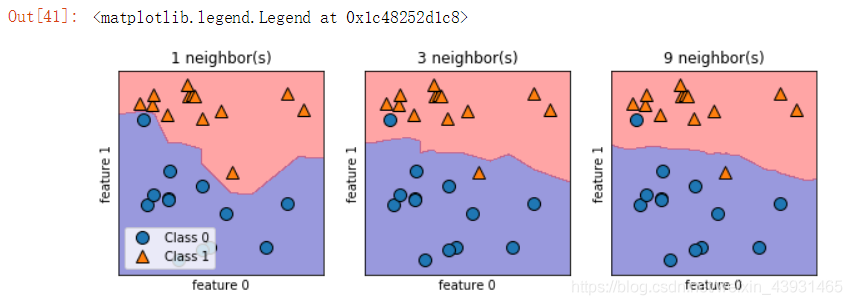
k越大,邻居个数越多,决策边界越平滑,模型越简单(模型复杂度越低)。
在cancer数据集上的应用
from sklearn.datasets import load_breast_cancer

cancer = load_breast_cancer() # Bunch对象
x_train, x_test, y_train, y_test = train_test_split(
    cancer.data, cancer.target, stratify=cancer.target, random_state=66)

training_accuracy = []
test_accuracy = []
neighbors_settings = range(1, 11)

for n in neighbors_settings:
    clf = KNeighborsClassifier(n_neighbors=n).fit(x_train, y_train)

    # 训练集精度
    training_accuracy.append(clf.score(x_train, y_train))

    # 泛化(测试集)精度
    test_accuracy.append(clf.score(x_test, y_test))

plt.plot(neighbors_settings, training_accuracy, label='training_accuracy')
plt.plot(neighbors_settings, test_accuracy, label='test_accuracy')
plt.legend()
score函数提供了一个缺省的评估法则来解决问题,用训练好的模型在测试集上进行评分(0~1)。
stratify参数作用是:保持测试集与整个数据集里target的数据分类比例一致。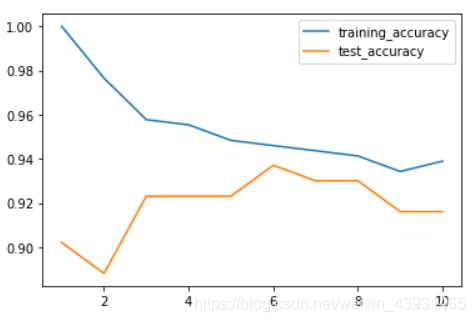
模型复杂度:高->低
过拟合->最佳模型(约88%精度)->欠拟合
k近邻回归:KNeighborsRegressor
多个近邻是,预测结果为邻居的平均值。
可视化:mglearn.plots.plot_knn_regression(n_neighbors=3)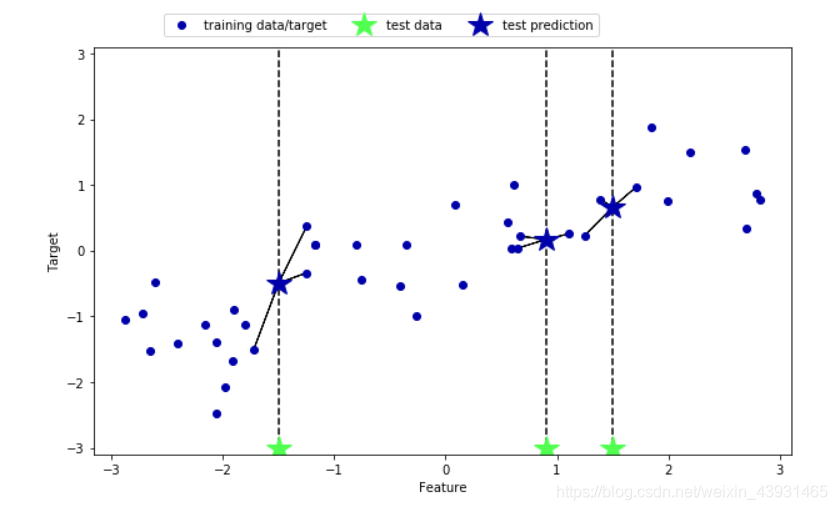
在wave数据集上的应用
from sklearn.neighbors import KNeighborsRegressor
from sklearn.model_selection import train_test_split

x, y = mglearn.datasets.make_wave(n_samples=40)
x_train, x_test, y_train, y_test = train_test_split(x, y, random_state=0)

reg = KNeighborsRegressor(n_neighbors=3)

reg.fit(x_train, y_train)

print(reg.score(x_test, y_test))
print(reg.predict(x_test))
print(y_test) # 0.834...
score方法评估模型,在回归问题,返回R^2分数/决策系数(0-1),是回归模型的优度度量。=1完美预测,=0对应常数模型(总是预测训练集响应的平均值)
分析算法
# 创建画布
fig, axes = plt.subplots(1, 3, figsize=(15, 4))

# 创建1000个均匀分布的数据点
line = np.linspace(-3, 3, 1000).reshape(-1, 1)

for n, ax in zip([1, 3, 7], axes):
    reg = KNeighborsRegressor(n_neighbors=n).fit(x_train, y_train)

    ax.plot(x_train, y_train)
    ax.plot(line, reg.predict(line))
    ax.plot(x_train, y_train, '^', c=mglearn.cm2(0), markersize=8) # 指定颜色,标记大小
    ax.plot(x_test, y_test, 'o', c=mglearn.cm2(1),markersize=8)
    ax.set_title('{} nerghbors\n train score:{:.2f} test score:{:.2f}'.format(n,reg.score(x_train,y_train),reg.score(x_test,y_test)))
    ax.set_xlabel('Feature')
    ax.set_ylabel('Target')
axes[0].legend(['Model prediction','Training data/target','Test data/target'],loc='best')
linspace(x1,x2,N)函数,其中x1、x2、N分别为起始值、中止值、元素个数。若缺省N,默认点数为100
reshape(行,列)函数可以根据指定的数值将数据转换为特定的行数和列数。reshape(-1,1)之后,数据集变成了一列。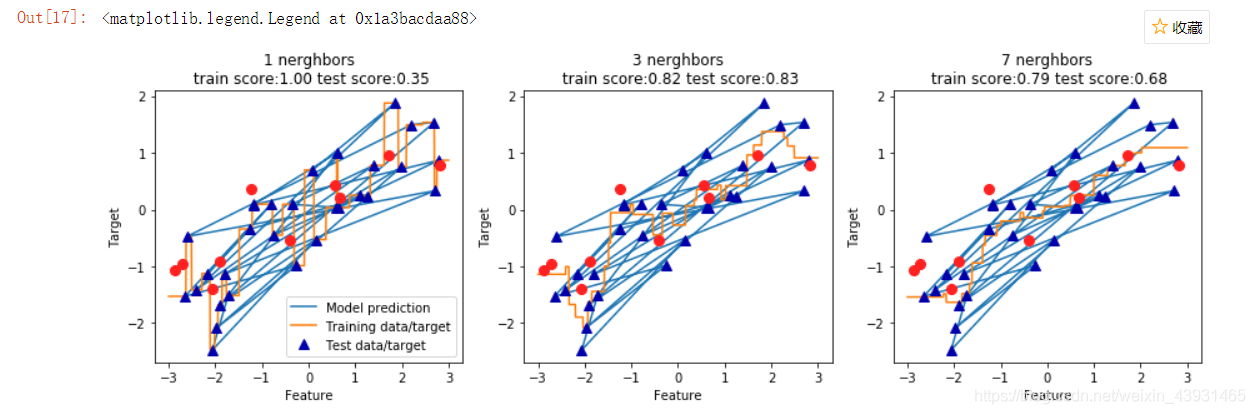
更多邻居后,预测结果更加平滑,但是对训练数据拟合不足。
参数
KNeighbors分类器有2个重要参数:邻居个数、数据点之间距离的度量方法。
距离默认使用欧氏距离。
优缺点
优:模型容易理解;构建模型速度快
缺:预测速度慢且不能处理具有很多特征的数据集