J - A Knight’s Journey
Background
The knight is getting bored of seeing the same black and white squares again and again and has decided to make a journey
around the world. Whenever a knight moves, it is two squares in one direction and one square perpendicular to this. The world of a knight is the chessboard he is living on. Our knight lives on a chessboard that has a smaller area than a regular 8 * 8 board, but it is still rectangular. Can you help this adventurous knight to make travel plans?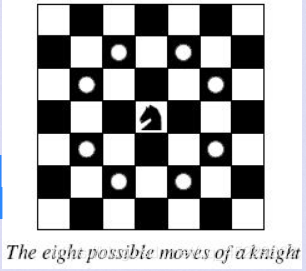
Problem
Find a path such that the knight visits every square once. The knight can start and end on any square of the board.
Input
The input begins with a positive integer n in the first line. The following lines contain n test cases. Each test case consists of a single line with two positive integers p and q, such that 1 <= p * q <= 26. This represents a p * q chessboard, where p describes how many different square numbers 1, . . . , p exist, q describes how many different square letters exist. These are the first q letters of the Latin alphabet: A, . . .
Output
The output for every scenario begins with a line containing “Scenario #i:”, where i is the number of the scenario starting at 1. Then print a single line containing the lexicographically first path that visits all squares of the chessboard with knight moves followed by an empty line. The path should be given on a single line by concatenating the names of the visited squares. Each square name consists of a capital letter followed by a number.
If no such path exist, you should output impossible on a single line.
Sample Input
3
1 1
2 3
4 3
Sample Output
Scenario #1:
A1
Scenario #2:
impossible
Scenario #3:
A1B3C1A2B4C2A3B1C3A4B2C4
代码:
#include<iostream>
#include<cstring>
#include<cstdio>
using namespace std;
int t;
int p, q;
int movex[8] = { -1, 1, -2, 2, -2, 2, -1, 1 };
int movey[8] = { -2, -2, -1, -1, 1, 1, 2, 2 };
int room[100][100];
int a[100][100];
bool f;
void dfs(int x, int y, int step)
{
	a[step][0] = x;
	a[step][1] = y;
	if (step == p * q) {
		f = true;
		return;
	}
	int posx, posy;
	for (int i = 0; i < 8; i++) {
		posx = x + movex[i];
		posy = y + movey[i];
		if (posx >= 1 && posy >= 1 && posx <= p && posy <= q && !room[posx][posy] && f == false) {
			room[posx][posy] = 1;
			dfs(posx, posy, step + 1);
			room[posx][posy] = 0;
		}
	}
}
int main()
{
	cin >> t;
	int k = 0;
	while (t--) {
		memset(room, 0, sizeof(room));
		cin >> p >> q;
		f = false;
		room[1][1] = 1;
		dfs(1, 1, 1);
		if (f == true) {
			cout << "Scenario #" << ++k << ":" << endl;
			for (int i = 1; i <= p * q; i++) {
				printf("%c%d",a[i][1]-1+'A',a[i][0]);
			}
			cout << endl;
		}
		else {
			cout << "Scenario #" << ++k << ":" << endl;
			cout << "impossible" << endl;;
		}
		if (t != 0)
			cout << endl;
	}
}